FULL SNOW MOON – SORROW AND KINDNESS
by angeliska on February 25, 2013
The Snow Moon of February is waxing, rising: also know as Storm Moon, Hunger Moon, Bony Moon and Little Famine Moon. In most places, this is the month of the heaviest snows, the harshest weather, and the hardest hunting. This was often a season of starvation, for the native people and animals in the North. Though it’s springtime here in the South, I know other places are still bitter cold, still blanketed under heavy folds of white ice. I don’t know what that’s like, but I have been sitting with this winter feeling, a frostbitten heart warmed back to beating by hot breath, soft mittens. I told the daffodil buds pushing shyly through the mulch that it was safe to raise their ruffled heads, that the time of frost and rime was done with. I hope I wasn’t lying. This year has cored me like an apple: taken all the parts of me that I thought were essential, and chewed them up, spit out the pips, left nothing but my stem and my skin. It was enough. I have a palmful of seeds to plant anew, I have my heart, I have this dirt. I came through slaughter, bloodied and broken, bowed. I came through. It’s taken a long time to write this. I began it when I was at my most shattered, and then shelved it for months when it was too raw, the pain too embarrassing. I felt tired of writing about my sorrow – though more than that, I felt tiresome. The fear got put in me, an arrow lodged between two ribs: the niggling doubt planted there, that what I chose to share was too much, too sad – wrong somehow. I stopped writing. I tried to write about only pretty things. I stopped. I was frozen in the middle of the road, gnawed on by the hungry scavengers, those wolves of the mind, that feast on your anxieties. In a long winter, the cold gets in your bones, it finds the drafts, the cracks in you, and it sucks the heat right out of your blood. That’s the way doubt works, too.
In the coldest months, the weakest animals in a pack get picked off, get left behind – eat or be eaten. You are either predator or you are prey. Your vulnerability is a liability, and fight or flight is the only choice. If you’re too tired to fight, and have nowhere to run, you just stop, freeze, forever. “The weak are meat the strong do eat.” Kill or be killed. A sacrificial lamb, a scapegoat, left desolate in the snow, the boot on your back, teeth at your throat, felled beneath a pitiless victor. The rapacious hunter whose hunger knows no bounds, so empty inside that no amount of flesh can fill a belly that’s just fur slung over bones. Hunger makes creatures cold-hearted and crazy, makes them turn against their own. This is the way of the world, the way of nature, I know. I can sit with it, I can look, and look and take it in. I won’t look away, but instead turn my gaze to the images that make my soul crumple, that speak to the bleak desolation of grief, the howling heart, alone in a vast landscape, crying in the bitter wind. Victims of severe frost, halted mid-motion by prisons of ice. O, innocents, wandering lost in the snow – death draws near with an icy scythe, to cut you down in one white instant. Winter is brutal, and all we can do is huddle together. The only way to survive is to help each other, to stay with your pack, to find your tribe. Our communities are all we have: our lovers, friends and family. The ones who keep you close, keep you warm at night. All we have is each other, so why do we hurt one another? Where does this capacity for cruelty come from? What is it that inspires kindness, the small acts of tenderness that make life possible even in the direst times? I’m coming to understand that our ability to experience grief and move through it can make us more kind, more compassionate to others. That awareness and empathy for suffering is what gives us the strength and love to extend compassion beyond ourselves. This can be a vicious world. Every act of grace and gentleness counts. Kindness changes everything. I’ve been rereading Cloud Atlas for the dozenth time, and have been thinking a lot about the themes that run through that beautiful book: of slavery and subordination, of the currents of love and bravery that triumph in the midst of the horrors we humans can inflict on each other.
“Our lives are not our own, we are bound to others, past and present. And by each crime and every kindness, we birth our future.”
I’ve also been delving into The Places That Scare You – A Guide to Fearlessness in Difficult Times, by Pema Chödrön recently, and finding much wisdom there. This book contains major teachings for me, and has given answers and solace in deep lessons that I feel I have been searching for for many years. The quote in the beginning of the book, and the explanation of bodhichitta pulled me in immediately:
Confess your hidden faults.
Approach what you find repulsive.
Help those you think you cannot help.
Anything you are attached to, let it go.
Go to the places that scare you.
– Advice from her teacher to the Tibetan Yogini Machig Labdrön
“An analogy for bodhichitta is the rawness of a broken heart. Sometimes this broken heart gives birth to anxiety and panic; sometimes to anger, resentment and blame. But under the hardness of that armor there is the tenderness of genuine sadness. This is our link with all those who have ever loved. This genuine heart of sadness can teach us great compassion. It can humble us when we’re arrogant and soften us when we are unkind. It awakens us when we prefer to sleep and pierces through our indifference. This continual ache of the heart is a blessing that when accepted fully can be shared with all.”
I read the chapter on cultivating compassion today, and it brought everything together for me so profoundly. Everything I’ve been struggling to write about for months is right here:
“For arousing compassion, the nineteenth-century yogi Patrul Rinpoche suggested imagining beings in torment — an animal about to be slaughtered, a person awaiting execution. To make it more immediate, he recommended imagining ourselves in their place. Particularly painful is his image of a mother with no arms watching as a raging river sweeps her child away. To contact the suffering of another being fully and directly is as painful as being in that woman’s shoes. For most of us, even to consider such a thing is frightening. When we practice generating compassion, we can expect to experience our fear of pain. Compassion practice is daring. It involves learning to relax and allow ourselves to move gently toward what scares us. The trick to doing this is to stay with emotional distress without tightening into aversion, to let fear soften us rather than harden into resistance.
“It can be difficult to even think about beings in torment, let alone to act on their behalf. Recognizing this, we begin with a practice that is fairly easy. We cultivate bravery through making aspirations. We make the wish that all beings, including ourselves and those we dislike, be free of suffering and the root of suffering.
“We use the seven-step aspiration practice to soften our hearts and also to become more honest and forgiving about when and how we shut down. Without justifying or condemning ourselves, we do the courageous work of opening to suffering. This can be the pain that comes when we put up barriers or the pain of opening our heart to our own sorrow or that of another being. We learn as much about doing this from our failures as we do from our successes. In cultivating compassion we draw from the wholeness of our experience — our suffering, our empathy, as well as our cruelty and terror. It has to be this way. Compassion is not a relationship between the healer and the wounded. It’s a relationship between equals. Only when we know our own darkness well can we be present with the darkness of others. Compassion becomes real when we recognize our shared humanity.”
To Practice: Choose an image that enables you to contact the suffering of another. If you find this too difficult or painful, recognize the teaching in your response.
Many of the following images depict death and sorrow in a graphic and deeply affecting way. If pictures of dead animals or profound grief are upsetting to you, you may not want to continue, though I attest that they were not chosen gratuitously. I have kept some of these images archived for years, not fully understanding why I needed to look at them, why I needed to make myself feel so deeply for them. Now I understand. I hope you will, too. Also: I was unable to track down the original provenance for many of these images. If you are the source, or if you are aware of who made the image, please let me know and I will ascribe it rightfully.

Untitled – Erick Swenson

No Comment – Idiots


Snarling Wolf, Ely, Minnesota, 1998
“A remote-controlled “carcass cam” captures an inside view of a gray wolf fiercely guarding its meal at the International Wolf Center in Ely, Minnesota. Wolves at the center are provided with food, but wild populations generally hunt in packs. After a large kill, a single wolf can consume more than 20 pounds of meat.”


Yuri Kozyrev – Beslan, North Ossetia Sept. 5, 2004
I wish I could find a clearer version of this one. Somewhere I still have the scrap of the original cut out from a magazine when the tragedy at the Beslan school happened. I meditated on the pain and longing of the woman in the photo every day for a long time. Every fiber in her being outstretched, seeking her lost beloved one. The empathy and sorrow of the people surrounding her. The hands holding hers. The heart cries out.

Marcel Harasimowicz – Zdobycz kruków (Prey Of Ravens), 1888


“Kazimiera Mika, a ten-year-old Polish girl, mourns the death of her older sister, who was killed in a field near Jana Ostroroga Street in Warsaw during a German air raid by the Luftwaffe.
“While I was photographing the bodies, a little ten-year old girl came running up and stood transfixed by one of the dead. The woman was her older sister. The child had never before seen death and couldn’t understand why her sister would not speak to her…
The child looked at us in bewilderment. I threw my arm about her and held her tightly, trying to comfort her. She cried. So did I and the two Polish officers who were with me…”
I had this photograph tacked up to the wall next to my bed all through my adolescence. Every night laying in bed I would look at it and feel so much love and sorrow for this girl grieving over the body of her sister. Even though I had not yet begun grieving my losses, I understood what it meant. I needed to look at it, at their faces.


Photograph by Yuri Kozyrev

“An orphaned rhesus monkey and white dove that seemed to have lost its mate forged a special bond at the Neilingding Island-Futian National Nature Reserve in China. The monkey was born on the island but had strayed from its mother. Luckily, it was taken in by work staff in the protection center and became friends with the pigeon that had lingered there after possibly losing its mate.”


Photograph by Eugenio Recuenco

Photograph by Yuri Kozyrev
Kindness
Before you know what kindness really is
you must lose things,
feel the future dissolve in a moment
like salt in a weakened broth.
What you held in your hand,
what you counted and carefully saved,
all this must go so you know
how desolate the landscape can be
between the regions of kindness.
How you ride and ride
thinking the bus will never stop,
the passengers eating maize and chicken
will stare out the window forever.
Before you learn the tender gravity of kindness,
you must travel where the Indian in a white poncho
lies dead by the side of the road.
You must see how this could be you,
how he too was someone
who journeyed through the night with plans
and the simple breath that kept him alive.
Before you know kindness as the deepest thing inside,
you must know sorrow as the other deepest thing.
You must wake up with sorrow.
You must speak to it till your voice
catches the thread of all sorrows
and you see the size of the cloth.
Then it is only kindness that makes sense anymore,
only kindness that ties your shoes
and sends you out into the day to mail letters and
purchase bread,
only kindness that raises its head
from the crowd of the world to say
it is I you have been looking for,
and then goes with you every where
like a shadow or a friend.
– KINDNESS
by Naomi Shihab Nye
from The Words Under the Words: Selected Poems
The full Snow Moon in Virgo challenges us to release ourselves and others from judgement, from the critical mind that seeks to find fault, lay blame. We are all imperfect, fallible, messy beings. We make mistakes, we hurt one another, consciously or blindly. We are all doing the very best we can. This full moon I seek to open my heart up to true acceptance and forgiveness, for myself and others, and to let go of all my resentments, frustrations and grudges. They have been a very heavy burden. I don’t want them anymore. They do not serve me well. I am ready for peace. This is a time for healing. The Moon in Virgo opposing Chiron, The Wounded Healer, activates and shines a light on doing this work first in your own heart, and then with an eye towards service and helping others. The lesson I have been given recently is to make myself “incapable of disappointment” – in order to do that, I must give permission to all things to be exactly as they are. This is hard work, and I am trying. Snow Moon, help me to be kinder, gentler and more patient – to myself as well as others.
“Judge nothing, you will be happy. Forgive everything, you will be happier. Love everything, you will be happiest.” – Sri Chinmoy
“Three things in human life are important: the first is to be kind; the second is to be kind; and the third is to be kind.” – Henry James
FULL SNOW MOON IN VIRGO
Full Moon in Virgo: Into the Dark Woods
You do not have to be good.
You do not have to walk on your knees
For a hundred miles through the desert, repenting.
You only have to let the soft animal of your body
love what it loves.
Tell me about your despair, yours, and I will tell you mine.
Meanwhile the world goes on.
Meanwhile the sun and the clear pebbles of the rain
are moving across the landscapes,
over the prairies and the deep trees,
the mountains and the rivers.
Meanwhile the wild geese, high in the clean blue air,
are heading home again.
Whoever you are, no matter how lonely,
the world offers itself to your imagination,
calls to you like the wild geese, harsh and exciting —
over and over announcing your place
in the family of things.
– Mary Oliver
All On a Mardi Gras Day
by angeliska on February 23, 2013
I’m still slowly editing all my photos from Mardi Gras, so in lieu of a much belated post from me, I wanted to share a peek into the magic of that day while the memories are still fresh, and the music is still echoing in my mind… It was a grey, drizzly day, but it only dumped down on us once or twice, and the Indians made it out after all. New Orleans photographer and sculptor Christopher Porché West of A Studio On Desire captured so many wonderful images of my beautiful friends and beloved strangers on my favorite day of the year, I felt moved to show some of the ones that I loved the most here. His photographs really serve as a beautiful reminder that Mardi Gras morning is for everyone – regardless of their age, race, gender et cetera. I think it’s really what I love most about that celebration: that you see old ladies shimmying down the street with old men dressed as old ladies, and families with kids in wagons, tiny babies cradled lovingly by their beastly-bedecked mamas, mariachis, strange bejeweled birds, and all people who haven’t slept in days debauching extravagantly past the front stoops of those who chose not to masque, but peer curiously out their front doors at the revelry in the street. All on a Mardi Gras Day. It is so, so beautiful. There is truly nothing else like it.
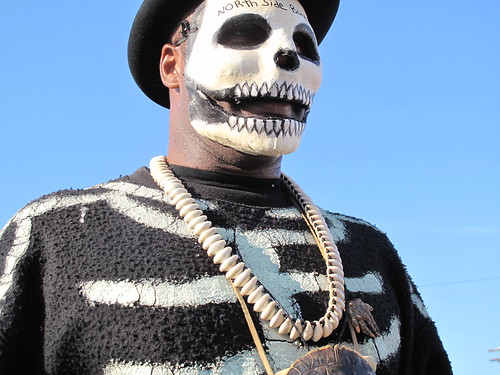
Mardi Gras morning starts with the Skull & Bone Gangs clattering and banging on trashcan lids with bloody cow femurs, making a frightful racket to wake up the living for the big day of misrule and wildness. I’m always occupied with my costuming, so I’ve never seen the bone boys doing their thing at dawn, but maybe one year they’ll come bang on my door, saying, “Wake up, wake up, do not be late. It’s Mardi Gras Morning. Go celebrate! Young and old got to go. Make your move to change your life now, or else you will become like me. YOU NEXT!”
THE SKULL AND BONE GANG WAKES YOU UP ON MARDI GRAS DAY…
Skull and Bones Gang channels spirit of Mardi Gras
If the Bone Gangs get you up and at ’em, you can go out and chase some Mardi Gras Indians, first thing. This year the Young Seminole Hunters were looking very pretty indeed. Don’t know what that’s all about? Check out this piece I wrote a few years back: Who are the Mardi Gras Indians?


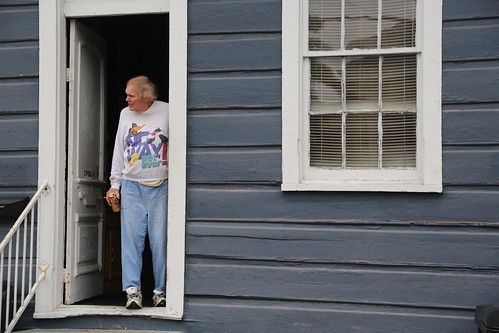
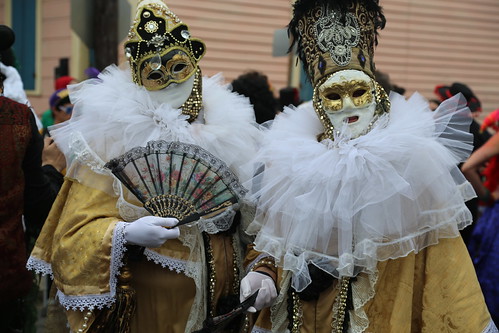
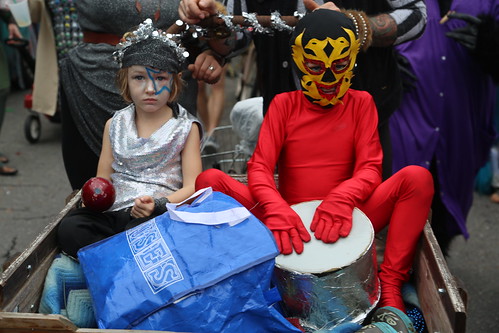
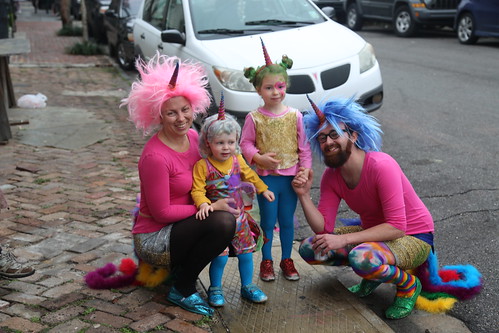
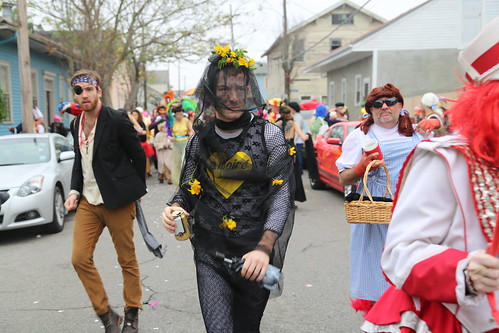
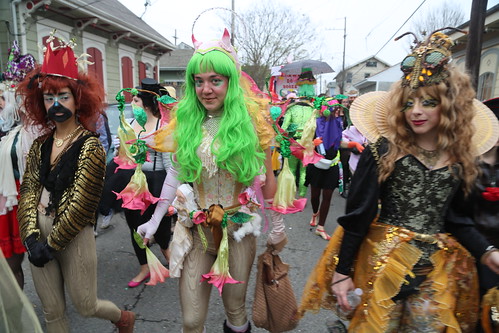
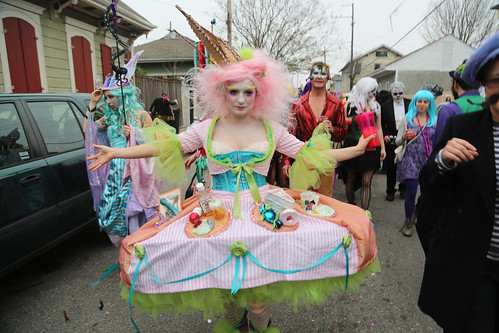
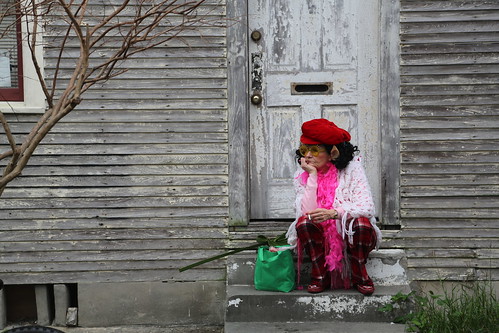
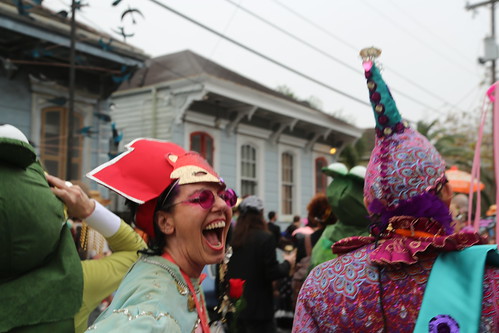
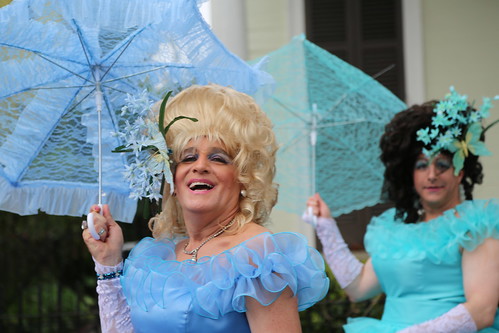
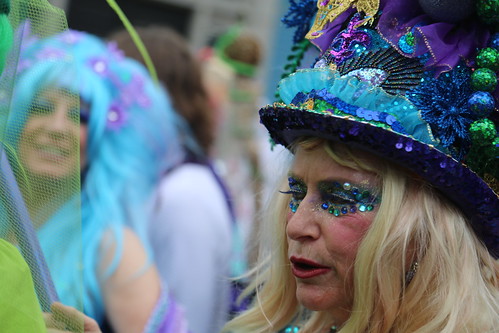
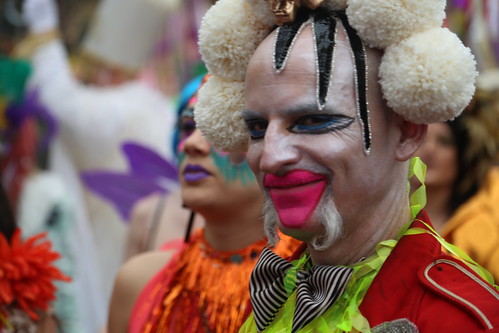
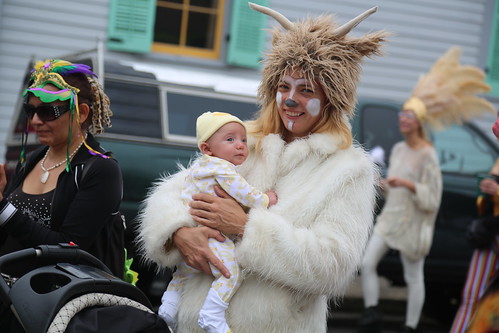
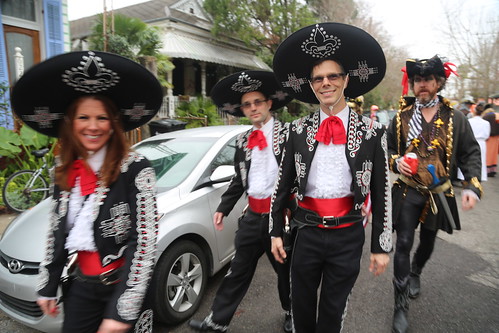
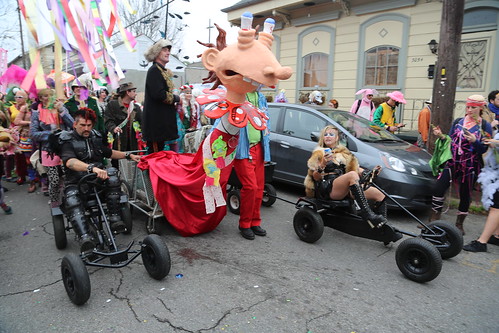
Here’s the full set of Porché West’s Mardi Gras 2013 photographs.
Some of his most amazing work can be seen here, and here also:
NEW ORLEANS COLOR
“Mardi Gras Skeletons” Royce Osborn
Dr. John, the Night Tripper – Mardi gras day
MARDI GRAS DAYS OF YORE – CIRCA 2009
by angeliska on February 6, 2013
I’m opening a time capsule into a Mardi Gras day of yore that I never got around to writing about – I have a few of those stowed away in my dusty attic of an archive, and it’s just not right. It always seems strange to write about it when the season isn’t upon me, so I wait and stash these caches of jewel-like memories from my favorite holiday away until another Carnival season takes me by surprise. I’m going to do my best to share more of them here, because they really are so special, and I honestly can’t really think of anything else right now.
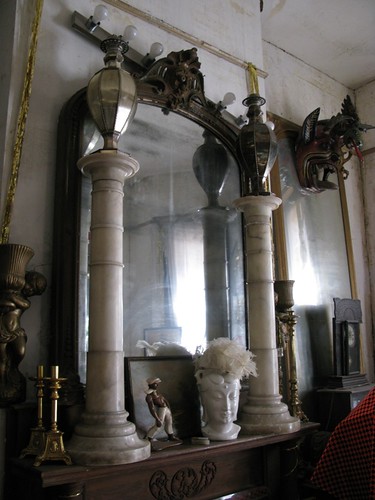
Fat Tuesday morning dawns in a flurry of last minute costuming: bustles being strapped on and wigs pinned down tight before heading over to Clouet St. where the Krewe of Sainte Anne has traditionally gathered. Marcus Fraser is an antique dealer (and owner of Le Garage) who has opened his exquisitely appointed home and magical garden to the revelers to meet up at before parading forth into the bright day. There is no better backdrop to photograph your costumes in first thing (before the threat of anything going awry or major fashion malfunctions have the chance to strike!)

A remnant from yellow fever days…
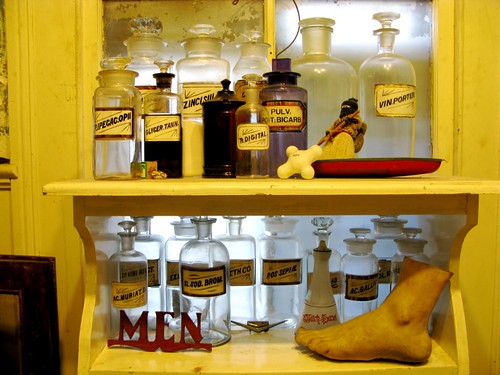
The lavatory was decorated with an amazing collection of medical antiques long before that theme came into vogue…
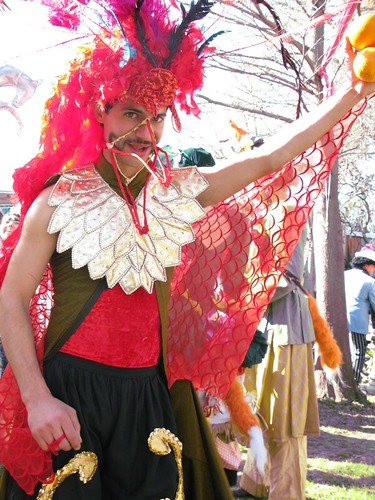
Mateo Hinojosa as a splendiferous phoenix.
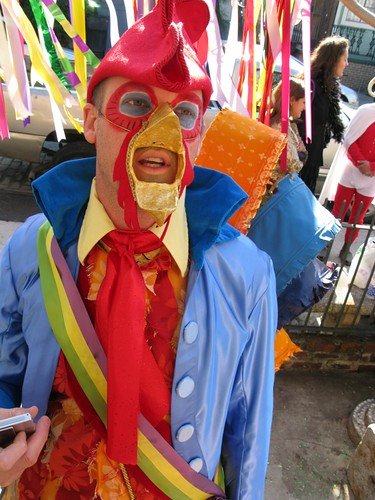
Jonathan Straus in his fabulous rooster costume
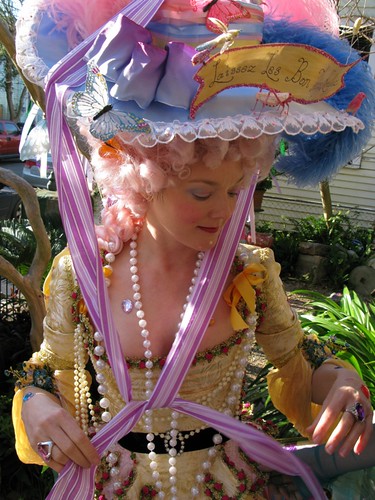
Jenny Singsaas-Straus as a Mardi Gras Marie Antoinette
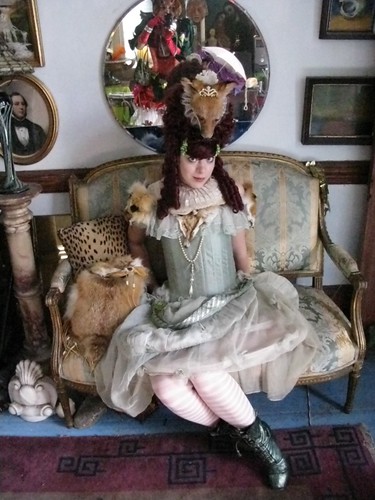
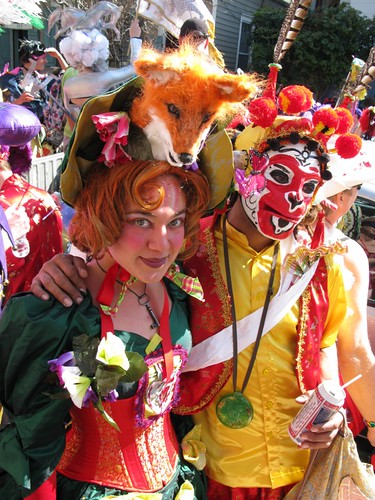
I was an Elizabethan Kitsune Queen!
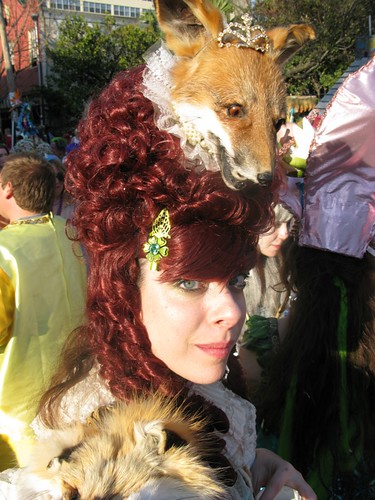
Attaching a Victorian taxidermy fox head to a wig was quite a feat of engineering, I must admit.
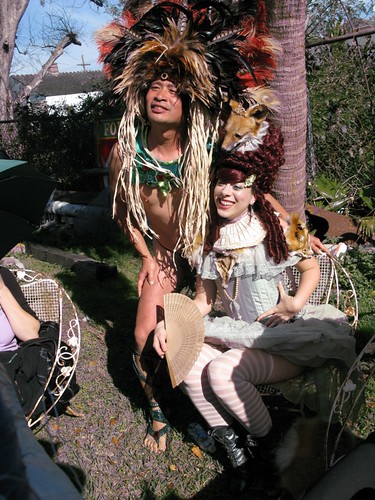
Gordon was visiting from Taiwan – he surprised and amazed us all with his Amazonian dancer ensemble!
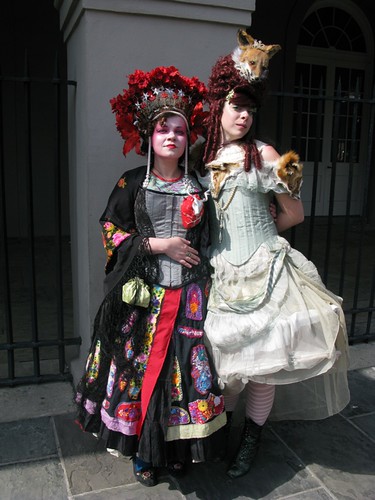
Miss Angie designed her gorgeous costume on the Taiwanese aboriginal story of the girl who fell in love with a stag.
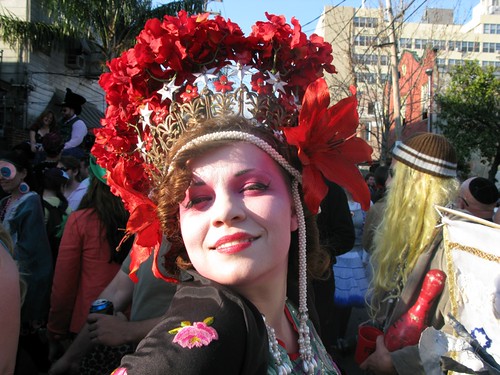
She is so beautiful!
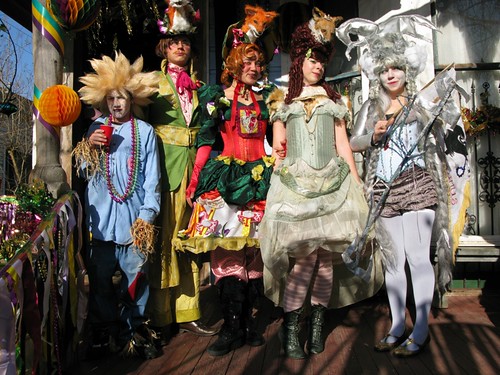
Gathered together before heading out into the fray…
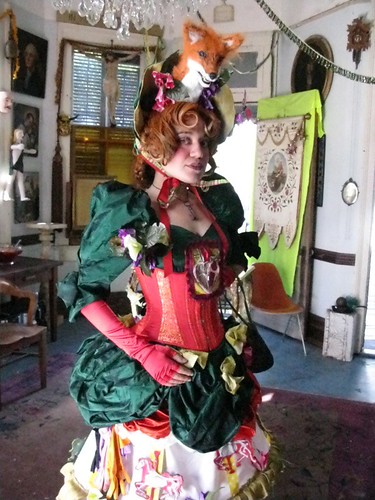
Perfection!
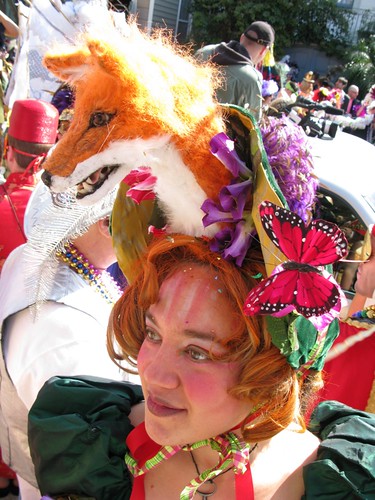
Miss Foxglove
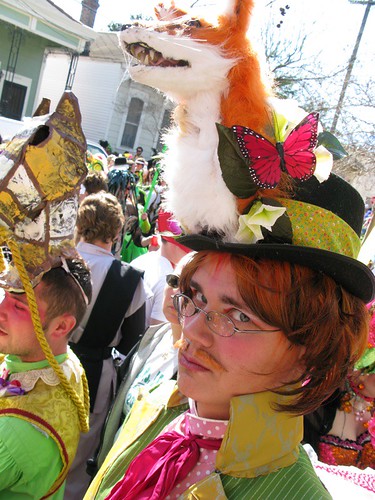
Mr. Foxglove
Pandora Foxglove and Lester as Hanuman
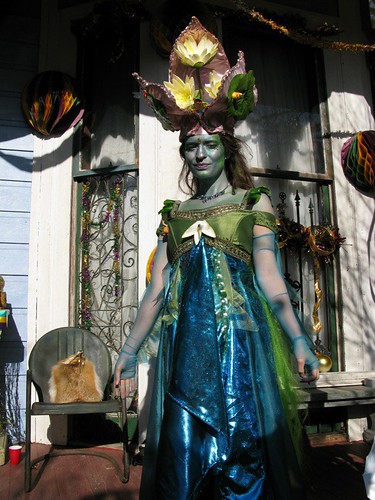
Raven was a pond sprite water spirit
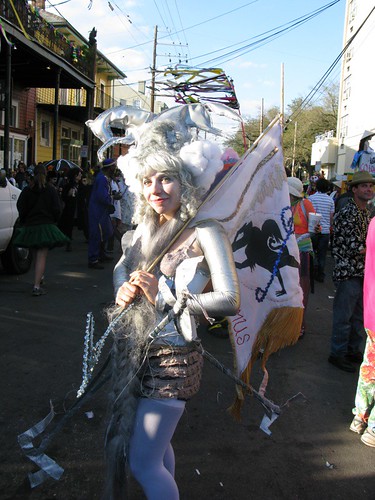
Nina was a weathervane
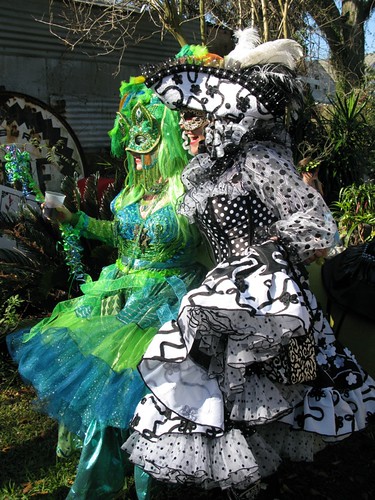
Incredible revelers
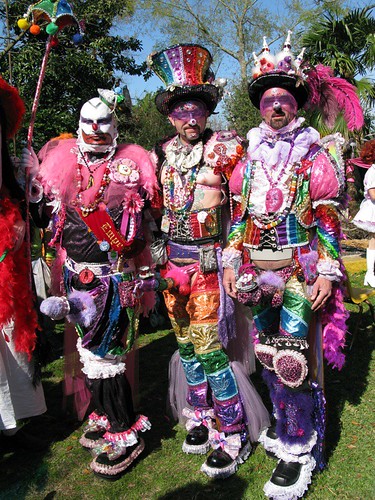
Salamander and his krewe of rainbow sex-clowns
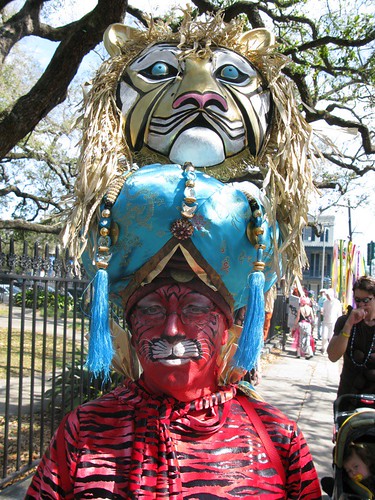
Andrea the Tiger Prince
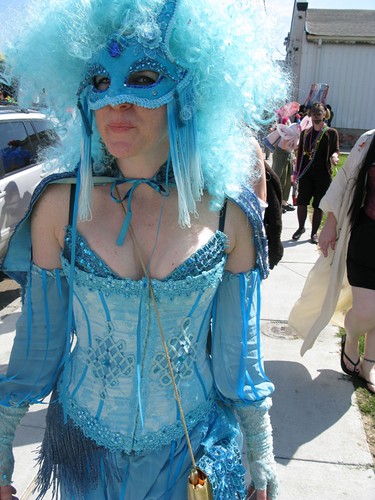
Crystal Blue Persuasion!
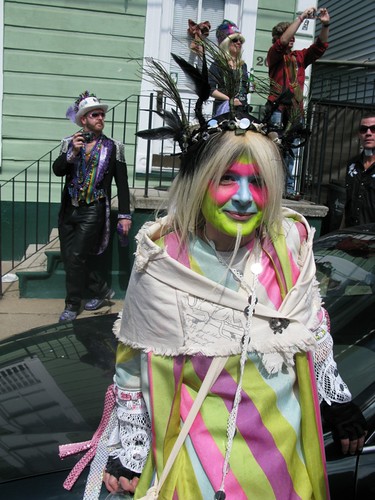
This little goatee lady was one of my favorites… I don’t know who she is, though!
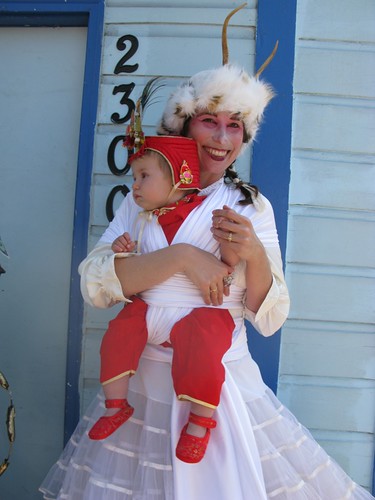
Marcela and baby Ruby!
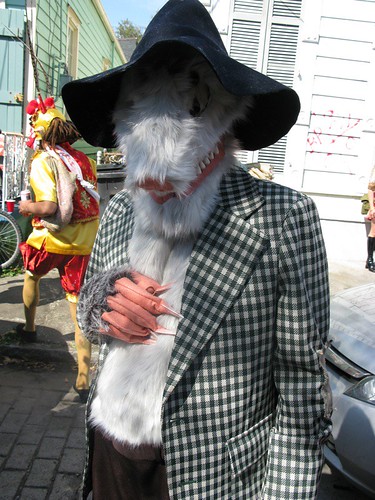
Possum Man!
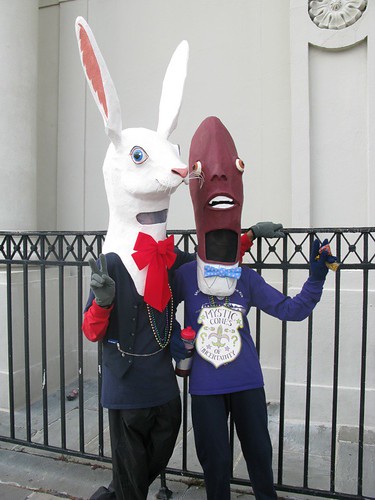
A bunny and a bean!
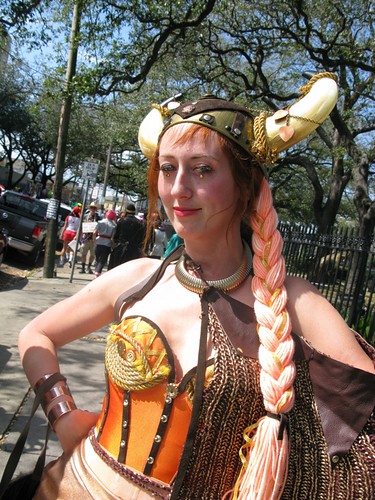
Allyson Garro as an electric Valkyrie
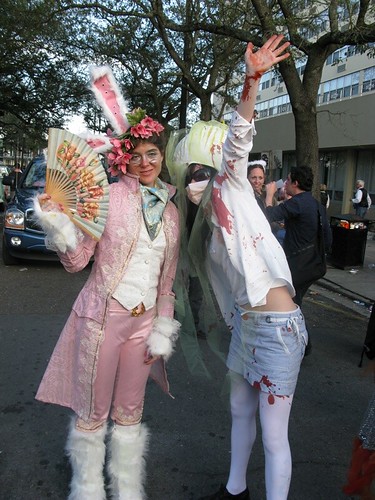
A cute bunny and someone bloody
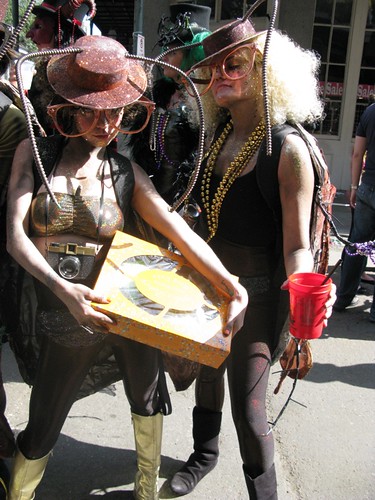
Those cute cockroaches got a king cake!
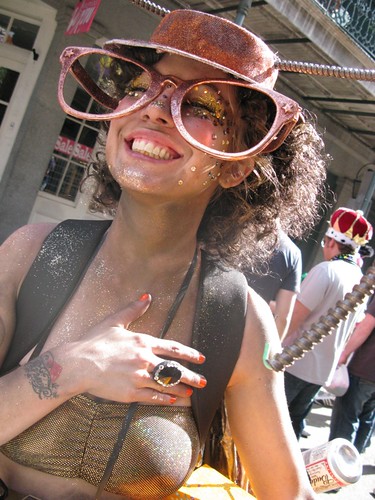
Only Jamie Gandy could make a palmetto bug into something cute!
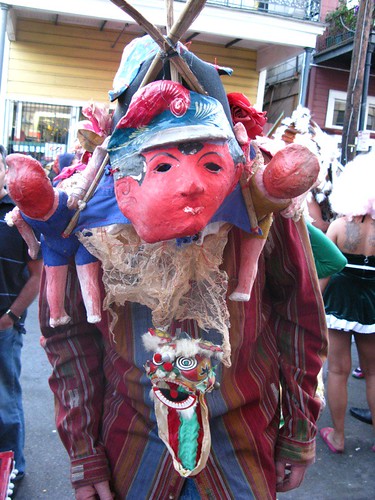
Who’s that under there?
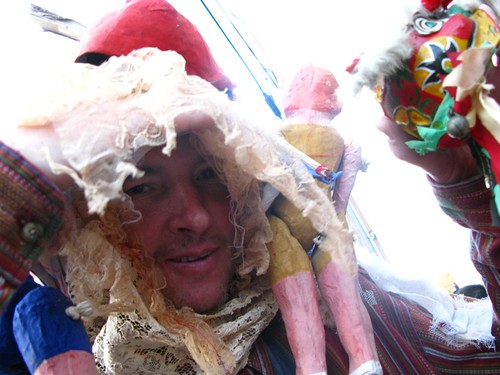
It’s Mr. Shade!
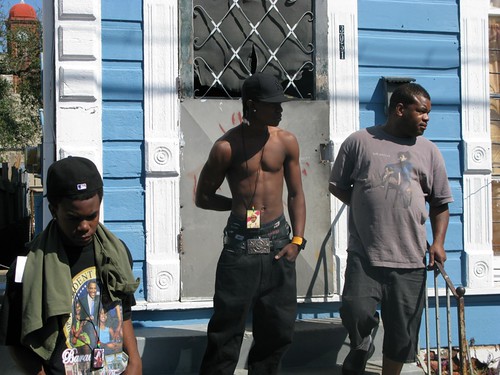
Watching the parade go by on Royal St.
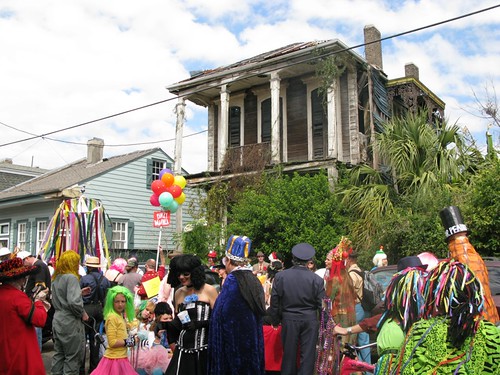
Saint Anne processes onward…
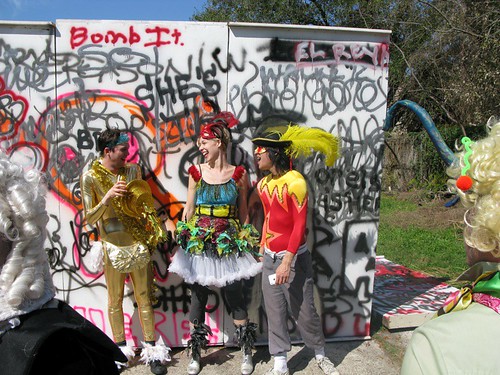
A random grafitti wall popped up in the middle of the street.

Family portrait
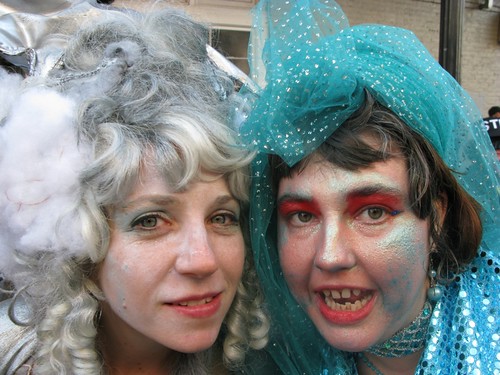
Loveys
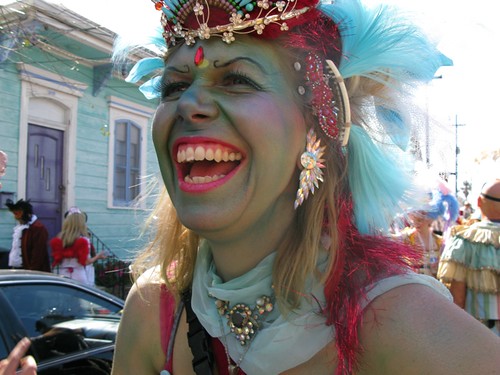
Shannon Brinkman
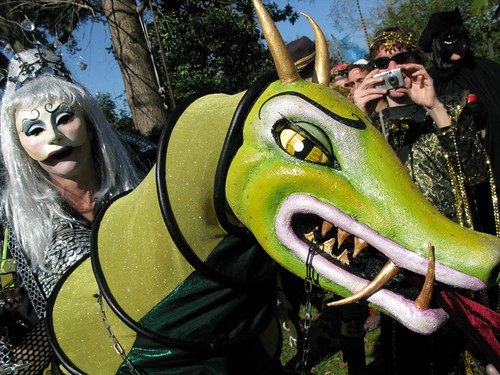
This articulated dragon was truly mind-blowing…
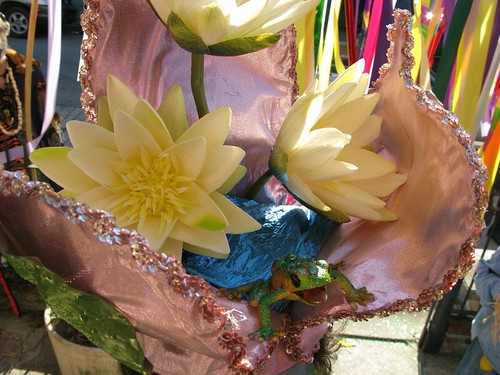
Raven’s waterlily crown from above
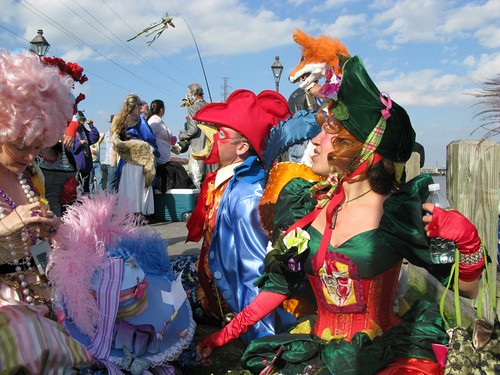
Down by the riverside…
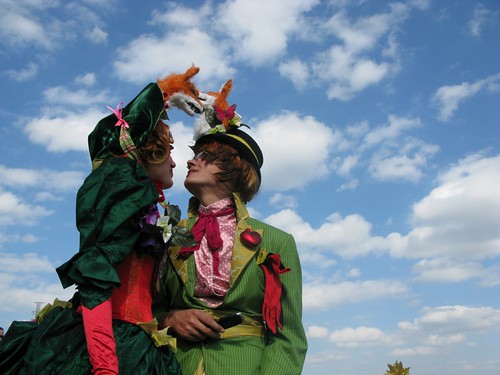
Foxes whispering sweet nothings
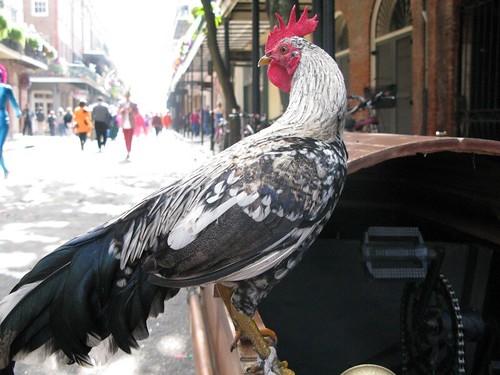
On Mardi Gras day, you see so many magical things – like a beautiful rooster perched on a sidecar down on Chartres St.
My full set of photos from the day can be found here: Mardi Gras 2009
I also had the honor of being featured in National Geographic Traveler Magazine’s article about Mardi Gras I need to sit down and scan the original issue, but here’s the Dutch version:

Photograph by Krista Rossow
Here’s an excerpt from the article by Janelle Nanos, from the January/February 2010 issue of National Geographic Traveler:
My bearings are off. It feels as if I’m in a maze of fun house mirrors. I’m standing at an intersection in New Orleans and before me is a blue-skinned Vishnu, the Hindu protector of the universe, none of whose many eel-like arms seems to point me in the right direction. Behind me, a rooster crows. I turn and realize it’s a man wearing a gold beak and blood-red cockscomb. Above, ribbons dance like spotlights against a bright blue sky, and people perched on wrought-iron balconies flap their arms like sparrows. A masked woman—or is it a man?—rides by on a dragon. This is Mardi Gras? I wonder. It seems like an alternate universe.
This parade—put on by the Society of St. Anne—is not the boozy, Bourbon Street Mardi Gras you hear so much about. It’s an unofficial event held in the Bywater, a bohemian enclave—one of 16 distinct neighborhoods in the Crescent City—that’s a world apart from the throngs in the French Quarter.

“Laissez les bon temps roulez,” reads Marie Antoinette’s hat. Jenny Singsaas of Burbank, California, has made her costume for the five years that she has attended the Society of St. Anne parade. “The most wonderful thing happens on that Tuesday,” says Singsaas. “There are people you only see once a year, that day, in costume, but you recognize each other and are great friends.”

Wandering into Marcus Fraser’s backyard in the Bywater neighborhood on Mardi Gras morning is a little like falling down the rabbit hole. Costumed revelers mill about, catching up with friends and complimenting each other’s elaborate ensembles before the Society of St. Anne parade begins to wander down Royal Street towards the French Quarter.
And finally, some videos from the day from Jenny Singsaas-Straus + Jonathan Straus of House of Straus:
This little dog named Underfoot was trying to fight my fox head. He was so confused by it!
Frenchmen St. – Mardi Gras Afternoon
“Things to note in this video: Angeliska & Underfoot obviously – what lovers. Adorable Pandora, nuff said. I’m starting to feel my alcohol as my laugh has morphed into a chicken cluck & brawwwwk and I’m unconsciously moving like a chicken to whatever music is playing. Jenny caught James spanking people with his fox’s gloves – which he giddily discovered and then undertook as a civic service to everyone who passed. And lastly the gorilla that first notices the camera and then apes for it. No video is complete without a gorilla. “Qui pe resist un gorille?”
Go, go, go, you hot struttin’ coq!
Perchta
by angeliska on January 6, 2013
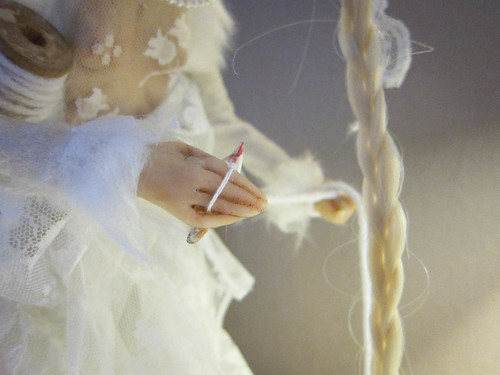
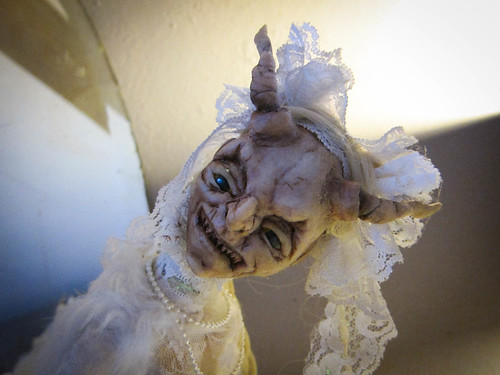
Pandora Gastelum of The Mudlark Confectionary and The Mudlark Public Theatre lovingly created this incredible art doll of the Two-Faced Goddess Perchta for my birthday last year, and I’ve been meaning to share both images of her creation and her story ever since:
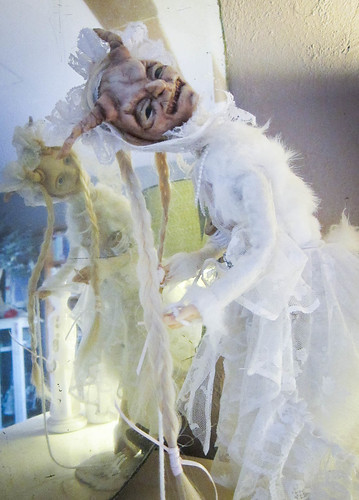
Perchta – Derived from an early Germanic word meaning “bright or “glorious”. Perchta is famed for her dual nature. Her grim aspect is known as “Perchta the Belly Slitter”. Perchta is alternately described as kind or violent, as a monstrous hag or a willowy maiden.
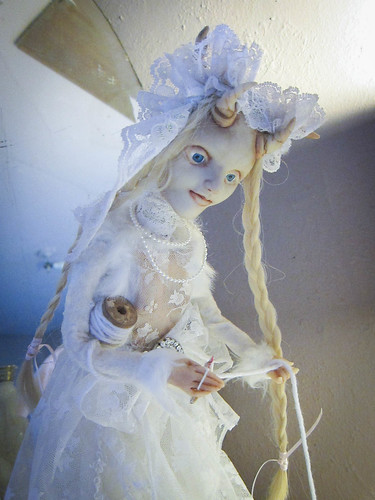
Perchta is typically veiled and clothed in white and is often portrayed with the horns, shaggy fur and hooves of a goat. The Medieval Church wrote of “sinners” who would leave food for Perchta in the “Night of Perchta” to obtain prosperity and well being in the coming year, as well as commanding the people to surrender their belief in “Frawen Percht”, and complaining of locals who would rather chant of “Domina Perchta” than say their prayers to the Virgin Mary.
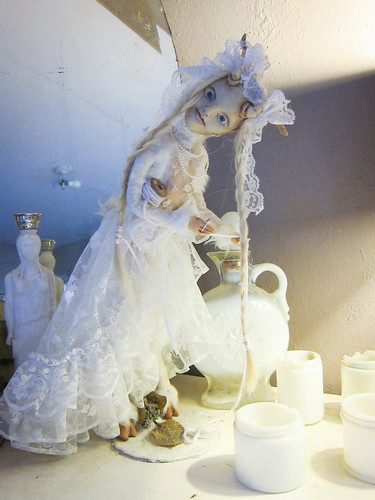
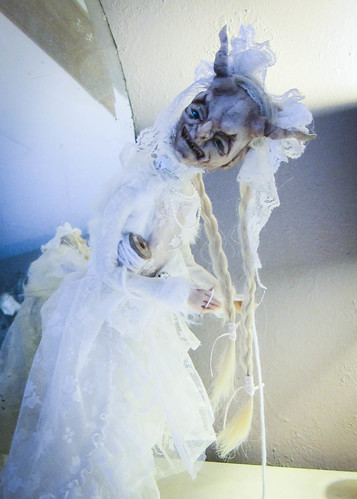
Perchta is associated with the spindle and with spinning. When the shepherds brought flax to her in the summer, she blessed their flocks, and they would often see her walking along the steepest slopes around twilight, with a golden spindle in her hand. The spindle is strongly associated with fate and fortune and is central to traditions of girls’ puberty initiations. Perchta oversees the timely completion of the season’s spinning – if you don’t get it done on time, Perchta might curse you with bad luck in the next year, or even cut open your stomach, pull out your entrails, and refill you with rubbish!
Perchta is associated with the Wild Hunt in folklore and is often said to be the one leading it. The Wild Hunt is held by the Forest Gods in the deep winter months, and may be dangerous to humans; being in the path of it can be deadly. Perchta’s victims are typically portrayed with their bowels trailing behind them. This symbolic evisceration implies a profound examination of the self.
Perchta is a major figure in the winter holidays throughout the alpine world. She is widely held to be the female counterpart to the devilish Krampus, and will often accompany him on his hunt for naughty children on December 5th. Perchta is particularly associated with Epiphany, starting the night of January 5th and going on to January 6th. This holiday is sometimes referred to as “Perchtentag”, meaning Bright Day, Perchta’s Day, or Perchten’s Day.

“Perchtenlauf is an ancient Pre-Christian ritual where young men dress in costumes with frightening “Perchta masks” going from house to house frightening away the evil spirits of Winter that wander the countryside seeking to harm humans. This procession was traditionally done on the winter solstice. This is the longest night of the year where the sun shines the least. It is also the beginning of when the Sun begins its return trip and shines for longer periods bringing the warmth of Spring. Perchta was summoned on this night to frighten away the long cold winter and make room for the brightness of spring. Hundreds of years ago when the threat of death during the cold winter months was very real for the Teutonic tribes people, it was necessary for people to be given hope of the coming spring. Perchta was the goddess who fought back against the darkness of winter not only in the external world but in the hearts of humans. The ritual of Perchtenlauf no doubt has roots extending into pre-historic ice age shamanic rituals of the proto-Teutonic people. Surprisingly, the ritual of Perchtenlauf has been continuously practiced in the Alps up until the present.
Perchta shows dual faces at this time. To the faithful, she appears as a beautiful goddess of light who blesses humans with health and prosperity. To the evil hearted, deceitful and wicked, she appears as a ferocious demon with horns and fangs. In this depiction, she is strikingly similar to the east Indian goddess Durga who alternately appears as the nurturing mother of all and the frightening Kali Ma who devours demons and drinks their blood.”
– From Perchta: Protective Goddess of Light and Dark by Thunderwizard

…”the Krampus was believed by alpine Germans and Austrians to accompany Saint Nicholas on his rounds, but rather than just stuffing lumps of coal in a naughty child’s stocking, the Krampus – who, by the way, was depicted as a very tall, very shaggy, goat-like man — would inflict corporal punishment on the boy or girl with a cluster of sticks. If the child was particularly naughty, he or she would simply be thrust into a basket and taken away, one supposes, to whatever horrible place the creature came from — a place we can be quite sure was not Christmastown. Such a fate must have been one of the more effective threats leveled on a badly-behaved medieval child by his angry parents. Better than the ‘no presents’ approach, certainly. (Although in fairness, one must wonder exactly what presents a poor village child would have been expecting. Perhaps imagining terrible punishment from an other-worldly goat creature, and the avoiding of the same through good behaviour, was simply a natural anthropological response to having no upside at Christmas.)
Unfortunately, surviving the time of the Krampus would not get your family off the hook for the season, for it was also believed that during the twelve days following Christmas, a goddess would make her rounds of the countryside, inspecting homes and spinning rooms for any signs of disorder or laziness. This was, to the northern Germans, Frau Holda, an almost entirely benevolent divine being who taught humans the household arts of spinning, weaving, and reaping, but who was no softy: she was believed to ride with Wotan’s ghostly army (into which host the spirits of unbaptized infants were incorporated when they died), and was fond of setting on fire the spinning distaffs of any girls she thought had been unproductive and slothful that year.
Frau Holda‘s wrath, however, was mild compared with that of Perchta, the south German variant of the same goddess. On her festival day, she expected celebrants to eat only fish and gruel, which was considered fasting fare. The penalty for failing to do so, wrote Jacob Grimm in his Teutonic Myths, was ghastly: ‘whoever has partaken of other food on her day, she cuts his belly open, fills it with chopped straw, and sews up the gash with a ploughshare for a needle and an iron chain by way of thread’. In Swabia, her role was believed to similar to that of the Krampus – though more lethal — as ‘with hair all shaggy she walks round the houses at night, and tears the bad boys to pieces.’”
– From In the bleak midwinter, an excellent article by I. Garrick Mason at sans everything
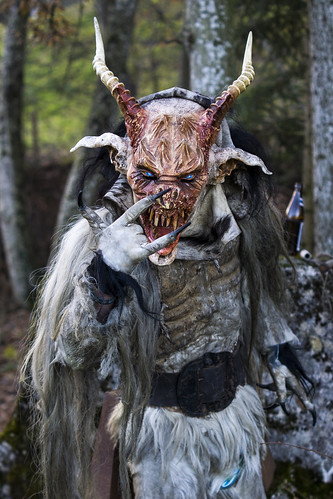
By s.stegh

From CRUSHEVIL:
Masked figures from the ‘Wilde Jagd’ Christmas folklore festivity in Salzburg, Austria. These festivities originate through the Perchtenlaufen custom, a period when the fearsome witch Perchta, who envies happily married couples, roams the villages. Processions of horribly masked figures armed with sticks and clubs meet throughout the festivity to chase the witch away.”
This picture is from Masks, Face Coverings and headgear by Norman Laliberté and Alex Mogelon

These headdresses are maybe the most captivating examples of folk ritual costume I have seen – in a long time. I would love to see them in person, in color. There’s got to be some crazy alpine museum in the mountains where some of them still exist, wouldn’t you think? I must find this place.

Some of the masks worn by Perchten Dancers of Salzburg.
I discovered this amazing article via the marvelous digital history project. It was originally published in the Wide World Magazine, September 1908. I’m reposting an excerpt here, but the whole thing really is just too fascinating, so please do go read all about it.
The Perchten Dancers of Salzburg Austria Tyrol Pinzgau
By MRS. HERBERT VIVIAN.
Amongst the mountains of the little Austrian Duchy of Salzburg dwell peasants who still mingle religion and mythology in a curious jumble and observe many remarkable customs. Perhaps the most extraordinary of their festivals is the Perchten dance, which is performed only at very infrequent intervals. Mrs. Vivian was fortunate enough to witness the latest celebration of this unique function and secure a set of striking photographs.
The Perchtentanz is named in honor of Perchta, another name for Holda or Freya, Woden’s consort and the mother of the gods. Although banished from many of her ancient haunts by rude civilization and unbelief she still clings to Salzburg and parts of the Tyrol, where the peasants not only believe in her, but fear her. Perchta means the Splendid, the Magnificent One. She may be seen, they say, wandering through the great fortress of Salzburg at dead of night. Towards the beginning of the year, in the guise of a tiny, wizened witch, with gleaming eyes, long hooked nose, and wildly tangled hair, she lurks at crossroads, waiting for travelers. When one approaches she greets him, with her friendliest smile, and holds out to him a black cloth. If he takes it he is done for, and will certainly not survive the year; but if he brings out his crucifix and says, “Dame Percht, Dame Percht, throw the cloth on the earth,” then every joy and blessing will come to his house.
If Perchta shows herself in a stable, sickness and death are sure to follow, unless the careful peasant hangs up a bunch of consecrated St. John’s wort, a potent herb in these lands. On other occasions the goddess gathers all the un-baptized children round her, and sweeps through the country at the head of the band. At Christmastime a spoonful of every dish used to be placed on a fence, or a gate, outside the house as an offering to this much dreaded lady. One of the strangest things about Perchta is that she has a double nature. Sometimes she is the soul of goodness and charity, at other times she is full of hate and malice to mankind. Men are fascinated by her, but their feelings are mixed, and fear is mingled with longing fear on account of her un-canniness, and longing because of her wondrous powers.
Perchta has her troops of followers, strange beings half-way between mortals and immortals, These do not live among the children of men, but appear amongst them at such times as Advent and the Feast of the Three Kings. Like Perchta herself, they are divided in disposition, for some are good, kindly creatures, such as the “beautiful” Perchten (Schiin Perchten); while. others, like the Schiachen Perchten, are wild, irresponsible, malicious things. They are more felt and heard than seen. In swarms they come down on men’s dwellings, and are recognized by their weird screams and laughter. They love to draw men into danger by alluring sounds and spells, and to punish undiscovered crimes. The Perchten dances originated among the peasants of the mountains, who desired to imitate these mythological beings, but of late years the performances have seldom been seen.
Presently there was a stir. The “beautiful” Perchten were arriving. Nothing could. be more fantastic than the appearance of these gentlemen. The pictures describe them far better than any words of mine can do. The lower part of their costume is unobtrusive, and all one’s attention is centered on their heads, which are crowned with what surely must be the most immense and eccentric head dress in the whole world. Two diamond. shaped boards, in all some ten or twelve feet high, are covered with red velvet. On them are fixed dozens of silver watches and chains and every kind of ornament the Perchten have been able to collect or borrow – looking glasses, artificial flowers, pictures of the Virgin, bracelets, necklaces, and coins. At the top comes a crown, above that a moon, and then again a star.
In their right hands the “beautiful” Perchten clasp a naked sword, and with the other they lead their partners – young men dressed as women. The latter were disguised so skillfully that it was almost impossible to tell whether they were really women or not, for of course there were many wives and daughters of the Perchten helping with the preparations. I remarked on this to my guide, so he immediately seized hold of the first person in woman’s garb he saw, and inquired:
“The English lady wants to know if you are a man or woman. Now, let’s hear which you really are.” As a matter of fact, the victim was a very shy girl; and there were blushes and giggles, accompanied by squeals of delight from the crowd.
The noblest of the “beautiful” Perchten wear bird head dresses. These are large pieces of moss covered board, and on them are fixed every rare bird that has been shot in the neighborhood by the Perchten and their friends. The “tafel,” as they are called, are really most striking and artistic. On the top comes a large bird with outspread wings, in this case a huge peacock with a gigantic tail. Naturally these head dresses are of a terrific weight; and have to be supported and steadied by an iron rod which is fastened to the back at the waist. I should think the poor fellows suffer for being beautiful, as the strain and the heavy load must conduce to violent headache. The back of the erection is usually covered with canvas and painted with a pastoral scene, such as the Almfahrt. A good part of the toilette of the Perchten had to be done in public, and it was rather amusing to see their wives fussing round them doing up buttons and tying strings.
This song isn’t really related to Perchta, and is Finnish rather than German, but I’ve become obsessed with learning it, and have been playing this entire album all through the winter holidays. It was only recently that I discovered the meaning of the lyrics, which are quite bleak. I love how happy and lilting this little lullaby is, only to have its deeper meaning revealed – if you can understand Finnish… A dual natured kantele seems fitting for Frau Perchta.
Eriskummainen kantele (The bizarre kantele)
Ne varsin valehtelevat, (Those indeed tell lies)
tuiki tyhjeä panevat, (are saying just empty words)
jotka soittoa sanovat, (those who judge the playing)
arvoavat kanteletta (claiming the kantele)
Väinämöisen veistämäksi, (being crafted by Väinämöinen)
Jumalan kuvoamaksi, (woven by the God)
hauin suuren hartioista, (out of a great pike’s shoulders)
veen koiran koukkuluista. (from the crooked bones of a water dog)
Soitto on suruista tehty, (But no, music is made from grief)
murehista muovaeltu: (and moulded from sorrow)
koppa päivistä kovista, (– its belly out of hard days)
emäpuu ikipoloista, (its soundboard from endless woes)
kielet kiusoista kerätty, (its strings gathered from torments)
naulat muista vastuksista. (and its pegs from other ills.)
Sentä ei soita kanteleeni, (Therefore my kantele will not play)
ei iloitse ensinkänä, (nor will rejoice at all)
soitto ei soita suosioksi, (music will not play to please)
laske ei laatuista iloa, (give off the right sort of joy)
kun on huolista kuvattu, (for it was fashioned from worries)
murehista muovaeltu. (moulded from sorrow)
12th Night Parades
by angeliska on January 4, 2013
It is with great excitement and shivery anticipation that I bear news of the rebirth of a very old tradition here in my hometown: a cadre of dear ladies and myself have joined forces as Krewe du Bisoux to bring the celebration of 12th Night to Austin. Our inaugural parade and fête will feature a decadent Kings and Queens Ball, with king cake (bien sûr!), our favorite marching band, and lots of glitter and revelry!
There’s a great article about what we’re putting together at The Gay Place:
12th Night Austin Rolls Out – The official, traditional kickoff to Mardi Gras comes to town

The celebration of Twelfth Night dates back to medieval England, and marks a turning point between the midwinter festival that begins with Halloween and ends as the Carnival season begins to fire up. Carnival means “farewell to the flesh”, and is a time of wildness, indulgence and celebration leading up to the final day of ultimate decadence before the austerity of Lent: Mardi Gras Day! Saturnalia and Bacchanalia were both celebrated in pagan Rome as lusty and decadent free-for-alls that involved excessive quaffing of wine, rich dishes, costumery, and all sorts of naughtiness. The darkest part of the year, in ancient times, required much merrymaking and fun to keep spirits bright during harsh winters that often brought much hardship. The twelve days of Christmas begin with Christmas day, and end on the Twelfth Night, or Epiphany. The end of the Winter Solstice season is ideally celebrated with a sense of triumph – that we made it through, that we survived to see another year! What better excuse for dressing up and dancing in the streets? Eat, drink, and be merry was their motto – and we’ll be trying our best to celebrate by that maxim, along with the Cajun French phrase you hear around Mardi Gras time in Louisiana: Laissez les bons temps rouler! – or: Let the good times roll!
In New Orleans, Twelfth Night is celebrated with king cake parties and, on a larger scale, Masquerade Balls. It is the night that the big Mardi Gras Krewes crown their King and Queen. On a scaled down version, house parties celebrate their own “king,” depending on who finds the plastic baby hidden in their slice of king cake. Tradition has it that the person to find the baby in their cake is rewarded with good luck for the year to come, and also is obligated to host the next king cake party before the season is over. Before plastic babies came into vogue In times of yore, a bean or a pea was hidden in the cake – the Bean King and the Pea Queen preside over the year’s festivities. It was custom for this day to be a time for everything to be turned on its head: to crown the peasants as kings, and for the royalty to run rampant in rags. On Twelfth Night, the Lord of Misrule dictates that everyone must come as they are not – the practice of dressing up in costumes or hiding one’s true face behind a masquerade mask is really a kind of ritual mummery that is practiced in ceremonies and magical rites in many cultures. When we dress in costume, we are given the freedom to become someone else – to enact fantasies, totems or characters from the deepest recesses of our psyches. It may seem to be nothing more than frivolity, but in truth, mummery can be a powerful form of catharsis for our spirits. Also, it really is a whole lot of fun!
Parades and processions have long been part of this celebration – taking to the streets in wild ensembles with noisemakers, instruments, pots and pans to bang on, (or even better – a marching band!) is another symbolic way of turning our every day sense of reality around. Houses and businesses that we might walk or drive by on any normal week are suddenly made more mysterious and special when we dance and frolic past them in a wild parade. It’s a form of reclaiming public space, of taking back streets and sidewalks that are usually only used in typical workaday fashion, and celebrating there. There’s something very magical about gettin’ down to a brass band in the middle of the street – a certain kind of freedom that’s not quite there in an enclosed space, or a venue dedicated to that purpose. We want very much to share that experience with Austin, and create a new tradition to help us all bring a bit more magic, dazzle and joy into our city!

La Jeunesse de Bacchus (1884) – William Adolphe Bouguereau
I’ve been reading Dancing in the Streets – A History of Collective Joy by Barbara Ehrenreich, which is a wonderful look at the history of parades and public celebrations through the ages. Parading is such a huge part of the way I love to express my lust for life: I am fascinated by the history of festivals, costumed processions and ritual mummery, and this book really delves into why we, as humans have always felt the need to celebrate in these ways.

I discovered the artwork of Harvey Dinnerstein via Matthew D. Innis’s excellent art blog, Underpaintings, and I am so grateful to him for introducing me to Dinnerstein’s work. I bought both books of his paintings after reading that article! Also, Innis has collected some of my favorite paintings with a processional theme in his post – the Alma-Tademas and James Gurney dinosaur parades I adore especially. One of Dinnerstein’s masterpieces, Parade, was painted in 1972, and I have found myself completely captivated by it.

From Underpaintings:
Of creating Parade, Dinnerstein said, “I had in mind a processional image, somewhat like the reliefs of Roman sarcophagi, related to Reubens’ development of similar themes. I have a memory of an experience viewing Delacroix’s Death of Sardinopolis at the Louvre. When you place yourself at a distance from the painting, so that the range of your vision encompasses the width of the image exactly, there is a dazzling effect of movement, and I hoped to arrive at some of that kind of energy in my painting.
and
With his work, Parade, Dinnerstein sought to emulate the grand allegorical paintings of the Renaissance, but from the Naturalist viewpoint which made up his training. He found in the political demonstrations of the sixties, a use of symbolism and myth by the protesters from which he could create his own epic image. From his own notes and sketches made during his personal observation of that tumultuous time, Dinnerstein engineered this spectacular piece.

A parade is a reminder to sing and dance while we may! I plan on doing as much of that as I can in this life, and I can’t think of a better way to ring in a new year and the start of Carnival than by celebrating 12th Night! If you’re in Austin, please do join us, and if not – well, get yourself a pan to bang on, a banner and a band and start your own parade wherever you may be!
New Year's Eve Foxfires at the Changing Tree
by angeliska on December 31, 2012
The turning of year draws close, we pause, here at the limen between what’s done and what’s to come – the snake’s lips meet its own tail and we ride the circle, blind and naked as babes. The reflexive curl inward, a protective gesture towards completeness: to be a whole and finished being, perfect and inviolable. But I’m not. There is so much left undone and unresolved that I have to just accept – to keep rolling onwards into the new dawn as calmly as I can, trusting that in time I will find a way to mend the broken things, understand the heart’s riddles, knit together what’s unraveled and do the rest of the work. That process is never really completely done though, I think. Nothing’s ever as tidy or as comprehensible as we might like, and I want to be able to sit with that as much as I can: to move forward into the unknown trusting somehow in that essential unknowableness. The ouroboros is the end and the beginning, alpha and omega. I always associate it with the final card in the the tarot: The World, which symbolizes the completion of the journey of The Fool, the moment when he dissolves and becomes one with everything. Solve et Coagula. When the Fool is reborn, the journey begins again – not with one, but with zero. Another circle, a goose egg, an ouroboros. This loop is everything, our eternal return, our journeying that is never finished, always beginning. I feel like I’m starting over like The Fool this year, my arms open, ignorant of what the future holds or what I might encounter on this strange journey. I’ve lost so much this year: so many beloved people and relationships, structures, ideas, belief systems I had constructed and held fast to – more than anything, I’ve lost things I thought were concrete, permanent, lasting. But nothing is. Nothing at all. There is only this moment, and this one, and this one. This process has of course been painful and confusing in the extreme: but I have come to the point where I’m finally resting against the snake’s mouth, the place where I can see the end of the tunnel and start to grasp some of the major lessons this intense cycle has brought me. It will take time for me to work through it all, and as much as I might like to be able to sum it up perfectly right in this moment, I am forcing myself to sit still, to not push, to wait and do the work as it comes. I can honestly say that this has been absolutely one of the hardest and most brutal years of my entire life, in terms of loss and hard lessons. It’s also completely true that I’ve grown exponentially in relation to a lot of that hard change, and that I am working hard every day to be the best possible version of myself. I’ve also gained many treasures – in the form of amazing friends, family and all the people I know who are constantly inspiring me to try and be kinder, wiser, and gentler. I am deeply grateful. Even for the hardest parts – because I am learning so, so much. There is so much I still have to process about this year – I think it will take a long time to express it all the way I want to, but I do intend to try. Right now, I just want to come full circle. I want to go back to the place where my people come from, to the place where my bones will rest when all that I am is gone, I want to bring gifts of fire to the twisty black witch-oaks that burst up through the cracks in pink granite, and as best I can – honor all this change, this turning, the dark road behind me, and the shining one up ahead.
This year was a fierce thing: it burned away everything that could not last.
I am asking for a more tranquil time: to focus on fluidity, on being open, on peace.
Dragons and snakes, circles and ladders, mountains and pits, shadows and stars.
Come, let’s light the foxfires.

New Year’s Eve Foxfires at the Changing Tree, Oji, 1856-1859
by Ando Utagawa Hiroshige
A Japanese woodblock print of Hiroshige from 1857 depicts fox Fires on New Year’s Eve at the Garment Nettle Tree at Oji. According to Japanese legend, trickster fox spirits gather once a year at night at an old tree at the Oji shrine, bearing torches, to receive their orders for the following year. One of the two trees depicted can still be seen.
Hiroshige was a favorite of my Grampa’s. He gave me several books of his prints before he died.

Ouroboros (Uroborus) with lamp by Leo Reynolds
The Ouroboros or Uroborus is an ancient symbol depicting a serpent or dragon eating its own tail.
The Ouroboros often represents self-reflexivity or cyclicality, especially in the sense of something constantly re-creating itself, the eternal return, and other things perceived as cycles that begin anew as soon as they end (compare with phoenix). It can also represent the idea of primordial unity related to something existing in or persisting from the beginning with such force or qualities it cannot be extinguished. The Ouroboros has been important in religious and mythological symbolism, but has also been frequently used in alchemical illustrations, where it symbolizes the circular nature of the alchemist’s opus. It is also often associated with Gnosticism, and Hermeticism. Carl Jung interpreted the Ouroboros as having an archetypal significance to the human psyche. The Jungian psychologist Erich Neumann writes of it as a representation of the pre-ego “dawn state”, depicting the undifferentiated infancy experience of both mankind and the individual child.

“The armadillo girdled lizard possesses an uncommon antipredator adaptation, in which it takes its tail in its mouth and rolls into a ball when frightened. In this shape, it is protected from predators by the thick, squarish scales along its back and the spines on its tail. This behavior, which resembles that of the mammalian armadillo, gives it its English common name. This behavior may have inspired the mythical creature Ouroboros.”

Ouroboros – The Lion and the Snake by Wiertz Sébastien
“Plato described a self-eating, circular being as the first living thing in the universe — an immortal, mythologically constructed entity.
‘The living being had no need of eyes because there was nothing outside of him to be seen; nor of ears because there was nothing to be heard; and there was no surrounding atmosphere to be breathed; nor would there have been any use of organs by the help of which he might receive his food or get rid of what he had already digested, since there was nothing which went from him or came into him: for there was nothing beside him. Of design he created thus; his own waste providing his own food, and all that he did or suffered taking place in and by himself. For the Creator conceived that a being which was self-sufficient would be far more excellent than one which lacked anything; and, as he had no need to take anything or defend himself against any one, the Creator did not think it necessary to bestow upon him hands: nor had he any need of feet, nor of the whole apparatus of walking; but the movement suited to his spherical form which was designed by him, being of all the seven that which is most appropriate to mind and intelligence; and he was made to move in the same manner and on the same spot, within his own limits revolving in a circle. All the other six motions were taken away from him, and he was made not to partake of their deviations. And as this circular movement required no feet, the universe was created without legs and without feet.’
In Gnosticism, this serpent symbolized eternity and the soul of the world. The Gnostic text Pistis Sophia describes the disc of the sun as a 12-part dragon with his tail in his mouth”

Sergei Sergeivich Solomko (1867-1928)
I want to sleep and dream in the crook of the changing tree. I’m ready to become a different kind of bird. I feel like this coming year is already sparkling and crackling with possibilities.

Ouroboros – by Jason Brammer

The Orphic Egg
The egg symbolizes the belief in the Greek Orphic religion that the universe originated from within a silver egg. The first emanation from this egg, described in an ancient hymn, was Phanes-Dionysus, the personification of light. In Greek myth, particularly Orphic thought, Phanes is the golden winged Primordial Being who was hatched from the shining Cosmic Egg that was the source of the universe. Called Protogonos (First-Born) and Eros (Love) — being the seed of gods and men — Phanes means “Manifestor” or “Revealer,” and is related to the Greek words “light” and “to shine forth.” An ancient Orphic hymn addresses him thus: “Ineffable, hidden, brillian scion, whose motion is whirring, you scattered the dark mist that lay before your eyes and, flapping your wings, you whirled about, and through this world you brought pure light.”
This year, I’m headed back out to Lone Grove, to the place where I traditionally prefer to ring in the New Year.
My dear friend Chip Warren is a wonderful photographer who captured so much magic during our celebration in 2011 –
he made this fantastic video to give you an idea of what it was like that year.
His full set of New Year’s Eve 2011 photos are here:
Lone Grove New Years 2011
More words of wisdom from my comrade Dr. Caraway: Ambling in the new year
Some musical mixes from myself and from Lau to honor the turning of the year:
More to read from New Year’s Eves of yore:
✶ FUCK THE PLAN 2012
✶ AN EPICALLY EPIC AND FAIRLY TARDY YEAR IN REVIEW – OR, HOLY SHIT: 2011!
✶ A Bright Blue Wish
✶ New Year’s Redux
✶ Stargazer Honey
✶ Blue Moon
✶ Lone Grove New Year
✶ Pink Moons
✶ The New Year
✶ Lucky Stars and Garters
✶ La Nouvelle Année
Winter Solstice – Bright Stars + Firelight
by angeliska on December 20, 2012
The winter solstice is nearly upon us – this one so trepidatiously anticipated as a harbinger of either the end of the world, or the beginning of a new era of human conscious – depending on you talk to. For me, this is a moment to stop, to take a deep breath, to light a fire. I want to nestle in my little nest, to gather friends and beloved animals around me, to sip mulled wine and burn away everything I am ready to let go of. The solstice is a time of wonder, of ritual, of candles lit under shivering stars.
I found a wonderful book recently that has been very inspiring reading as I’ve been preparing my celebration. I’ve included some illustrations and excerpts from it here in this post:
The Winter Solstice: The Sacred Traditions of Christmas
by John Matthews (with contributions from Caitlin Matthews).
I love this excerpt from the introduction:
“The Solstice is a time of quietude, of firelight, and dreaming, when seeds germinate in the cold earth, and the cold notes of church bells mingle with the chimes of icicles. Rivers are stilled and the land lies waiting beneath a coverlet of snow. We watch the cold sunlight and the bright stars, maybe go for walks in the quiet land. . . . All around us the season seems to reach a standstill — a point of repose.”
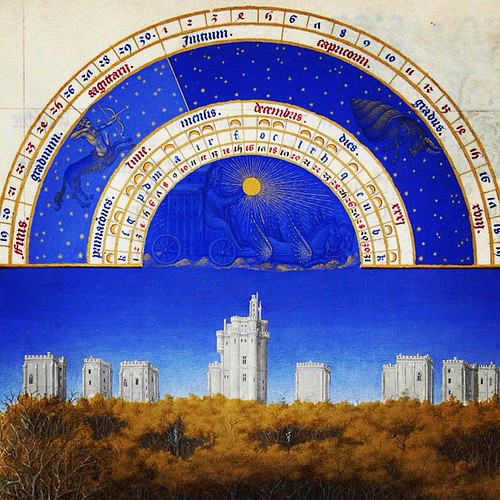
From the Très Riches Heures du Duc de Berry – one of my favorite things in the whole world.
“At this point we shall discuss the order of the steps by which the soul descends from the sky to the infernal regions of this life. The Milky Way girdles the zodiac, its great circle meeting it obliquely so that it crosses it at the two tropical signs: Capricorn and Cancer. Natural philosophers name these ‘the portals of the sun’ because the solstices lie athwart the sun’s path on either side, checking farther progress and causing it to retrace its course across the belt beyond whose limit it never trespasses. Souls are believed to pass through these portals when going from the sky to the earth and returning from the earth to the sky. For this reason one is called the portal of men, the other the portal of gods: Cancer, the portal of men, because through it descent is made to the infernal regions [to life on earth]; Capricorn, the portal of gods, because through it souls return to their rightful abode of immortality, to be reckoned among the gods.”
– From A Commentary on the Dream of Scipio, written by the medieval scholiast Macrobius (5th cent AD) The Dream of Scipio was a cosmological section of Cicero’s work, On the Republic, which did not survive as a manuscript, but was found beneath heaps of tomes in the Vatican library in the 19th century. What was found, however, did not contain the Dream of Scipio, which is only preserved in the commentray by Macrobius. Alas.
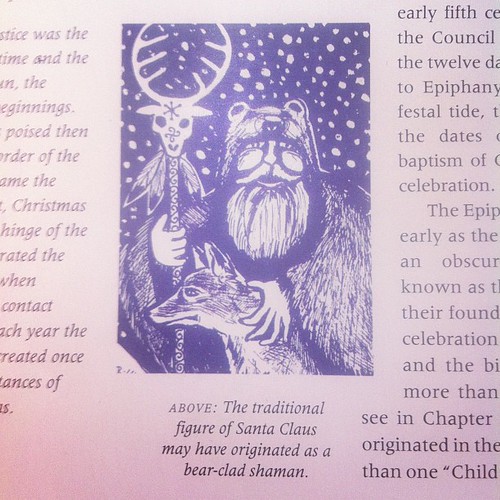
Santa was a bear shaman, y’all.
“Shaman, will the sun be reborn? Will we have a good harvest? Will we catch enough fish, will there be enough meat to eat, will the reindeer drop enough offspring to keep us through another year?
What will the new year bring for us, for me? Tell us, shaman, make your journey and bring us the gifts of your seeing!
You are the bringer of gifts, the protector, the magician, the future is yours to see, the sack on your back carries the gifts of the future and the past — tell us, shaman, tell us.”
– Alison Mcleay
The psychedelic secrets of Santa Claus – Modern Christmas traditions are based on ancient mushroom-using shamans.
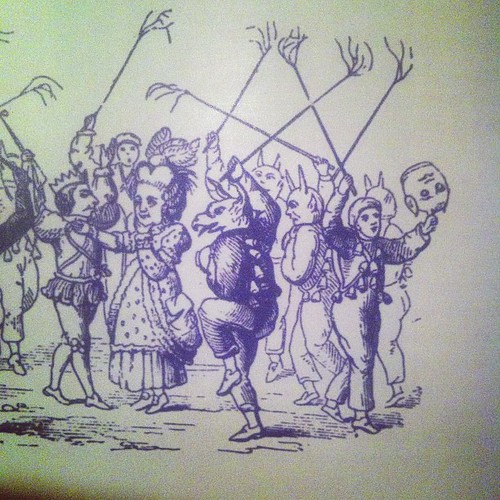
Animal disguise is part of many ritual Solstice dances and performances…
“The many animals that throng the Winter months are particularly present during the Twelve Days of Christmas, those days in which guising is performed, when we walk between the worlds, masking and veiling our features so that animal spirits can moves through us and among us, bringing their gifts and challenges. These customs embrace us all, for we are all still animals and are all part of the pattern of ancient ‘wildness’ that threads through the celebration of Midwinter.
This is itself a reflection of a once powerful but now neglected sense of oneness between human beings and the natural world that was our environment before we began to build cities and gather together in amorphous groups. That this ancient wildness is still there, only a little but below the veneer of our civilized lifestyles, is apparent by the number of traditions still in practice that involve dressing as animals and performing ancient rituals.”
– John Matthews
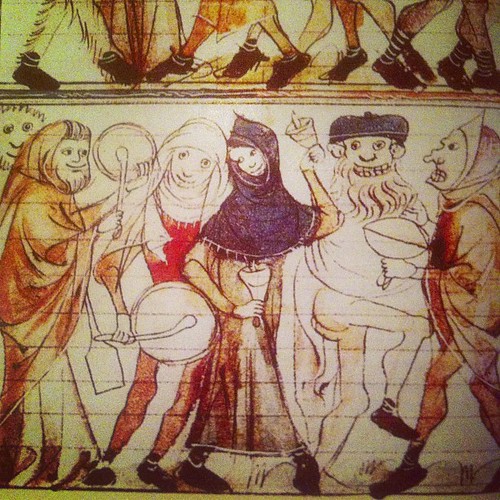
Medieval Mummery! We’ll be engaging in lots of this sort of thing this season, since we are celebrating through 12th Night with a glorious parade!
“On those days the heathen…put on counterfeit forms and monstrous faces. Some are clothed in the hides of cattle; others put on the heads of beasts, rejoicing and exulting that they have so transformed themselves into the shapes of animals that they no longer appear to be men… furthermore, it is those who have been born men who are clothed in women’s dresses…and effeminate their manly strength by taking on the forms of girls, blushing not to clothe their warlike arms in women’s garments; they have bearded faces, yet they wish to be women… ”
– Caesarius of Arles, 6th century A.D.
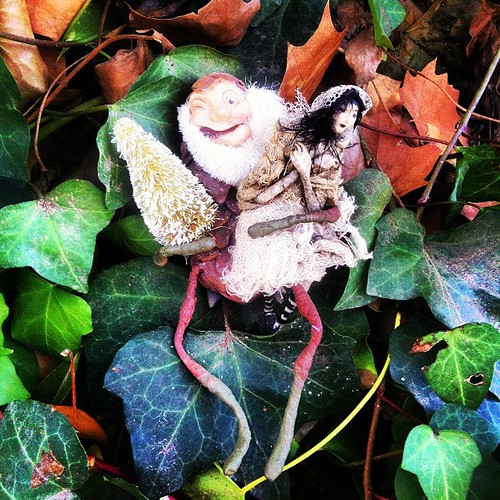
The King of Winter & an ice nymph. They are coming tonight to touch everything with frozen fingers, laughter echoing like icicles shattering.
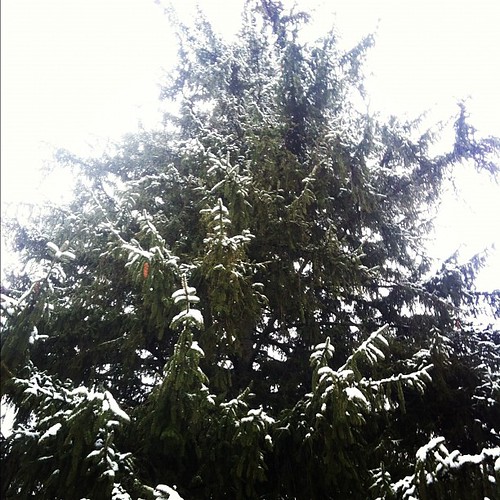
“If a cosmic tree points the way to heaven for us every Christmas, Santa Claus undertakes the magical flight of the shaman. He is sometimes said to be responsible for erecting the Christmas tree sky pole himself. Descending vertically down the chimney Santa returns by the same route back to the roof. Our chimneys, like the cosmic axis, carry him from one realm to the other…”
– E.C. Krupp, Beyond the Blue Horizon

May your Winter Solstice be full of magic, hope, and wonder.

“Hope is at the very core of the Winter Solstice. There will be hunger, darkness, fear, loneliness, grief and suffering. People die, cities crumble, rivers freeze and green things wither away (except for evergreens, of course, which is why we treasure them) – and throughout it all we go on hoping that better days will come, even if we can’t imagine what those days might look like or where on earth they will come from. We go on hoping, tending the hidden suns deep inside of ourselves even as our bodies freeze, our stomachs grumble and our hearts break. We go on tending that tiny flame even after it seems reduced to nothing but cold grey ashes. We go on tending that tiny flame as if our very lives depend upon it – and you know what? They do. Our lives do depend on tending that little flame, that hidden sun. They really do, and in order to tend that flame we have no choice but to wait with it in the darkness from time to time.”
Before There Was Christmas – A Sermon by the Rev. Aaron McEmrys, delivered to the Unitarian Society of Santa Barbara, December 20, 2009
Related posts from winter solstices of yore:
WINTER SOLSTICE – BLOOD MOON
Winter Solstice – Messe de Minuit
Winter Solstice – Dark Season
Feast of All Souls
by angeliska on December 7, 2012
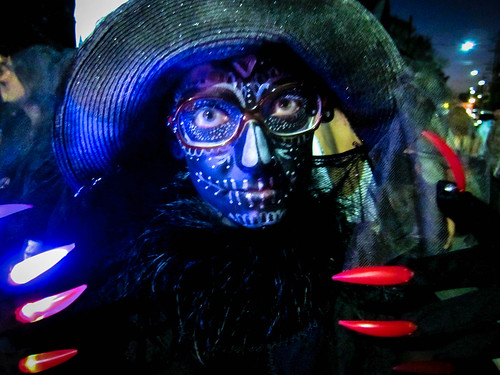
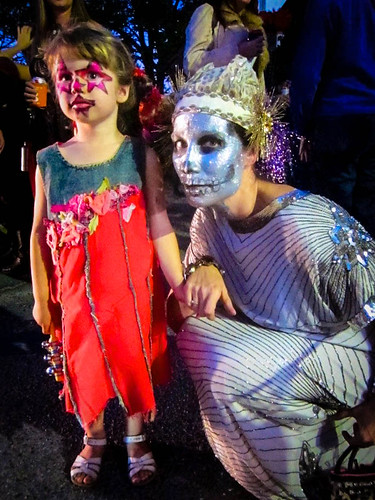
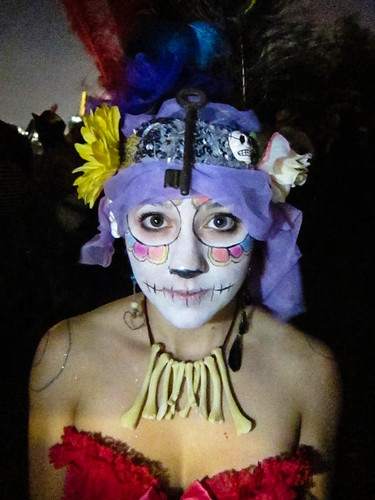
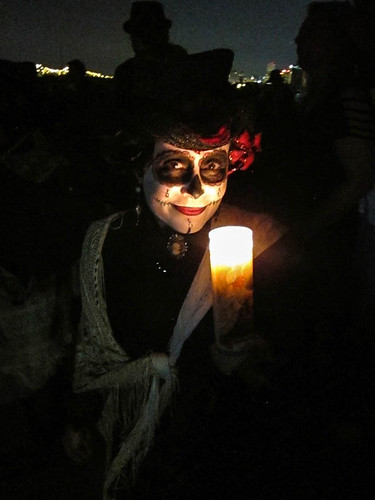
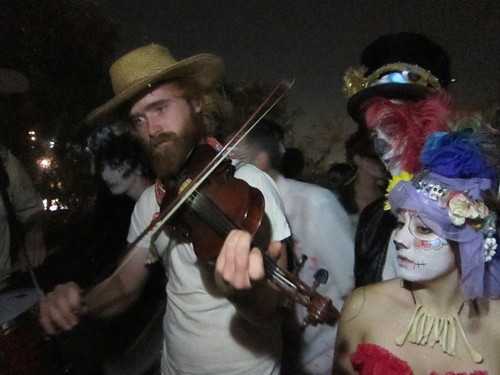
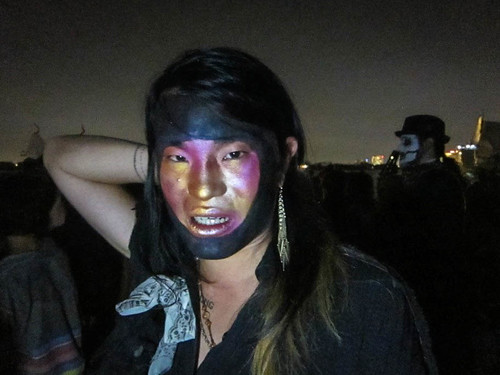
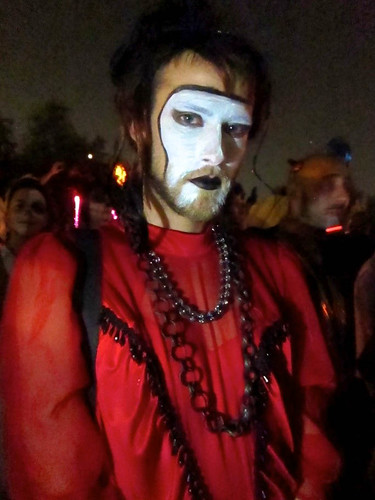
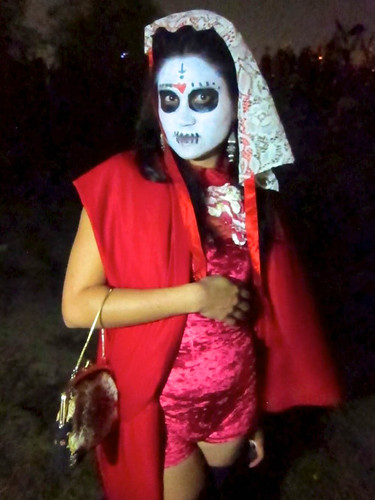
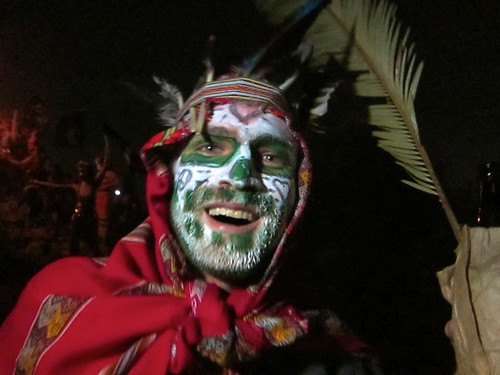
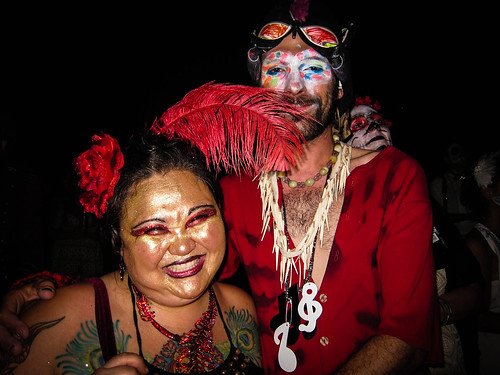
This year on November 2nd, which is Day of the Dead or All Souls’ Day, (also known as the Commemoration of All Faithful Departed), I was in New Orleans – a city that is on more intimate terms with death than many other cities, and a place where the dead are honored with elaborate marble necropolises, with both liturgical rites and pagan processions. The Day of the Dead parade is a tradition that I have has the great joy of participating in many times now, and has become such a major part of how I most want to honor those I’ve loved and lost every year. There’s something very powerful about this solemn, joyful, wild, rag-tag processions that wends its way through the dark streets, between houses and over train tracks, carrying ashes, lanterns, photos and memories. Every face painted with a skull, some glittered and grease painted, some intricate, some abstract. The sun set in a Maxfield Parrish blue fantasia, and we all gathered by the tracks: urchins and dogs and mamas and their little ones and elders and sisters and brothers and lovers. And the dead – invoked, unseen, everywhere.
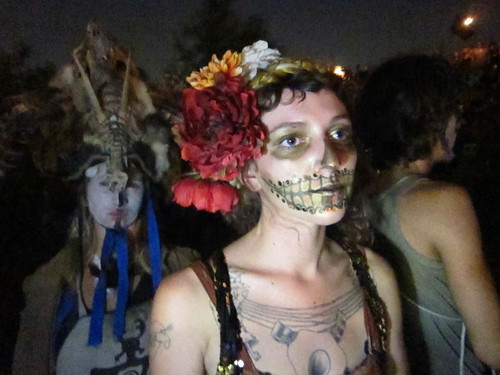
All souls laid bare, glowing and glimmering in the half-light.

Pandora makes a beautiful lantern every year for her parents.
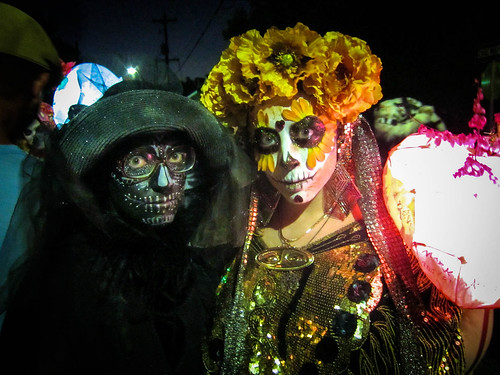
She also made a little heart lantern for me, to honor my dead. So many of them this year.
I wrote their names, garlanded them in coral vine, and carried them to the river.
Corinne knocks me out every time.
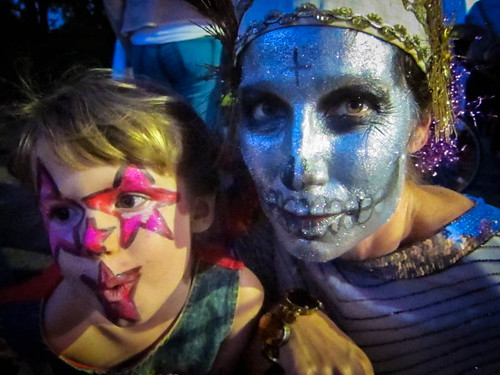
Ruby and Marcela.
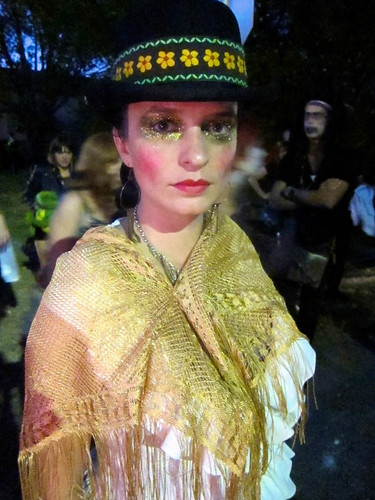
Raven as a Bolivian cholita.

Lizann shining in the streetlight.
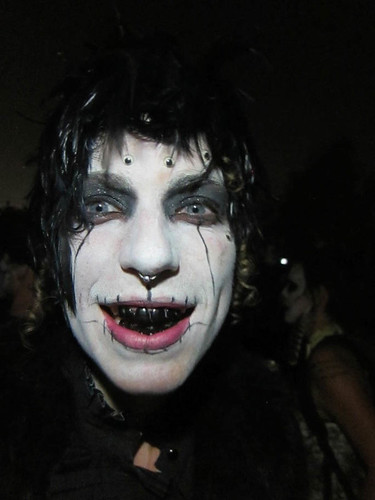
Rachel David makes me smile.
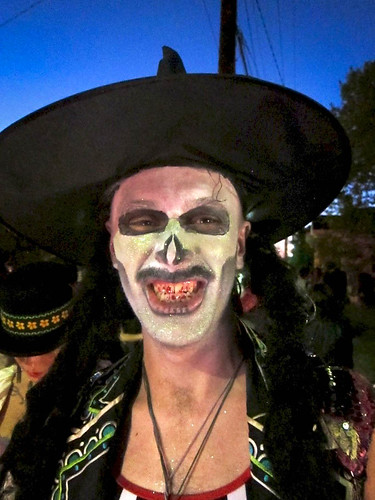
Randall Chili Frangelico is a scary witchface.
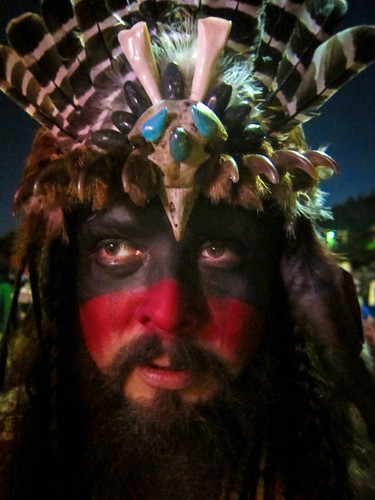
Mr. Michael James. Hot shaman.
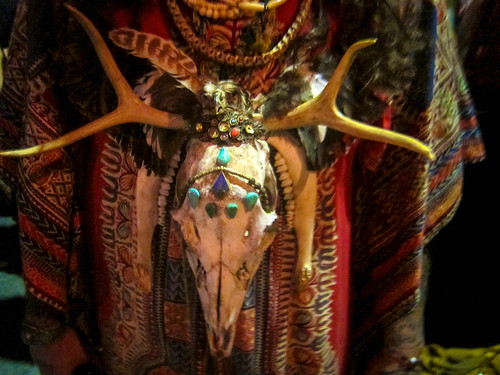
His deerskull neckpiece…
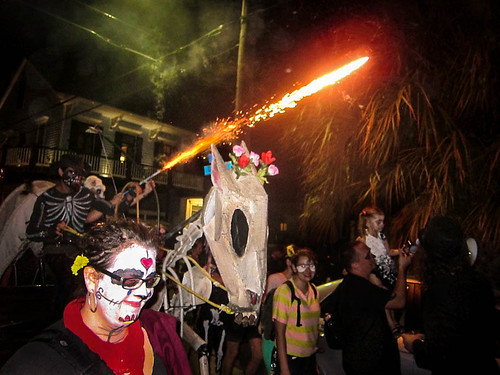
Parade! Fireworks! Dead horse wagon!
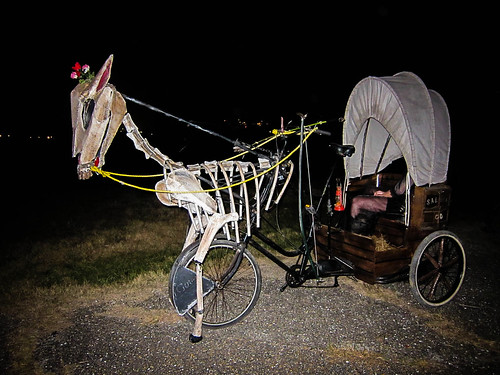
This is still maybe the best thing I have ever seen. Every time I see it, I fall in love all over again.
It moves so beautifully, clip clopping delicately down the street. Richie is such a genius.

Even the doggies got dressed up.
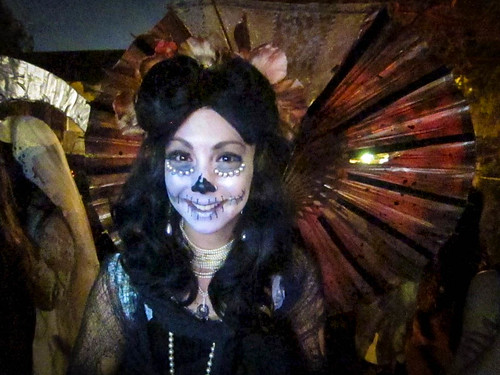
Radiant pearl.
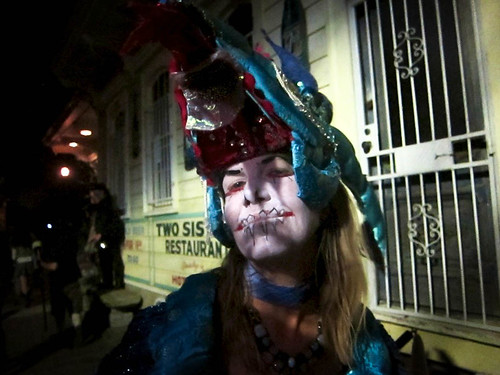
Shannon Brinkman
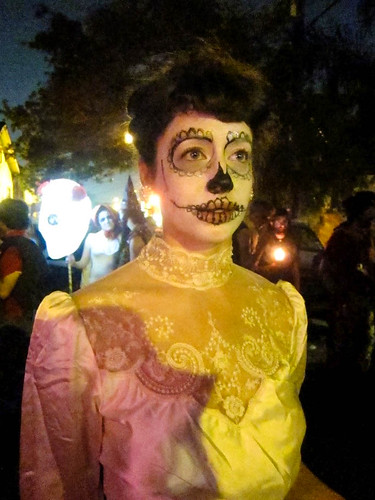
A beauty.

Lauren Silberman
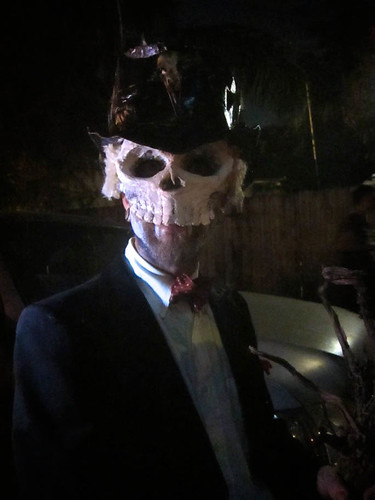
Tommy
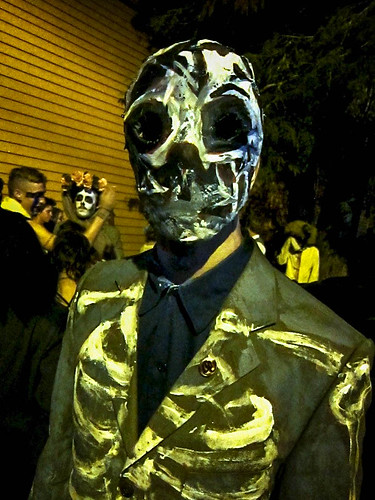
I don’t know who is under there, but I like their mask.
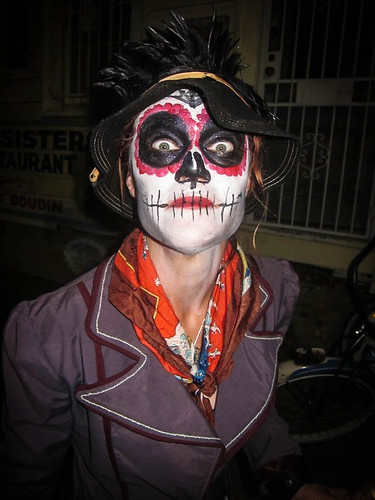
Mary Go Round
Marion
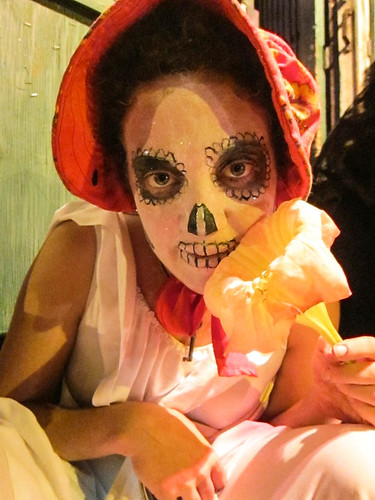
Pandora is a dollbaby.
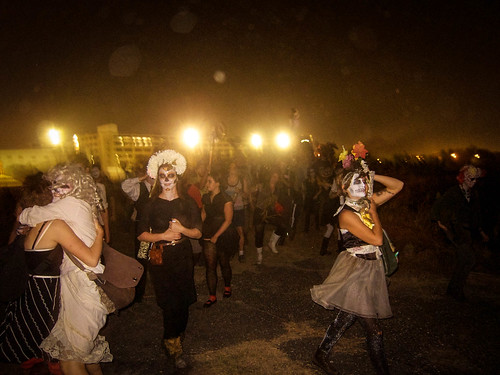
At the end of the world!
We sing while we may…
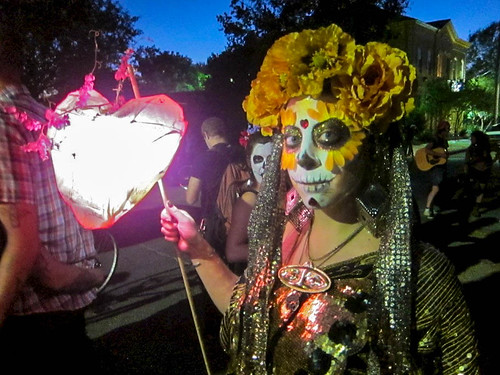
Heart in my hands, eyes lined in marigold petals, found on the ground in Rosalie Alley the night after the voodoo ceremony for the Guédé.
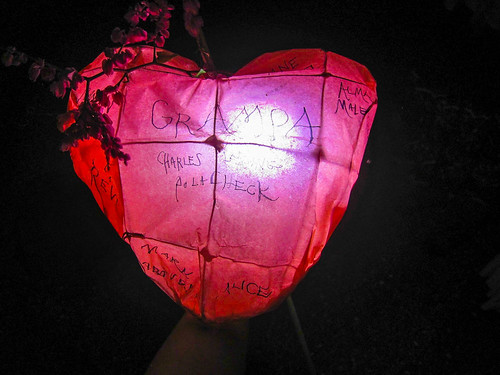
I wrote the names of these dearly departed on my heart and burned it by the river:
Charles Lessing Polacheck
Mark Aboudja
Alice Stevenson
Diane Naegel
Ray Henry Ulrich
Jennifer Cruz
Esme Barrera
Helen Hill
Jon Flee
Alma Maleckar
Nefairia Devi
Ramon
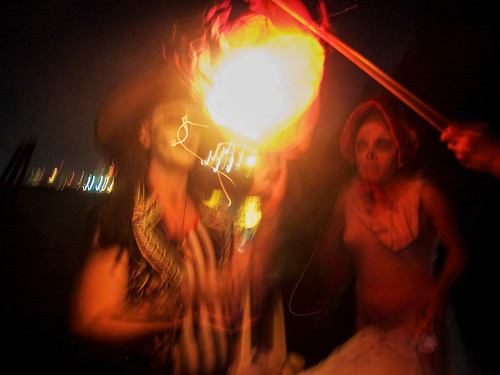
We are aflame with love, with grief, with everything in us, everything around us – catching fire, ashes drifting out to sea.
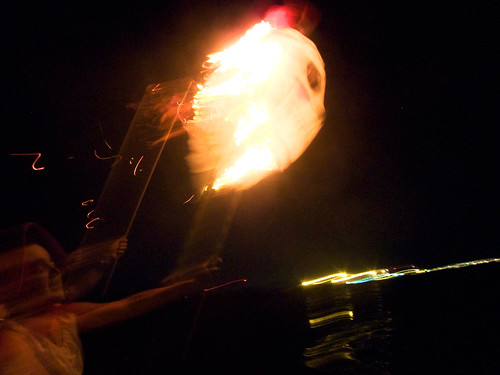
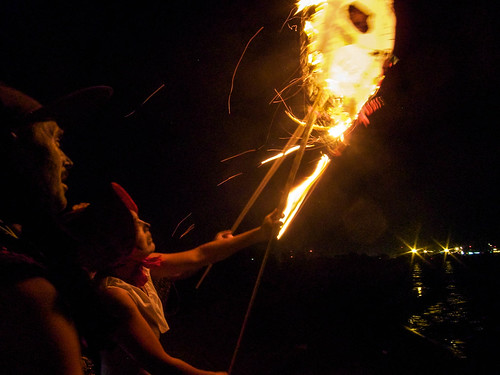
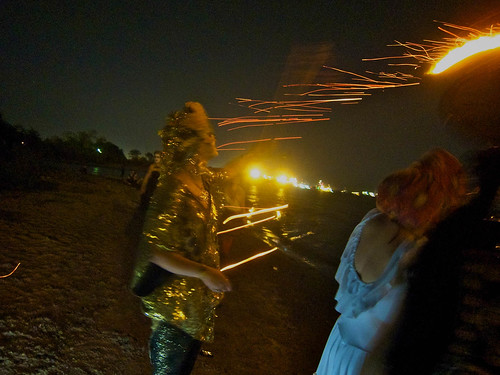
Goodbye, goodbye, goodbye.
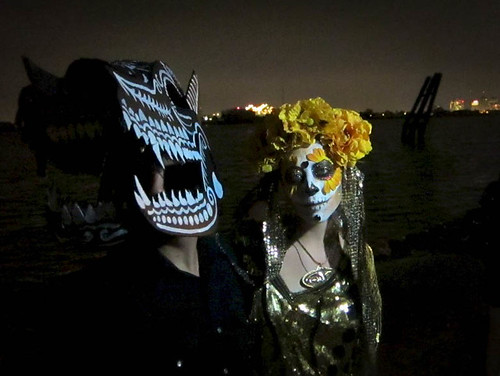
By the river, peaceful now.
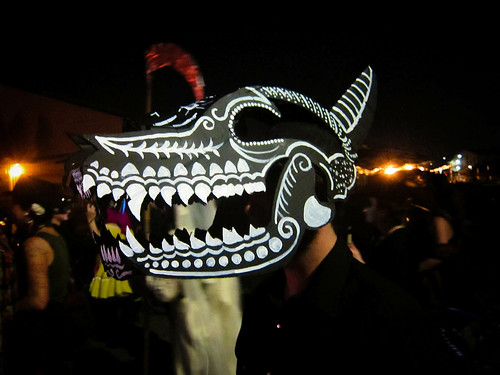
This mask was so very excellent – made from cardboard!
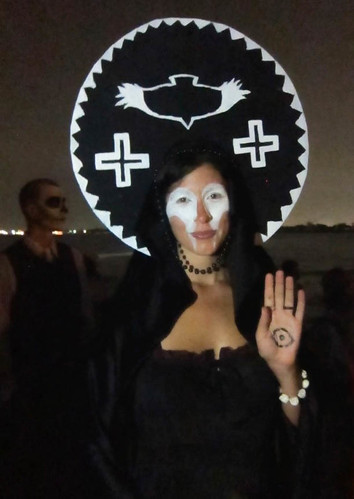
Our Lady.
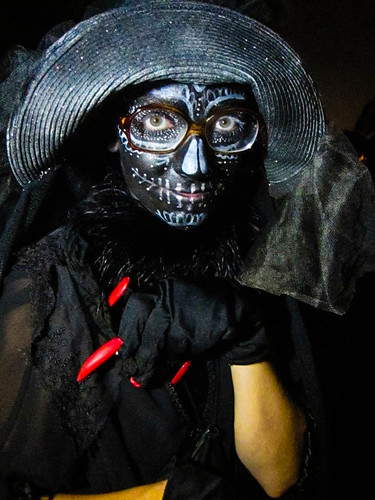
Can’t stop Corinnie!

Miss Olivia LadyBabyMiss
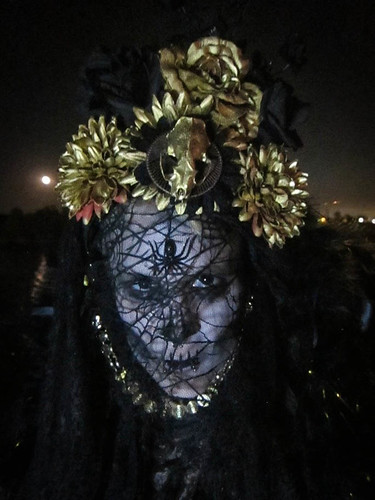
Nikki (I think?)
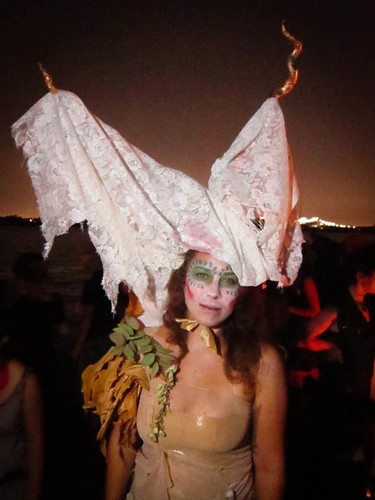
Antlered maiden
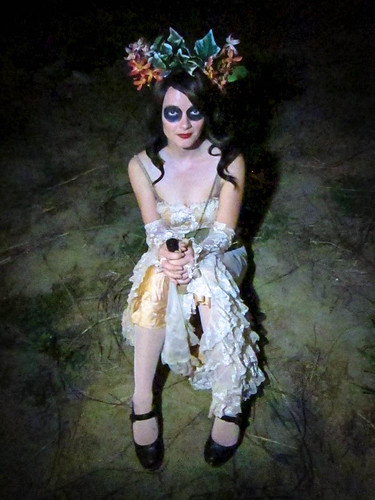
Doll girl
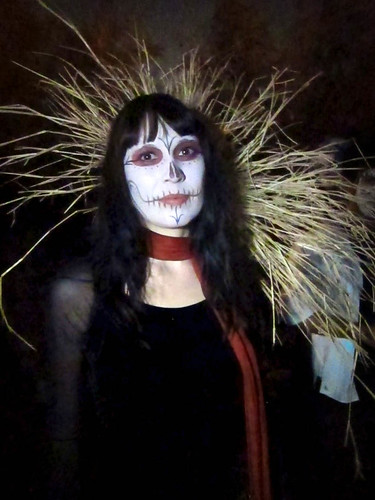
Star
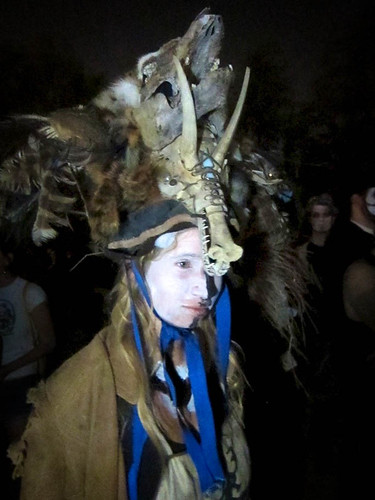
Eliza
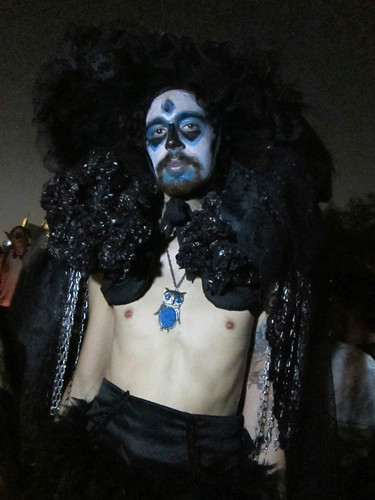
Dino
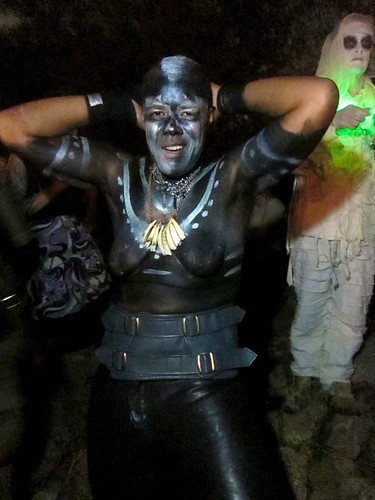
GIT IT!
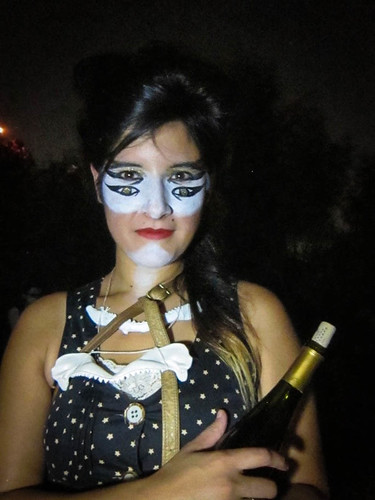
Alita Edgar
Calamity & friend.
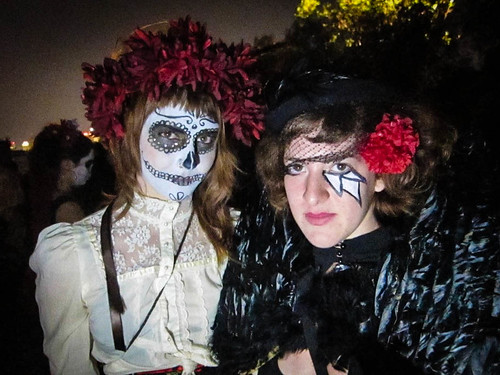
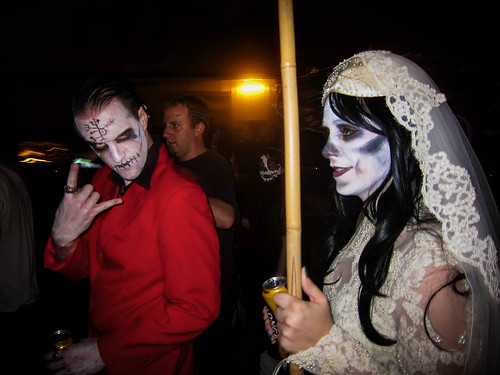
Josh + Sophia
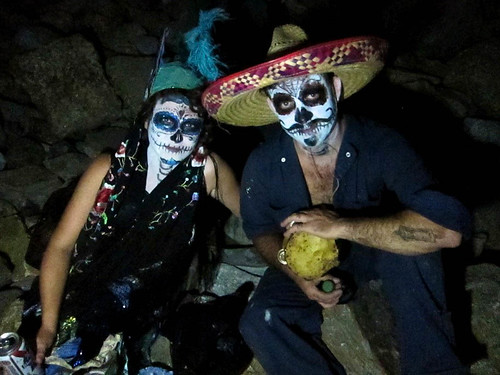


Misha

Amanda Stone
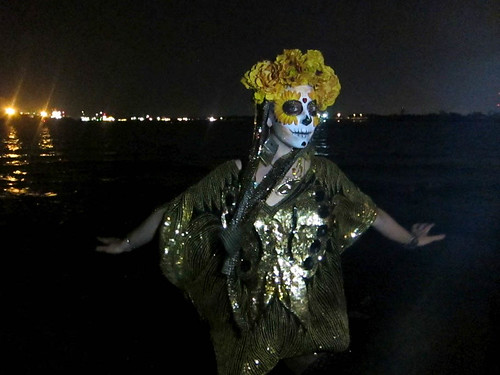
Dancing along the edge.
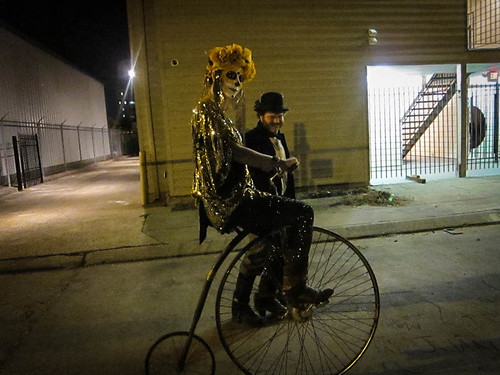
I got to ride on a nice man’s pennyfarthing!
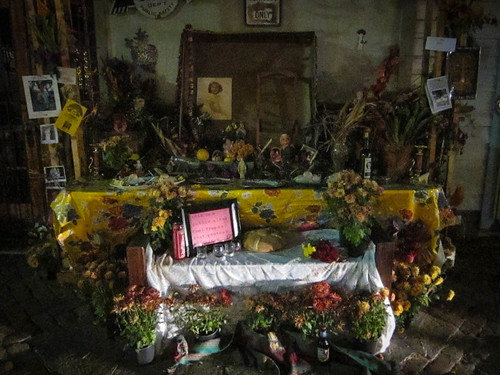
On the long walk back to the world, I came across this beautiful altar.
The sign reads: this is public altar – feel free to post photos and offerings
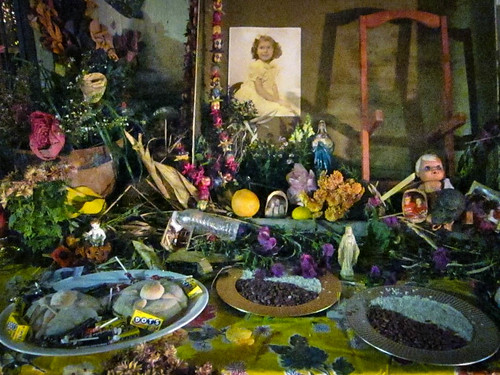
Folks from the neighborhood had come and added photos and memorials of their loved ones. It was strange to come across photos of people I recognized there, like My friend Felix’s dad, Hart McNee, who passed away in 2009. Strange and beautiful. I’m so grateful to be able to experience rituals like this. It is my dream in life to be able to create more opportunities for people to grieve and celebrate and honor their dead in beautiful ways like this. One day, I hope to help make a similar procession happen in Austin… Hopefully, one day very soon.
Full set of photos here:
Day of the Dead 2012
Further reading on Day of the Dead:
✂ LAS CATRINAS
✂ Day of the Dead in New Orleans
✂ Cempasúchil por los Muertos
✂ Día de los Muertos – R.I.P. Studs Terkel
✂ Santissima Muerte!
L’Autre
by angeliska on November 30, 2012
I’ve been wanting to draw this all together for awhile, ever since I found a half-full bottle of Diptyque’s L’Autre on Ebay last year. It’s a scent I’d been hearing tale about for years – one that intrigued me since it is so often reviled as being too weird, or too stinky. Being a Capricornian sea-goat, I tend to savor a good ripe stink – if it’s the right kind… I find the funk of the Indian spice asafoetida to be strangely pleasing, and the animal musk of certain armpits have been known to drive me to fits of wild nuzzling, like a truffle-hunting boar. It’s the faun in me, the forest dweller that loves to roll like a wolf in rotting piles of leaves and mushrooms. Even the smell of roadkill on a breeze isn’t always initially repulsive to my nose.
So, I instinctively knew that I might adore L’Autre, the Other – that naughty satyr trapped and gamboling in a glass bottle. There are so many perfumes I find truly abhorrent – but most of them are cloying, sugary synthetic concoctions meant to mimic the juice of carefully engineered robotic fruit, and usually worn by desperate women attempting to buy a renewed sense of juiciness at the mall. I’d literally rather slather myself in the ooze from a dead raccoon or be sprayed by a skunk before allowing myself to be spritzed with some eau de mango whale-butt. I’m serious.
L’Autre is a woody blend of spices including cumin, coriander, cardamom, carvi and patchouli, that for me, evokes a certain place in time: an autumn in London circa late 1960’s/early 70’s. There’s something about the spice over a coolness, a stoniness. It’s an old English rock-wall draped in dry moss, with an orange paisley scarf flung over it, forgotten by a hippie couple, who bought it in India, and used it many times to couple on, to serve lentil picnics over, to wrap around their attar drenched necks.
It’s the scent of an irrevocably civilized person who travels, and seeks out the exotic, and forces themselves to be alright with not bathing while on their voyage. Perhaps I’m reading too much into it, but I can’t help feeling that the wildness and naughtiness in it are made even more exciting when paired with a certain staidness. It’s a deceptively calm, pale face with a ribald glint in the eye. It makes me think of cold British weather made cozy indoors with spicy stews and tea and tapestries and incense and sex. All the very best things about autumn. It’s perfume for the moment when the sixties really started swinging, and the Beatles and Donovan all went to hang out with the Maharishi.
It’s Norwegian Wood: all sitars and aching blue balls and wine spilled on the persian rug. At least, that’s my interpretation. I don’t feel right putting it on unless I’m wearing something rusty, sable or saffron. It makes me want to dress in a russet leather trenchcoat, or in old riding gear. It makes me want to tumble on a lambskin rug in front of a fire with someone wild until winter’s over.

My dwindling bottle perched on an assortment of my favorite fall patterns. Two frocks, and my beloved velvet jacket that was rescued by my sister from a Portland trash-pile. I hornswaggled it off her and wear it constantly.
“Capturing the memory of long walks through the spice markets of Damascus, L’Autre is a dry, sensual blend that recreates all the mesmerizing magic found in the rich landscape of the Orient. L’Autre, is the second fragrance creation from Diptyque.”

Norman Parkinson, Jan Ward in a Jean Muir dress, Monument Valley, Utah, 1971 from British Vogue.
“Before I had ever smelled L’Autre by the niche French house Diptyque, I heard someone call it the dirtiest perfume they’d ever smelled. Most of the “stories” behind perfumes are pure, distilled lies (marketing being their dirtiest ingredient), but this one seems to check out: Diptyque claims that its creative director, Desmond Knox-Leet, was transfixed by the smell of a Damascus spice market, which he had his perfumer Serge Kalouguine recreate. The result is one of the world’s most literal-minded perfumes. L’Autre is piles of spices simmering in the hot African sun. It is desert dust, the dirt on the street and a hint of body odor from the salesman’s robes. If the spice is somewhat obvious, it is a picture worth 10,000 words. To wear it or not might require a considered decision, but there is a reason you see it as dirty; perfumers know well that one of the molecules in cumin is also found in sweat.”
– Dirty Tricks by CHANDLER BURR

The majority of the images I chose to illustrate this paean to one of my favorite perfumes come from my amazing friend Laura McLaws Helm’s marvelous blog Sighs and Whispers. Laura is a fashion historian who specializes in the studying the styles of the 1960’s and 70’s. She is truly an encyclopedia of knowledge on the subject, and her blog is a treasure trove of images she has lovingly scanned from the magazines and advertisements of the era. I have spent many a sleepless night poring through her pages, tantalized and thrilled by the amazing stuff she’s found in her studies. Beware: once you fall down that particular rabbit-hole, it’s easy to lose yourself in a vintage fantasia for hours and hours!

Turkey: A Long Romance – Editorial By David Bailey for Vogue UK, May 1970.
“For those who like their pleasures first-hand and real, L’Autre is much more the thing; perhaps the sort of thing, in fact, that Mr Ford would have created were he not scared of his own penis. Because L’Autre is actually sexy, in a real, earthy, unashamed, all-consuming way. It smells of two things: man-spice and man-sweat. It is devastatingly uncomplicated. Spray it on, and it’s cumin. (Sorry.) Heavy, heavy garam masala, cumin-centric, with hints of coriander, ginger and black pepper. And then, after about five to ten seconds, comes the first hammer-blow of pure armpit. WHOMP! Oh God. It’s wonderful. You wait and sniff again. WHOMP! Grrr. WHOMP! Again!
L’Autre is the smell of the wolfman, if the wolfman lives in Peshawar and rarely washes. It is the smell of an Afghan spice market after a long summer day, while rugged tribesmen stand guard, using their Kalashnikovs to pick their teeth. It is like dancing all night with an awesomely muscled and shirtless Bollywood superstar, and burying your nose in his furry chest hair. It is sex. Sex and curry. And sex.“

Tent Living: A Delight of Gypsies, 1970
Photographs by Henry Clarke for Vogue UK, March 1970.
Somehow, I’ve drawn all these lines between my brain and my nose and fashion and a character in a book, a series of books, by A.S. Byatt. I don’t know how it happened, but it’s how I connect things I love – the colors, the mood, the feeling. There’s always a literary allusion, an associated smell, a season, a tone. Also, the music. I have to syncretize everything, to draw threads. Only connect. There are certain colors, certain songs, certain scents that I only want to experience in the fall. This is a collection of those things. Even though technically fall should be over by now, in Texas it’s hardly begun. The leaves are finally beginning to turn, and flutter. I don’t even have the heater on. This is the way it goes, down here. Indian summer forever.


In Great British Fashion – Editorial by Norman Parkinson from Vogue UK, September 15, 1970.
I have become obsessed with A.S. Byatt’s quartet of books following the life of Frederica Potter – so much so though that I’ve found myself coming back to them and rereading, getting sucked back into the story, even when I just mean to thumb through searching for a line to reference. I accidentally reread Babel Tower trying to write about L’Autre, which is why I’m only getting this up now that it’s basically December. Ah, books – they do that! Especially these. There’s something about the character of fierce, fox-faced Frederica, gathering conkers in the woods on a country estate, curled up over a book in a Yorkshire winter, battling it out in various courtrooms and classrooms… The four books span a life. I wonder if Byatt’s done, or if she’ll show us an older Frederica? I can’t help hoping that she will. I want to know what happens even later.
“There was a moment during this time, when his face was on hers, cheek on cheek, brow on brow, heavy skull on skull, through soft skin and softer flesh. He thought: skulls separate people. In this one sense, I could say, they would say, I lose myself in her. But in that bone box, she thinks and thinks, as I think in mine, things the other won’t hear, can’t hear, though we go on like this for sixty years. What does she think I am? He had no idea. He had no idea what she was.”
— The Virgin in the Garden, A.S. Byatt
“Hugh says, ‘You’ve done a lot of living, Frederica. Real things have happened to you.’
‘Having things happen to you and living’ says Frederica. She begins again. ‘They aren’t the same thing. I suppose they must be the same thing. I used to be so sure about living. I wanted.’
The sentence has no object and no end, apparently.”
— Babel Tower, A.S. Byatt

This isn’t my copy, because the cover (and several of the pages) were mauled by my dog awhile back. Again, I refuse to give it up, and still tote around my tattered tome. Like so:

Here’s a few good reviews of the quartet, if you’re curious – but honestly, go read them yourself! They are so beautifully realized. As a finished A Whistling Woman, (which I think is maybe my favorite of the four), I found myself constantly marveling over passages and feeling the intense urge to find and hug A.S. Byatt. She’s such a goddamn wonderful writer.
The Frederica Quartet – Frederica Potter/Alexander Wedderburn – all the beginning there was
Summer Reading: The Frederica Potter Quartet from Marissa Skudlarek
The Books: “Babel Tower” from The Sheila Variations

Vogue UK, May 1975 – via youthquakers
“At the end of the ride, when he comes to it, is a stile. Beyond the stile are rough fields and hedges. On the other side of the stile are a woman and child, standing quietly. The woman is wearing country clothes, jodhpurs, boots, a hacking jacket. She has a green headsquare knotted under her chin, in the style of Queen and her royal sister. She leans on the fence, without putting her weight on it, looking into the wood.”
— Babel Tower

I picture Frederica as looking like a cross between a young Grace Coddington and Tilda Swinton – gingery and sharp angles, with bright inquisitive eyes. Elegant, erudite and oddly elfin.
“There is a dress. It is dark charcoal grey with a high neck and long tight cuffs, woven with red silk braid and embroidery, very rich, very plain. It is a long tunic that goes over a short, slightly flaring skirt. It looks like, it is, Courrèges. Frederica, like most women with red hair, does not wear red, but there is one red, a clear dark vermilion, that brings out the fire in her hair and the gold in her dusting of freckles. This is that red. No one knows what to say.”

“Frederica comes back wearing the dress. In its honor she has put on black tights, and carefully dressed her hair in a chignon. She is beautiful. Frederica is never beautiful, though often alive with attractive energy, but just for the moment, in the Courreges dress, she is wholly beautiful. It is the word. The dress fits almost too perfectly: her small high breasts sit neat and elegant inside its beautiful seams; her thin wrists, her narrow waist, her long thin hips, are beautiful where the silk-lined cloth skims past them, making look like necessary forms in relation to each other. It is a strange style, formal, tailored, severe, ending so far above the knee that the brevity of the skirt should be childish, a gym-slip, a dolly-dress, but it is not.”

There’s a scene in Babel Tower where Frederica’s hair is somewhat brutally styled into a sleek Vidal Sassoon bob. I can’t help thinking that Byatt must’ve been modeling her haircut on Coddington’s. Frederica writes about herself in the third person:
“A woman is sitting in Vidal Sassoon’s salon, the Bond Street one. She is having her long hair, which she has always had, shorn into one of those smooth, swinging cuts, like blades in their precise edges and points. Two young men are working together on the nape of her neck. Her feet are surrounded by shanks and coils and wisps and tendrils of what until recently was her body. It sifts, it is soft, it pricks between her collar and her skin. One man leans over her and holds the two points of her new hair down, dragged down, to her jaw. He hurts her.”
— Babel Tower
Grace Coddington On Vidal Sassoon’s Famous Five-Point Haircut: ‘It gave you a certain freedom’
” Frederica goes to Paddington. She stands under the Departures and Arrivals. Her mouth is dry, her heart bangs audibly, her blood fizzes. She is alone. Her brown shoulder-bag hangs below the hem of her bright green cotton shift, which hugs her buttocks. Her long, thin legs tremble visibly. Her eyes are made up like does’ eyes. She has had her hair cut, finally: it is a shining bronze cap, or helmet, with pointed tongues licking her cheekbones.”
— Babel Tower

Remedios Varo
One of my favorite things about the quartet is that they contain books within books, stories within stories. There are letters, poems, a fantastic children’s fantasy, an Sadeian allegory, references to politics, events of the time, all the cultural shifts, and especially – the fashion. I love the way Byatt describes what Frederica wears, and even her makeup. It’s important.

Tilda Swinton Covers Candy Magazine
An aside: I restrained myself from buying this insanely expensive, insanely amazing magazine in New York, and I’m still regretting it. Oh, Tilda! Marry me.
CANDY 4. TILDA SWINTON from By Luis Venegas on
Vimeo.

Gayla Milovskaya by Barry Lategan, 1970s
“She wears a black linen shift, well above her knees, and a silk shawl, black, embroidered with creamy cabbagey roses and golden lilies, with a long, shimmering fringe. She has learned to line her eyes with a black, surprised stare, and to lengthen her lashes; nothing can make her angular quickness look doll-like, but this is as near as she will ever get. She has painted her wide mouth creamy brown, a pale colour, which does not wholly suit her.”
— Babel Tower

Photo by Barry Lategan for Vogue UK, June 1972.

Beauty Babe: Amber and Bronze
Ingrid Boulting by Barry Lategan For Vogue UK, January 1973.

Beauty Babe: Dreamy Summer Solstice
Editorial by Clive Arrowsmith for Vogue UK, April 1971.
So, of course I had to make an accompanying soundtrack to all this:
It’s a mix of new and old psychedelia and music from exotic otherwheres. It’s for putting on the record player while you eat dinner in front of the fire, or drink tea and stare out the window on a bitter cold day, dreaming of far-flung cities, warmer places. It is music for a red-haired woman named Frederica, for a woman made of flame, of white wood. A woman who dreams of traveling the world, but hasn’t quite yet.
For more on my obsession with perfumes for autumn weather: AUTUMNAL PERFUMES
Spirit Song Rock
by angeliska on November 20, 2012
Right. So, instead of getting married on 11.11.12 – I drove out to the hills, out to the place where the earth reaches up to touch the stars. The place where my bones come from, the place where my people are buried. This journey was big for me in so many ways. It was profoundly sad, as I had never intended to spend that day that way, alone on a hill – and it was also deeply healing, in ways I could never have predicted. I knew I had to go be in a place that welcomed me, that held me to it fiercely, my soul sewn to the dirt with copper threads. And I knew I had to do it by myself. This was my first solo roadtrip, my first solo highway drive, my first solo camping experience – and all on the heels of my first traffic ticket, and my first car accident. I was more than a little intimidated, but – I knew I had to make it happen, somehow, and I did, goddammit. I drove all the out there without incident, and as I neared my destination, I felt a kind of wild elation rising up in my chest.
There’s something incredibly powerful about making yourself do the things that scare you the most, and this year has been a long run of me facing and walking through many of my worst terrors. Being alone, being left, abandoned by the person I loved most. Losing his entire family, who I had thought of as my in-laws, who I had embraced as my own and been embraced by. Being lost. Fear of having been a fool, a chump, of wasting so much time investing love and energy in a dream that disintegrated so rapidly. Feeling cast aside, thrown away, in so many ways. Facing my grandfather’s death, losing him. Having painful separations from dear, old friends. Coming home to a dark and silent house. Driving. Driving. Driving. Every day, I have been walking through these fires that every day threaten to excoriate me, filet my heart out of my ribs and burn it into dust. I kneel before these tigers that will not let me be. I open my hands to them, and let my fears fall away.
High point at the end of the world
In the midst of all this change and loss and growth, I have found that I am actually not so very alone. So many sweet friends and family have reached out to me with messages and words of encouragement and love that have helped me press onward. This letter from Henry James to a bereaved friend has been kindly passed my way a few times now, and I’ve been reading it again and again:
“Don’t melt too much into the universe, but be as solid and dense and fixed as you can. We all live together, and those of us who love and know, live so most. We help each other—even unconsciously, each in our own effort, we lighten the effort of others, we contribute to the sum of success, make it possible for others to live. Sorrow comes in great waves—no one can know that better than you—but it rolls over us, and though it may almost smother us it leaves us on the spot and we know that if it is strong we are stronger, inasmuch as it passes and we remain. It wears us, uses us, but we wear it and use it in return; and it is blind, whereas we after a manner see. My dear Grace, you are passing through a darkness in which I myself in my ignorance see nothing but that you have been made wretchedly ill by it; but it is only a darkness, it is not an end, or the end. Don’t think, don’t feel, any more than you can help, don’t conclude or decide—don’t do anything but wait.”
Riding a bubble of earth…
There’s a reason they call this place enchanted. It’s a sacred place, a place where the medicine men and women would go on vision quests, a place where you can hear the ancestors voices calling in the wind. Enchanted Rock was called “Spirit Song Rock” by native tribes, and was revered as a holy portal to other worlds. When you get up there, you can understand why. There’s something unearthly about the place, a humming in the stone, a deep vibration that resonates in your bloodstream. I like to come out here on New Year’s Day, to make that bracing climb in the bright air and breathe in the sense of possibility, of new beginnings. Lots of people come out and do the same, and there’s a feeling in the air – a giddiness, a sweetness. It’s very beautiful. They say foul fortune and death will befall anyone who climbs the rock with bad intent, that you must make the climb with an open heart. Seems to me that all the folks I’ve met up there on the spirit rock have very open hearts. It’s not a difficult trek, so all kinds of people make their way up – elders with walking sticks, little bitty children, young lovers, serious climbers, and groups of school-kids singing teenybopper pop songs in surprisingly gorgeous harmonies. Humans have been drawn to the magic of this place for a long time. It has a power, a pull.
“Enchanted Rock is an enormous pink granite pluton rock formation located in the Llano Uplift. The weathered dome, standing above the surrounding plain is known to geologists as a monadnock. The rock is actually the visible above-ground part of a segmented ridge, the surface expression of a large igneous batholith.
Archaeological evidence indicates human visitation at the rock going back at least 11,000 years.
Folklore of local Tonkawa, Apache and Comanche tribes ascribes magical and spiritual powers to the rock (hence the name ‘Enchanted Rock’). While attempting to hide from Anglo settlers in the area, the natives would hide on the top two tiers of the rock, where they were invisible from the ground below. The first European to visit the area was probably Álvar Núñez Cabeza de Vaca in 1536. The Tonkawa, who inhabited the area in the 16th century, believed that ghost fires flickered at the top of the dome. In particular they heard unexplained creaking and groaning, which geologists attribute to the rock’s night-time contraction after being heated by the sun during the day. The name “Enchanted Rock” derives from Spanish and Anglo-Texan interpretations of such legends and related folklore; the name “Crying Rock” has also been given to the formation.”
– from Wikipedia
“According to the Apache, the Giver of Life sent the Gan, or mountain spirits, to teach the people a better way to live, govern, hunt, and cure illness. Accordingly to the myth, these benevolent but powerful mountain spirits live forever in the mountain’s caves and can be appealed to for guidance and protection.
There is no question that Enchanted Rock was the site for both the Gan dance of the Apache and the vision quest of the Comanche and other Plains Indians. Some of the earliest European visitors mention seeing stone sepulchres on the summit. As recently as thirty years ago flint shards were found on a large flat area on the northwest summit.
In 1892, James R. Mooney wrote in The Ghost Dance Religion, about Wovoka, a famous Paiute prophet and medicine man, whose influence was felt throughout the Plains. Although the excerpt is not specifically about Enchanted Rock or its native inhabitants, on a deeper level it speaks directly to the spirit of the place, Plains Indian spiritual leaders, and the mythological foundation of their religion.
‘Wovoka was by nature of a solitary and contemplative disposition, one of those born to see visions and hear still voices…His native valley, from which he has never wandered was roofed over by a cloudless sky in whose blue infinitude the mind instinctively seeks to penetrate to far off worlds beyond. Away to the south the view is closed in by the sacred mountain of the Paiute, where their Father gave them the first fire and taught them their few simple arts before leaving for his home in the upper regions of the Sun-land… It seems set apart from the great world to be the home of a dreamer.'”
– from Enchanted Rock Texas

I’ve heard people say before that long drives give one time to think, to clear their brains out. My car had its shitty broken tape player ripped out years ago, so I have no distraction from the road. I’ve been singing more. Old songs, sad songs. I sing them loud, and sometimes off key, but my dogs don’t mind. They like it when I sing. Spirit songs, mournful ululations and rallying war-cries.
Giant rock orb, turning leaves. Texas autumn.
I want to always come back to this place.
I read this today, and am trying to embrace it:
To be fully alive, fully human, and completely awake is to be continually thrown out of the nest.
– Pema Chodron
I feel like that baby bird, tossed out of the nest. I’m being challenged, constantly to endure, to survive. More than that, though – I am finding a way to savor the sharp air in my lungs, the wind on my face, all these new experiences. The further you get from your comfort zone, the closer you get to the real magic of life. It’s turning out to really be true.
Home.
I belong to this earth, to this land. It’s strange to feel such a deep sense of belonging, of comfort in a place. I never imagined it would be here. I’ve traveled all over the world, and seen some of the most stunning landscapes, but few speak to me the way this land does. It is so ancient, so weathered, so magical. I always feel like a child here, humbled by the wonder of it.
Sentinels.
Stormy sunset at the end of time…
The fiery end of 11.11.11 out on a lonesome trail… The last I saw of it for quite a awhile. Damn elusive trail.
My trusty travel companion and I right before we lost the trail. I guess that’s what happens when you’re too busy taking pictures for you and your dog’s black metal album liner notes, right? Honestly though, I might likely be dead or worse if it weren’t for my bandmate and all around best friend, Prinzesse Grrizelda. She’s such an amazing creature.
Note to self for future adventures: when one has lost the trail, it is unwise to think that climbing up and over a mountain in the dark is a viable solution, or any kind of a clever shortcut. Because it totally isn’t. There’s this other rock next to Enchanted Rock called “Little Rock”. This is a misnomer. It is not really little at all, and also, I’m not sure there are any real trails that go down it. Maybe there are, and I just never found them, but man – I was up there trying to get down for a long time. I stubbornly kept trying to scale down sheer rock faces, dodging vicious patches of prickly pear, with only a tiny handheld flashlight. Thank god I had that, at least – I very nearly left the house without it. Lord, would I have been screwed. It was exhausting, and terrifying, and I would have stupidly kept at it, and probably fallen to my death or seriously injured myself if my wonderful canine companion hadn’t been so much wiser than me. She followed me down the rock up to a point, but when the cliff drops started getting really gnarly, she dug her heels in and wouldn’t jump down, no matter how hard I pleaded and tugged on her collar. I tried and tried to get her to come with me, but she wouldn’t budge. Because she’s way smarter than me! I finally had to give up my foolhardy descent and figure out a different plan.
The sun had dropped over the horizon rapidly, and I remembered a fellow hiker earlier making his way down the big rock asking me incredulously if I planned to be up there after dark. “Maybe!” I replied, feeling way too smug and cocky about my trailblazing skills. In reality, I usually have a pretty great sense of direction, and often enjoy the challenge of getting a bit turned around so that I can orient myself again. But that’s on solid ground, with lights and roads. There was a moment, sitting up on top of this huge rock with my little light and map that I realized I might have to either holler for help, or spend the night up on the hill. They say that anyone who spends the night on the hill becomes invisible. I think that means they get eaten by coyotes. My pride wouldn’t allow me to holler, though I certainly thought about it. Also, my little tent and warm bedroll were waiting for me back at camp, luring me back… When I made it back up and over the other side and found the little sandy wash I’d been following that was totally not a trail at all, I was ecstatic. I’d never been so thrilled to be back down on terra firma. I had to retrace my steps in the dark, with branches and brambles and cactus clawing at my hair and clothes, but I just put my head down and let Grrizzle lead the way.
After a bit, we lost the sandy wash path again, and she started to drag me off in a different direction, which I resisted vocally until – lo and behold, the goddamn trail! I nearly lay down and kissed it. How wonderful are wise dogs, and trails, and campfires and unbroken limbs? Oh, so very. Another two mile trek, on which we actually lost the trail twice more, and eventually we made it back to camp, where I ate apple pie for dinner and felt very grateful to be safe and alive. A word to the wise: don’t be a cocky butt-head like me when it comes to your safety out in wild places – the truth I realized when stuck up there on that mighty batholith was that no one was coming to save me. I was well and truly on my own, and my survival was completely up to me. One mis-step, one slipped handhold, and I could have ended up crumpled in a crevice, a jumble of gnawed bones.
Worst of all, everyone would have imagined it was intentional, I’m sure. How tragic! The heartbroken bride leaped to her death on her wedding day, doomed to join the ghosts of other wronged women who haunt the rock. Apparently, there are many. I wasn’t willing to join them, even by accident. My life, though it is often difficult and heart-wrenching, is incredibly precious to me. I intend to die only when I am an old, old woman. Alone on the hill, I looked up at the Milky Way and forced myself to breathe deeply, to trust in myself to get myself safely back to camp. The stars that night were brilliant, so bright they made me want to squint. I thought about how incredibly far away they are, how tiny I am in comparison. A speck of dust in the eye of god. Less than that. Thinking of that oughtn’t really be comforting to me, but it is. I lay awake later, huddled in my sleeping bag, and let myself be lulled to sleep by the mating calls of two great horned owls, and a pack of coyotes yipping madly. Feral cats yowled and hissed among the rocks, and at one point, a canine of some kind came up to the tent and growled for a long time, but by that point I was too tired to care.
Witch grove.
I have a habit of refusing to give up the ghost. Ladies and gentlemen, this is what happens when a hurricane eats all your shoes and you only wear one pair of boots for a year or so. These trusty vintage Luccheses were gifted to me after Katrina, in mint condition, but I done wore ’em out. Wear and tear, rips and holes. We got plenty of character now, my boots and I.
Tiny delicate ferns, little lichens. So many tiny magical things living on this juggernaut. Minutiae hidden in the crannies.
A tintype of an unknown ancestor of mine. Rosemary for remembrance.
I think she’s so stunning, and I love all her jewelry.
I come from a long line of cowgirls. This is my great-aunt Ruth. She and my grandmother used to ride horses to teach in small rural Texas schoolhouses. I have a lock of her hair in a bottle my aunt Ruth (her namesake) gave me on this trip.
My mama playing her guitar in a graveyard.
The last night of my journey, I slept on a cot in the room where my mother died, in the house where my great-grandmother and my grandparents lived. Family place, ancestral home. The tap-roots burrow deep to find the water under the rocky soil here. Generations of my family have been dwelling on this land for centuries. I hear them, I honor them, I return to them.
Pontotoc Sunset.
I made this mix to listen to out there, but the wondrous still quietness and the animal chorus proved too captivating. I left it until I came back to civilization. COLD & STARRY EYED – Music for cosmic dreamers wandering around lost on high hills in the cold dark night. Shivering and dazzled, eyes raised to the sky.
The Fool On The Hill was my favorite song when I was little – I used to play it over and over and spin around and dance in the living room. I love that it’s so happy and sad all at once. I don’t mind being a fool on a hill, sometimes.
But the fool on the hill,
Sees the sun going down,
And the eyes in his head,
See the world spinning ’round.