Thief of Roses
by angeliska on June 13, 2014
I was raised to adore roses. My mother loved them passionately, and watching her nurture them, prize them, photograph and paint them, I always knew that they were sacred to her. From early on, I came to associate her name, Margaret, with a certain kind of rose.
Now I know that Margaret means “pearl”, and though my mother did very much appreciate baroque pearls, her name does not evoke the moony whiteness of an oyster’s gift, or the simple daisies called marguerites, but something far redder, wilder, thornier. If my mother were a rose, she would be a very particular one indeed. I know what it looks like, because when I see one twining over a neighbor’s fence, I am struck with a deep and visceral longing – like what I feel for my long gone mother.
My mother’s rose is deep magenta, the color of the lipstick she used to wear (that I so fiercely coveted) – a ripe fuchsia with a blue sheeny undertone, so dark that it looks purply-black in dim light. This is a wild rose, some cabbage-y pillowy tea rose bred with a cherokee outlaw bloom, cultivated in rare gardens, tricksy and uncommon. This is no tame garden variety long stem, no – this rose, were you to attempt to pluck one, would prick your fingers cruelly, and then drop all her petals out of spite.
Not that she’s an evil flower by any means – just one that won’t be contained, curtailed, or bartered for a kiss. This feral rose climbs rampant over stone walls, her spiky canes heavy with dusky nodding heads. These are the fairytale briar roses that enveloped Sleeping Beauty’s castle, and tore her suitors to pieces – enchanted by dark magic and ancient witchery.
My Margaret rose only grows way out in the country, on the edge of the woods, and if she could sing a song it would be a strange old one, played on a crackling fiddle with words sung in a low aching voice about lost love. A wild Irish rose, singing gypsy lullabies.
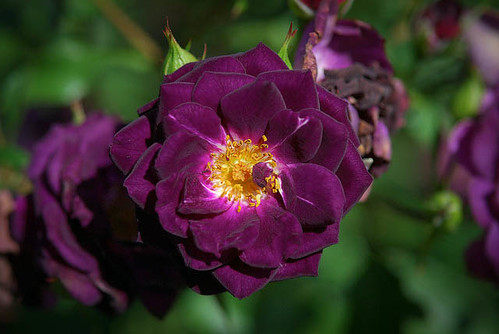
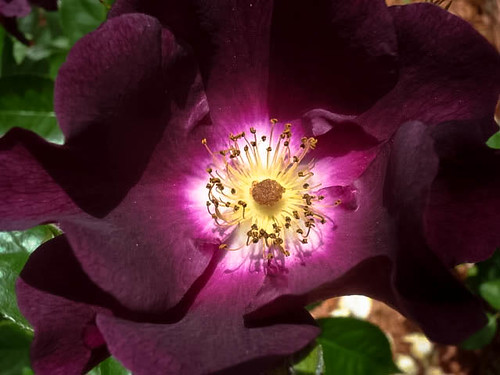
I’ve never found one for sale in a nursery, though they do sell a few that come quite close online. Short of ordering one of these bare-root babies, I think the only way to have my own is to work up the courage to knock on the door of one of the granny-ladies in my neighborhood who’ve been growing them for decades and beg for a cutting. One day I’ll figure out the spell to get them to root, and my garden will be tangled with heady blossoms.
I do have a beautiful Basye’s Purple in a pot, a birthday gift that came from the Antique Rose Emporium in Brenham, Texas. If it were combined with a Night Owl and perhaps a Midnight Blue, I think it would be the rose I see in my dreams, my mother’s rose.
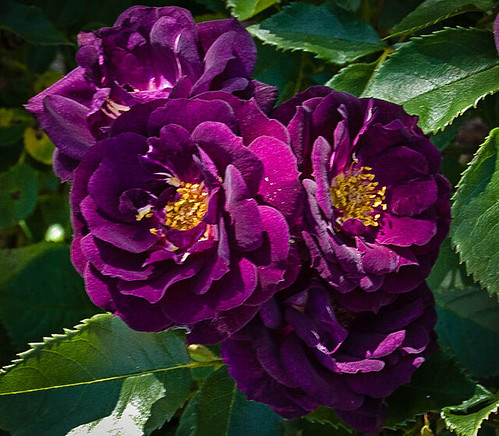
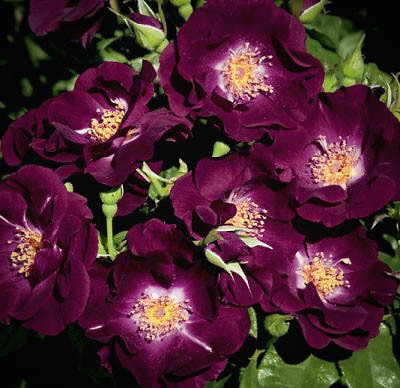
And what would such a rose smell like? Well, certainly not like your grandma’s tea rose sachets, oh no – this is a far more exotic and intoxicating aroma. Imagine smelling a color, breathing it in deep and holding all that richness in your lungs. A spicy earthiness that threatens to cause swooning. A dangerous rose. For years, I imagined what I thought a rose perfume ought to smell like, and was continuously dismayed to find only prim and proper pink roses, powdery and cloying.
I wanted to smell crimson red, burgundy, mulberry scarlet – I wanted to smell tempestuous, dark and somewhat peculiar. I think I’ve finally found what I was looking for in L’Artisan’s Voleur de Roses, described as “The brutal yet tender collision of rose and patchouli. It captures the chaos of a rose garden shattered by a thunderstorm.”
“Michel Almairac created Voleur de Roses (French for “rose thief”) in 1993. The L’Artisan Parfumeur website lists its notes simply as patchouli, rose, and plum. That sounds right to me. Voleur de Roses smells like a Syrah-soaked rose washed over with wet patchouli, moldering wood, and cold plum. The wet has an almost metallic edge, like the ocean. The fragrance’s patchouli is one of its main features, so if you don’t like patchouli, steer clear. Rose-phobes who do all right with patchouli might like Voleur de Roses. Its rose would be more at home at a dive bar than a garden party.
More than any other perfume I know, Voleur de Roses seems to elicit gothic descriptions. I’ve heard it compared to graveyards, dirty roots, and haunted basements. There is definitely something moody about the fragrance. Wuthering Heights’ Heathcliff might have worn it. Or, for a less lofty comparison, remember the turret organ room in The Ghost and Mr. Chicken? (Even Bon Ami couldn’t get rid of the blood stains on the organ’s keys, the ladies’ psychic society said.) It had to smell of Voleur de Roses.”
– L’Artisan Parfumeur Voleur de Roses – a fragrance review from NST
In my mind, Voleur de Roses evokes a bandit with flashing eyes, who kidnaps (consensually, natch) his rose, a lady fair clothed in red silk. She faints beneath his road-dusty cloak, dank with earthy patchouli and sweat, coming to in his arms, nestled a thorny grotto made from rose boughs. A wet garden dripping after the storm, strewn with fallen fruit and scattered petals ground into the damp dirt.
Imagine kissing your dashing lover underneath the brambles, and pausing only to feed each other over-ripe jammy plums. Sticky fingers with dirt beneath the nails winding through dark locks, grazing flushed skin striped bloody from rosy kisses. Perhaps that’s a bit extravagant, but Voleur de Roses is that kind of perfume: seriously seducing, yet playfully – slightly nasty in a faun-like way. This is what a very refined satyr might smell like, were his goat’s horns draped with a garland of stolen roses. Not your grandmother’s kind of rose at all. Or my mother’s, really – but it’s a perfect scent for me, a gothic romantic to the core.
I haven’t yet smelled it, but another perfume that might tango well with my dark dream of a perfect rose is L’Arte di Gucci . My friend Barbara Herman, (writer of a brilliant book about vintage perfume, Scent and Subversion) describes it tantalizingly:
“A dark, leather-patchouli rose, L’Arte di Gucci has a cult following among certain perfume lovers, and after hearing them sing its praises, I had to see what was up.
Black, inky and goth, L’Arte di Gucci is an Edward Gorey-esque animalic-rose chypre. In my fevered imagination, its rose comes from the rose bushes surrounding the dilapidated and haunted Victorian home of Merricat, the witchy protagonist from Shirley Jackson’s We Have Always Lived in the Castle. (On a less literary romantic note, it first brought to mind Calvin Klein’s 2005 perfume Euphoria, a spicy, woody floral that also has “exotic” flowers and notes: rose hips, Japanese apple, green leaves, Lotus, black orchid, red woods, black violet and amber.) L’Arte is definitely the darker — and more beautiful — of the two. As L’Arte di Gucci dries down, the rose just radiates from its dark lair lined with leather, vetiver, musk and oakmoss, the patchouli prominent throughout.”
Digging around the archives of Barbara’s incredible perfume blog, Yesterday’s Perfume, my curiosity was also piqued by a far subtler rose, Ombre Rose by Brosseau:
“Ombre Rose can be translated literally as “pink shadow” or figuratively as a rose’s shadow. Both readings suggest that the rose scent in this Françoise Caron-composed perfume will be softened, and we will smell its shadow rather than rose straight on. Shadows cast darkness over things, shrouding them and making them mysterious and maybe even sinister. But pink shadows? Not exactly intimidating!”
Barbara just passed through Austin on a mini-book tour, and did a reading from Scent and Subversion at Coco Coquette, where a roomful of perfume enthusiasts were kept rapt by her tales of scents from days of yore.
Read more about her work here:
From NPR’s All Things Considered: Perfume’s Scents Of Subversion? Sweat, Musk And Patchouli
From The NEW YORKER: HOW TO SMELL – A Review of Barbara Herman’s Scent and Subversion
A Whiff on the Wild Side: Confessions of a Vintage Perfume Addict
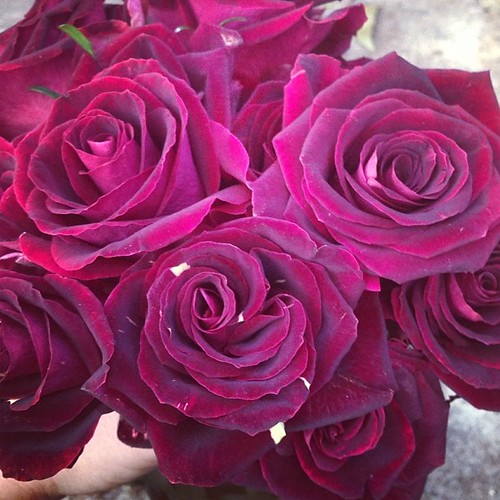
I love these velvety, witchy roses. They’re called HOCUS POCUS! Very apt.
Odd little creamy freckles on dark petals. The odder the rose, the better.
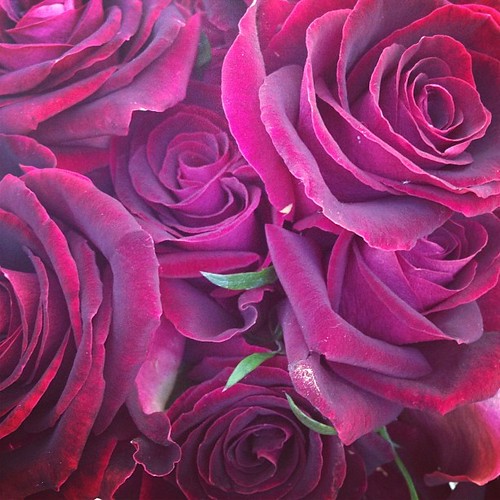
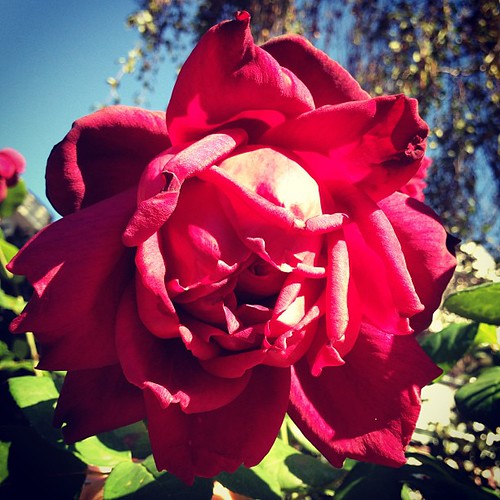
This rose was just bonkers. It smelled like blackcurrant wine & spiderwebs.
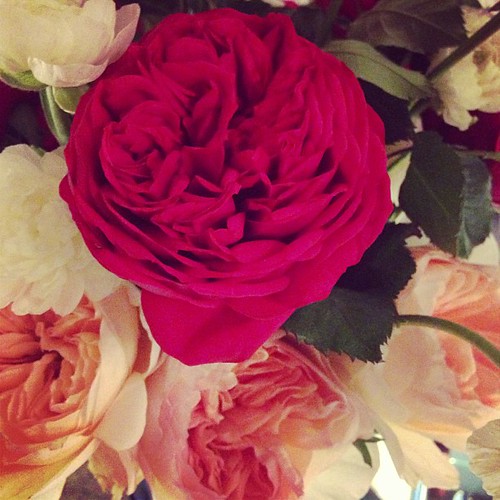
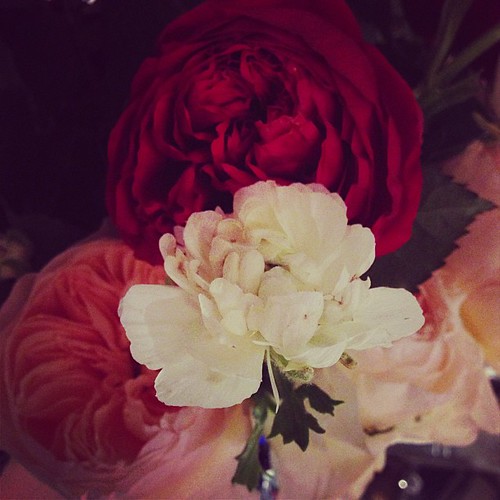
Along the way in my search for the perfect rose perfume, I found this helpful list: 25 Rose Fragrances Every Perfumista Should Try. The only one I’ve tried on it is Jo Malone’s Red Roses, which caught my attention when I smelled it on a chic lady shopping for antiques. It does smell red to me, a little – just not quite red enough.
Sa majesté la rose and Rose de Nuit both by Serge Lutens do tempt me, as does his La fille de Berlin.
Rose de Nuit:
“It repeats the rose theme in the base, suggesting its smooth, satiny touch, but never offering the full view. Like glimpsing into the dark room through the carved screens, one is left to imagine the rose that is hiding under the layers of woods and amber. Yet, whether those veils conceal a lover or a flower is a mystery that Rose de Nuit never answers with certainty.”
– from Bois de Jasmin
La fille de Berlin:
“It’s a deep red rose that dries down to a lusty animalic drydown and takes you on a whirlwind journey along the way. I love its explosion of crimson rose petals, which smell almost sinfully rich with their hint of overripe blackberries. (In the less poetic industry parlance, it’s called smelling money–a rose like that requires a generous budget.) Just like some roses can smell of violet, La Fille de Berlin takes a turn towards dark, jammy violets, making a small nod towards Bois de Violette.
…the scent was about finding beauty in the darkness and persevering through adversity with strength and humor, as women in postwar Germany had to do, when they were as plundered as their cities by occupying forces meant to restore order. This story is movingly told in the anonymous best-selling autobiographical book titled “A Woman in Berlin,” clearly an influence.
“Beauty is the moment when you rise up. It is the moment when you pick up your head, stride through your own ruins, and climb up the mountain,” explained Lutens. “That’s La Fille de Berlin. We all have our own ruins.”
– from Bois de Jasmin
I’d also love to try Wild Roses from Aftelier Perfumes:
“I wanted to capture in perfume the experience of walking around my garden and smelling each rose, as their perfumes blended in my nose. Wild Roses perfume evokes the garden in our imagination and memory — the book of a hundred petals unfolding: balsamic, spicy, apricot, and honeyed roses, mixed with the smell of warm earth and herbs.
The apricot-rose heart is perfectly rooted in a base of tarragon absolute — its herbal round anise aroma giving a nuance of both earth and leaves. The balsamic vanilla absolute and the whiskey-ness of aged patchouli support tarragon’s warm, powdery aspect. Indole contributes the almost animal aspect of ripeness in a rose. The heart is punctuated by pimento berry, lending its nuances of clove, ginger, and cinnamon. The candied-orange flower aroma of methyl methyl anthranilate, the soft powdery floral of heliotropin, and the slightly floral citrus of bergamot contribute a modern freshness to the opening.”
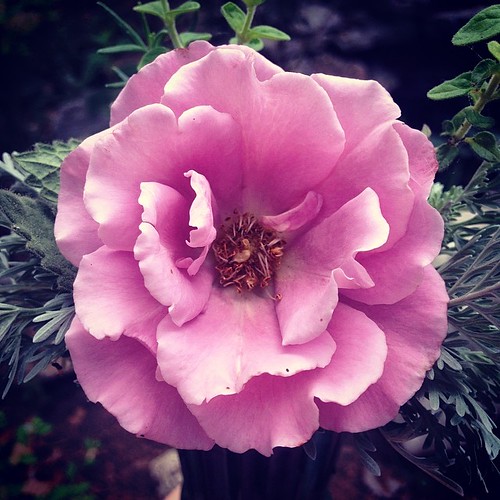
I did originally plant this rose just because it’s called “Angelface” – but it has turned out to be one of the sweetest smelling in my garden…
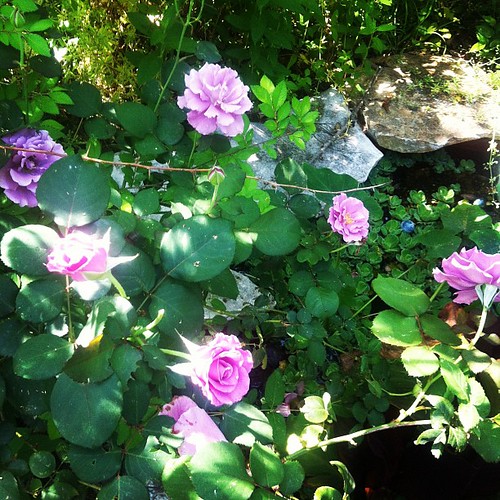
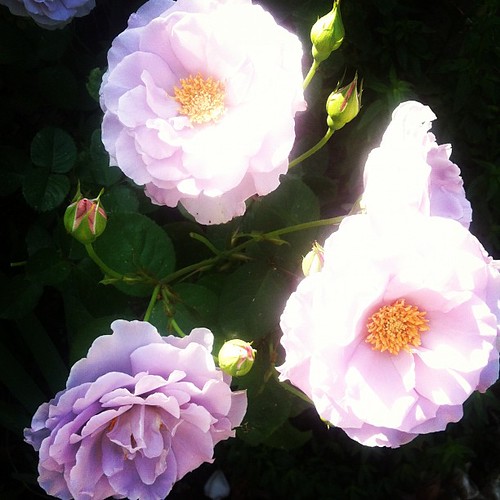
Violetta’s Dead Baby Girl roses
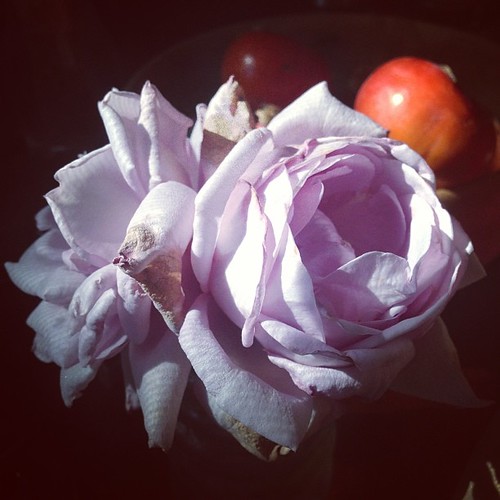
Even in a state of decay, these roses captivate me. The gorgeous autumn roses busting out everywhere are fueling my fixation…
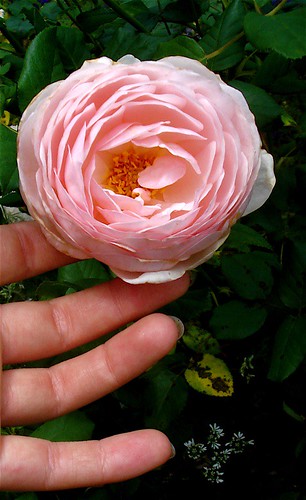
I made a music mix in honor of my rose obsession: Ashes of Roses – Music for burning rose petals on gray days. A soundtrack for burying your nose in a rose.
IN YOU THE EARTH
Little
rose,
roselet,
at times,
tiny and naked,
it seems
as though you would fit
in one of my hands,
as though I’ll clasp you like this
and carry you to my mouth,
but
suddenly
my feet touch your feet and my mouth your lips:
you have grown,
your shoulders rise like two hills,
your breasts wander over my breast,
my arm scarcely manages to encircle the thin
new-moon line of your waist:
in love you have loosened yourself like sea water:
I can scarcely measure the sky’s most spacious eyes
and I lean down to your mouth to kiss the earth.
― Pablo Neruda
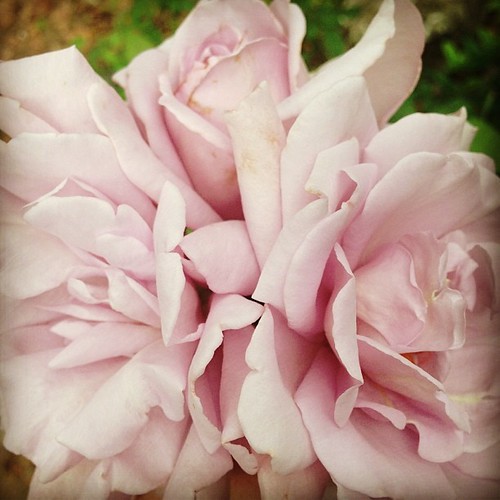
This was written in honor of tonight’s Full Rose Moon.
To read last year’s moon honoring, please follow:
SUMMER SOLSTICE – STRAWBERRY ROSE MOON
More writing about perfume:
L’AUTRE – Exotic Autumn Perfumes
AUTUMNAL PERFUMES
SPRINGTIME SCENTS
ENDLESS SUMMER – Summer Perfumes
SUPRISES + SUCHLIKE – Coeur de Vétiver Sacré
MAGIC WINDOWS #12 – Iris Perfumes
COLD WINTER MOON, SOLSTICE BLUE – Winter Solstice Perfumes
WINTER SOLSTICE – MESSE DE MINUIT
WINTER SOLSTICE – DARK SEASON
Beltane Vivification
by angeliska on May 1, 2014
Today is Beltane, the first day of May, and the world is bright and beautiful – at least, it is from where I’m sitting. Out my window, climbing roses twine over the gate, and my garden is coming along nicely with vegetables, flowers and herbs. My fruit trees were heavy with blossom, now heavy with ripening fruit. I took today to come back into my body – something I’ve been neglecting for far too long. Sometimes it feels like a lifelong habit, an ingrained way of being: my consciousness relegated to a balloon or bubble that floats above my corporeal form on an invisible tether. I learned how to disassociate early, as a young child, as a coping mechanism. To just go away from the intolerable here and now becomes so easy… How much better, just to drift… But, now, I want to come back, come back to earth, to my body, my pulse, my breath. The joy of movement, and the affirmation of what it is to be alive, to be truly human. I want to stay in my body, and to utilize it for all the wondrous purposes it was made for. Not just the basic tasks of getting from here to there, eating and digestion, sleeping and rising, propping one’s self up and simple ambulation – but to dance, to leap, to push further and harder and more joyously! I was raised to be sedentary, to be still – always reading and writing, but rarely moving around unless forced to. I woke up one night with a worrying thought about how much longer I might have on this planet, in this body. I intend to live long enough to be a very, very old woman – but you never do know, and anyway: if I do live that long, I’d like to be relatively fit, and have joints and muscles and things that actually function properly. So I’ve been trying. Back to walking around the lake, to yoga and dance classes, to remembering to breathe. I get furious sometimes when I hear people complain of being bored. It makes me want to slap them! How dare you get bored with this incredible life? My mother always told me that only boring people get bored, when I used to complain to her of ennui. I took her words to heart, and learned to live by them. My mother died of cancer long before her time, and I know for certain that she never got to do all the things she wanted to in this life. When I think of all the places I want to go and see, the books I want to read, the songs and instruments and languages and skills I want to learn, the people I want to meet, the foods I want to eat – well, it makes me want to live forever and never sleep. Never waste a day, a drop of life on being bored, on whining, on endless scrolling through the annals of the internet, on laziness. These words are an exhortation, an invocation, a vivification – to myself as much as to anyone reading this. When you are done here, with this little corner of life, these words and songs and pictures, promise me that you’ll go away from your computer, even just for a minute. I promise to do the same, to do all of this. Go outside. Stretch your arms up towards the heavens. Kick your shoes off and dig your toes into the dirt. Do a little dance. No one is watching. Or even if they are, it doesn’t matter. It doesn’t have to take long, or, you can take as long as you like. But go outside and look around. Breathe deep, and welcome the fire back into your body. Come back to life, to your life. There is only this one time to experience it in just this way – so, dance while ye may!
Vivication from Rachel Gutknecht on Vimeo.
“When everything seems like it is over, one must only try a wee bit harder to find the beauty. We are very lucky to just be alive.” This little film is a very good reminder.
“Death is always on the way, but the fact that you don’t know when it will arrive seems to take away from the finiteness of life. It’s that terrible precision that we hate so much. But because we don’t know, we get to think of life as an inexhaustible well. Yet everything happens a certain number of times, and a very small number, really. How many more times will you remember a certain afternoon of your childhood, some afternoon that’s so deeply a part of your being that you can’t even conceive of your life without it? Perhaps four or five times more. Perhaps not even. How many more times will you watch the full moon rise? Perhaps twenty. And yet it all seems limitless.”
― Paul Bowles, The Sheltering Sky
“Someone said that thirty was a significant birthday, and everyone around the table agreed. Someone else said it was the first time you heard the bell.
What bell? someone asked.
But they all knew what bell. It was like you’d already completed a few laps, observed another, but this was the first time you’d properly heard the bell. There had been one at seven, but you hadn’t heard it because you were so young; and then one at fourteen but you hadn’t heard it because you were too busy looking over your shoulder; then another at twenty-one but you hadn’t heard it because you were too busy talking; and then one at twenty-eight which for some reason took two years before you heard it. But they all agreed you did hear that one, eventually.
Your lousy career, said one guest. Babies, said one of the women. Lovers, friends, travel, said another. Parents aging. Bong. All the things you hadn’t done. Might not do. Bong.”
― Graham Joyce, The Silent Land
“To the Virgins, to Make Much of Time” is a poem written by Robert Herrick in the 17th century. The poem is in the genre of carpe diem, Latin for seize the day. It goes as follows:
Gather ye rosebuds while ye may,
Old time is still a-flying;
And this same flower that smiles today
Tomorrow will be dying.
The glorious lamp of heaven the sun,
The higher he’s a-getting,
The sooner will his race be run,
And nearer he’s to setting.
That age is best which is the first,
When youth and blood are warmer;
But being spent, the worse, and worst
Times still succeed the former.
Then be not coy, but use your time,
And, while ye may, go marry;
For, having lost but once your prime,
You may forever tarry.

Gather Ye Rosebuds While Ye May, John William Waterhouse – 1908

Gather Ye Rosebuds While Ye May, John William Waterhouse – 1909
In a little bit, I will go make ready for a small ceremony welcoming in the May, with a bel-fire, flower garlands, and traditional songs and ritual. No maypole yet this year, but one day I shall have one – and we shall sing the Summerisle song and Hal-an-tow and weave the sacred phallus tree all with ribbons and crown it with the Queen of May’s flower garland!
Maypole Dance (The Wicker Man 1973) from Artem Tyurin on Vimeo.
If you’ve never seen the original Wicker Man (hush, we shall never speak of the remake…) I suggest you hie yourself to a video store and remedy that! It is a folk-horror classic! I love this exchange between the square copper and the suave Lord Summerisle, (played by Christopher Lee!)
Sergeant Howie: Your lordship seems strangely… unconcerned.
Lord Summerisle: Well I’m confident your suspicions are wrong, Sergeant. We don’t commit murder here. We’re a deeply religious people.
Sergeant Howie: Religious? With ruined churches, no ministers, no priests… and children dancing naked!
Lord Summerisle: They do love their divinity lessons.
Sergeant Howie: [outraged] But they are… are *naked*!
Lord Summerisle: Naturally! It’s much too dangerous to jump through the fire with your clothes on!
Sergeant Howie: What religion can they possibly be learning jumping over bonfires?
Lord Summerisle: Parthenogenesis.
Sergeant Howie: What?
Lord Summerisle: Literally, as Miss Rose would doubtless say in her assiduous way, reproduction without sexual union.
Sergeant Howie: Oh, what is all this? I mean, you’ve got fake biology, fake religion… Sir, have these children never heard of Jesus?
Lord Summerisle: Himself the son of a virgin, impregnated, I believe, by a ghost…
Lord Summerisle: [singing] Summer is icumen in, loudly sing cuckoo. Grows the seed and blows the mead, and springs the wood anew. Sing, cuckoo! Ewe bleats harshly after lamb, cows after calves make moo.
Mediaeval Baebes – Summerisle (The Maypole Song)


A springtime wedding procession of the sistren bridesmaids – from Dana Sherwood and Mark Dion‘s wedding in a beautiful New Orleans cemetery, which I had the honor of officiating.
Wedding at Lafayette Cemetery, 2008, NOLA – photograph by Dawn Martin McFall
I loved this piece on honoring the sacred holiday by Byron Ballard:
“I love Beltane. I often say that it is always Beltane in my heart. Which is not quite true because it is also often Samhain in my heart these days, as we lurch through this Grand Cross thingy and this Tower Time.
But I relish the history of Beltane and the trappings and the way it was so stealthy going from a lusty Pagan rite to the perfectly lovely May Day of the Victorians. All pretty dresses and flower crowns. And now we try to manage a bit of both, as we can.
When my daughter was in elementary school, many of the teachers would put up a maypole in the school yard and celebrate the May. I came into several classes each year and taught them about the transition from Beltane to May Day. We’d have little cakes and sing songs. We’d go outside and wash our faces in the morning dew and then dance the circle round. It was always a bit of a challenge to get us going in the right direction but we got pretty good at it after all those years.
Beltane is almost here and it is time to think of maying, going a-maying. The apple trees on our land are in full blossom right now and that puts me in mind of hawthorn blossom.
Sorry, reverie.
If you have littles, you can teach them the bright activity of making May baskets out of cornets of paper with a pretty ribbon handles. Fill them with flowers from the yard and take them to your good neighbors or to your Gran. Come home to wash your face in that fresh dew to guarantee your perpetual good looks. Eat fruits for breakfast–strawberries and razzleberries and blueberries with cream.
Dress for the day in something light and summery.
Wear a flower crown, even if you are going to work.
Wear glitter, and ditto.
Give flowers to people you don’t know.
Find time to dance the Great Ring with a few or with many. With or without a maypole.
Whistle a tune.
Remember Thomas Morton and the utopia of Merrymount.
In the evening, if you are old enough, have a cold glass of Maywine and toast the new life of the season and the old life you are living.
Sleep near a faery mound that night.
Give yourself over to the greening of the year and the brightening of the light. For the holy day after Beltane is Midsummer and after that…the Long Dying of the Year commences. Again. And we begin to wind down the path that leads inevitably to Samhain.
So soon it comes. And Spring is tardy in making Her appearance this year.
We fight against the destruction and dishonesty by embracing the living Earth that we’ve been given. Let Beltane this year bring you home to the comfort and joy of that.
And, as always, fear not. Fear not.”
– Byron Ballard, from The Village Witch
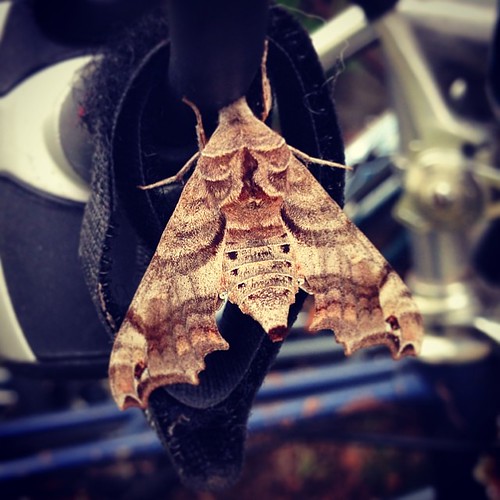
Moth friend resting on my bike lock… Harbinger of transformations.
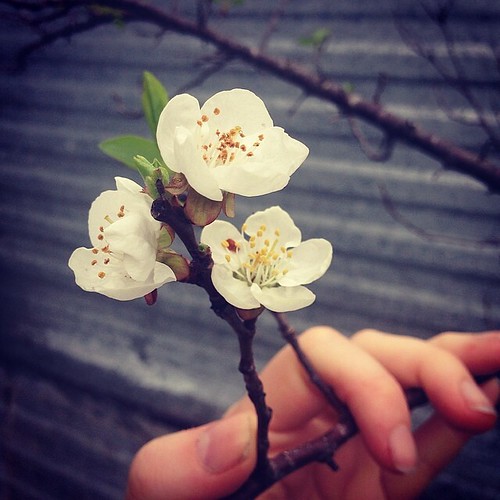
Hello, apricot tree! I totally thought you were dead – but no! One of my favorite things about spring is walking around making discoveries in my garden – seeing what survived the brutal summer and long winter freezes… To survive in my garden, you gotta be tough and hardy – the survivors stick it out and inspire me endlessly…
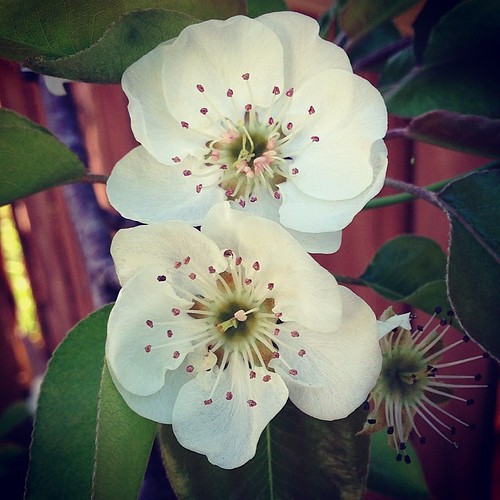
Pearblossoms.
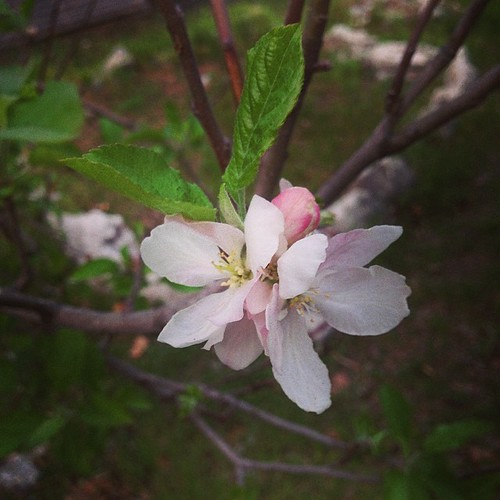
Appleblossoms.
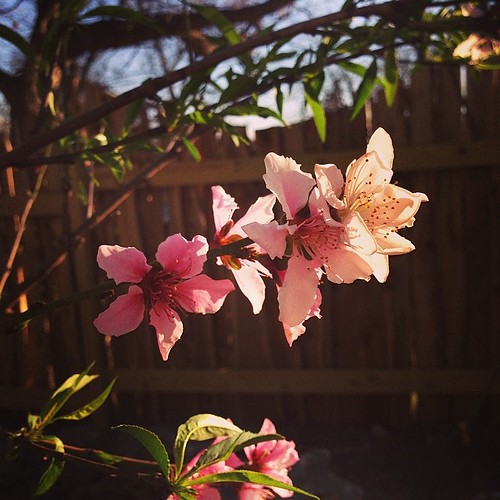
Peachblossoms.
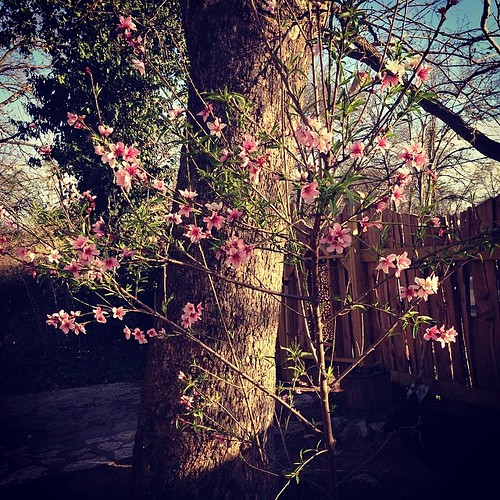
I have three peach trees, but this little volunteer is the happiest one! It grew from an errant pit, and is now twice the size of its older siblings.
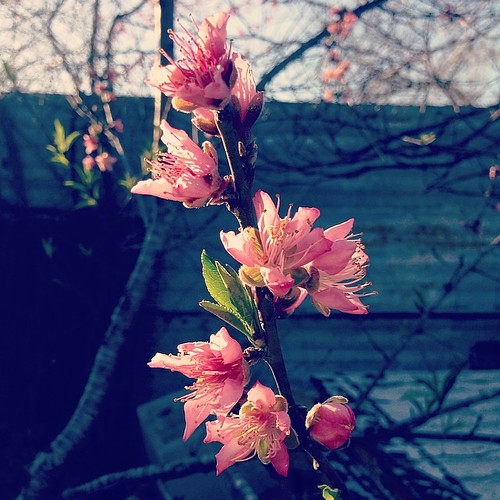
The nectarine blossoms are out in full force. I hope your May Day is glorious and filled with singing and dancing!
Beltanes and moons of yore:
BELTANE FIRE – PINK MOON
FULL MOON IN SCORPIO
FLORALIA
LA REINE MASQUÉE DE MAI
Mysterious Wisteria – The Awakening
by angeliska on April 29, 2014
I’ve been saying it over and over for the past few weeks now: I feel like I’ve woken up from a strange dream. Or more, it’s like waking up from a dream within a dream within a dream – never feeling quite sure if you’re really awake this time for certain. Coming back to myself has required a slow journey inward, a reeling in of all my webs, my loose threads, tying knots in some, severing others. Cycles of neglect spawn forgotten rooms, like those ones I still dream about sometimes: a dim place long unvisited, coated with thick swags of velvety dust. In order to nurture these corners long forgotten, others fall by the wayside: including and especially this one. So I brush it off, attempt to sidle my way back in and put things back in order. This is where I’m at. Simultaneously, there’s been a spring: a glorious, long chilly spring unlike anything we’ve seen down in these parts for quite awhile. Ever since gaining a garden, this has become my favorite season – spurning autumn’s fires for pale shoots and tender budding. Though for at least the third year in a row, I’ve found myself gripped by a strange malaise, an ennui of sorts that makes it difficult to want to do anything much at all. I’m slow to wake up, in the mornings – slow to rise out of my cave from a long hibernation. I guess that’s it. I am trying, though – forcing the chrysalis, squeezing the bud in efforts to get the green sap to rise and get flowing again. Uncharacteristically, I’ve not been much in a reading mood of late, which feels very strange indeed – though I did finally read Kate Chopin’s The Awakening, and loved it very much. In lieu of explaining anything more, I’ve chosen passages (in italics) from her marvelous novella, which seem to to a far better job of illustrating my current state. A strange brooding amidst a riot of lavender blossoms, a heart by turns hopeful and heavy, a turning, a lovely limen.
“She went and stood at an open window and looked out upon the deep tangle of the garden below. All the mystery and witchery of the night seemed to have gathered there amid the perfumes and the dusky and torturous outlines of flowers and foliage. She was seeking herself and finding herself in just such sweet, half-darkness which met her moods.”
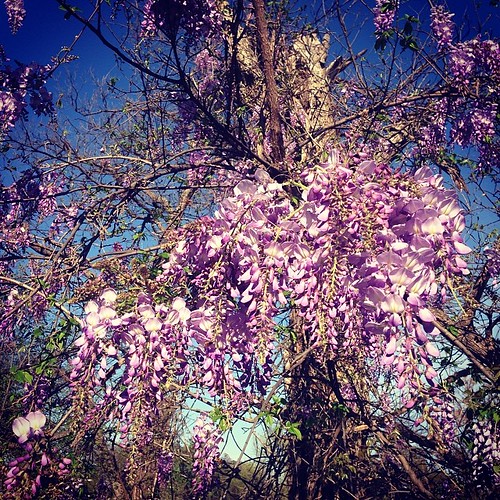
Lavender cascades of it tangling in the branches, alive with squadrons of bees…
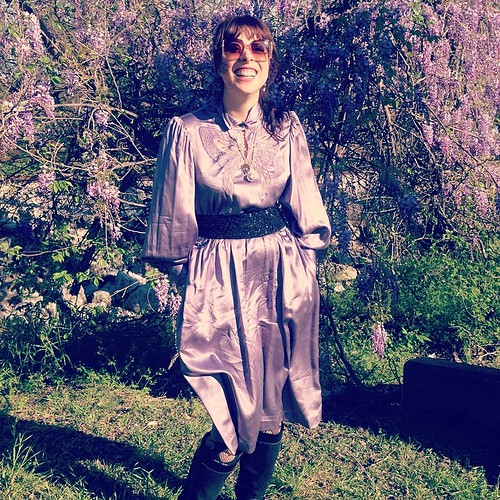
Wisteria makes me very giddy! Also, I’ve decided that since I’m such a grown up person now, that I ought really wear more things made of silk. And so, this vintage Chinese butterfly dress, which also makes me a little giddy…
“There were days when she was very happy without knowing why. She was happy to be alive and breathing, when her whole being seemed to be one with the sunlight, the color, the odors, the luxuriant warmth of some perfect Southern day. She liked then to wander alone into strange and unfamiliar places. She discovered many a sunny, sleepy corner, fashioned to dream in. And she found it good to dream and to be alone and unmolested.
There were days when she was unhappy, she did not know why — when it did not seem worthwhile to be glad or sorry, to be alive or dead; when life appeared to her like a grotesque pandemonium and humanity like worms struggling blindly toward inevitable annihilation.”
“She was becoming herself and daily casting aside that fictitious self which we assume like a garment with which to appear before the world.”
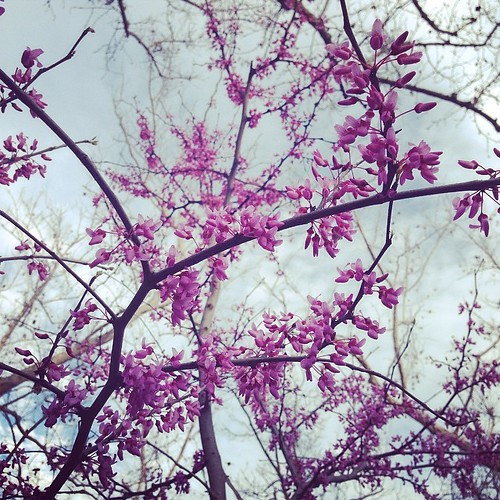
Redbud bumblebee wonderland
“But the beginning of things, of a world especially, is necessarily vague, chaotic, and exceedingly disturbing. How few of us ever emerge from such beginning! How many souls perish in its tumult! The voice of the sea is seductive; never ceasing, whispering, clamoring, murmuring, inviting the soul to wander for a spell in abysses of solitude; to lose itself in mazes of inward contemplation.
The voice of the sea speaks to the soul. The touch of the sea is sensuous, enfolding the body in its soft, close embrace.”
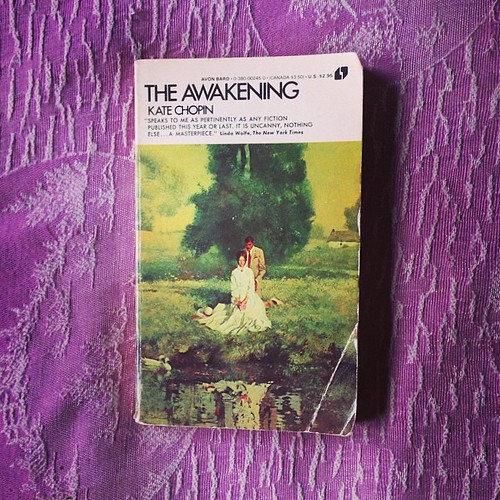
“There was the hum of bees, and the musky odor of pinks filled the air.”

So many miracles great & small are occurring lately… Today I found the first ring I ever made, lost years ago! Chrysoprase with silver kitty heads. It was laying in the dirt, perhaps formerly obscured by a rain barrel. I had just assumed it was lost forever.
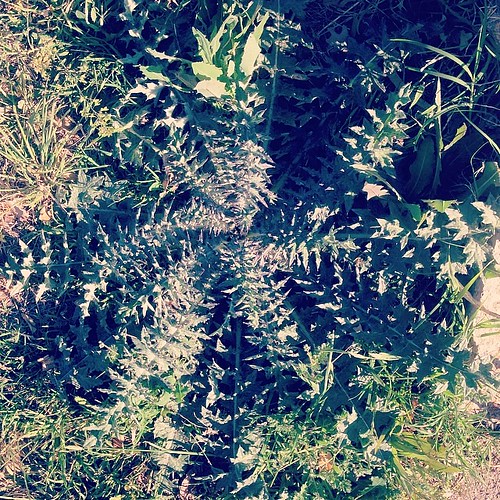
Dandelion fractal.
“Some people are born with a vital and responsive energy. It not only enables them to keep abreast of the times; it qualifies them to furnish in their own personality a good bit of the motive power to the mad pace. They are fortunate beings. They do not need to apprehend the significance of things. They do not grow weary nor miss step, nor do they fall out of rank and sink by the wayside to be left contemplating the moving procession.
Ah! that moving procession that has left me by the road-side! Its fantastic colors are more brilliant and beautiful than the sun on the undulating waters. What matter if souls and bodies are failing beneath the feet of the ever-pressing multitude! It moves with the majestic rhythm of the spheres. Its discordant clashes sweep upward in one harmonious tone that blends with the music of other worlds — to complete God’s orchestra.
It is greater than the stars — that moving procession of human energy; greater than the palpitating earth and the things growing thereon. Oh! I could weep at being left by the wayside; left with the grass and the clouds and a few dumb animals. True, I feel at home in the society of these symbols of life’s immutability. In the procession I should feel the crushing feet, the clashing discords, the ruthless hands and stifling breath. I could not hear the rhythm of the march.
Salve! ye dumb hearts. Let us be still and wait by the roadside.”
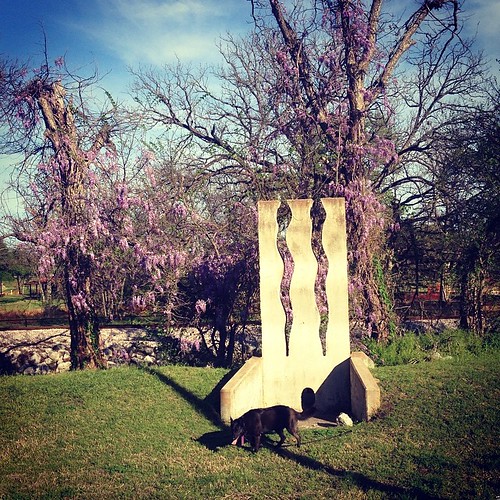
This place. Stone snakes. Garlands. My black dog. Joy in my heart.
“Even as a child she had lived her own small life within herself. At a very early period she had apprehended instinctively the dual life – that outward existence which conforms, the inward life which questions.”

“She had tried to forget him, realizing the inutility of remembering. But the thought of him was like an obsession, ever pressing itself upon her. It was not that she dwelt upon details of their acquaintance, or recalled in any special or peculiar way his personality; it was his being, his existence, which dominated her thought, fading sometimes as if it would melt into the mist of the forgotten, reviving again with an intensity which filled her with an incomprehensible longing.”
“Who can tell what metals the gods use in forging the subtle bond which we call sympathy, which we might as well call love.”
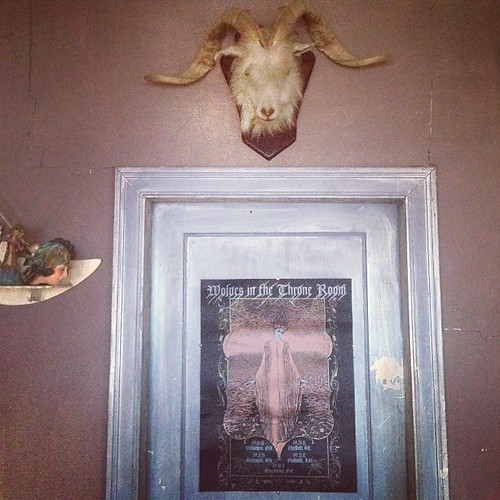
My bedroom door. Soon, this will no longer be my bedroom – I’ll have a new room, and it will be wondrous and strange.
“…a tangle of sea smell and of weeds and damp, new-plowed earth, mingled with the heavy perfumes of white blossoms somewhere near, but the night sat lightly upon the sea and the land. There was no weight of darkness, there were no shadows. The white light of the moon had fallen upon the world like the mystery and the softness of sleep.”
One Hundred Years
by angeliska on January 19, 2014
Today, my beloved grandfather would have been 100 years old, were he still alive today. I had hoped that he would make it there in life – he was so close! Only two years to go! But he was ready, I think, to not be here in his body anymore. Still though – the glory of making it to centenarian status seems so impossible and marvelous. I stand stupid and humbled in front of a big number like one hundred. A century, the triple digits! What a marvel that humans can and do live now regularly, to be so ancient – and longer. For me, selfishly, it’s more about longing to have had him present over the course of these past two years. I feel like I’ve needed him and his sage wisdom now more than ever. His sister Dena died in November (I’ll be sharing what I’ve written about her amazing life soon!), and now all four of the Polacheck siblings from that generation are gone.
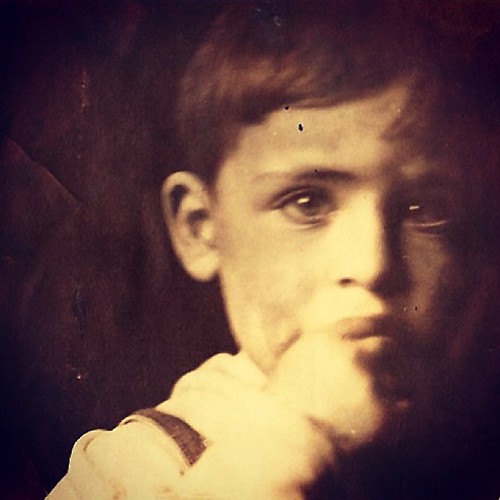
Charlie was child born in the year of the Great War, into a century of bloodshed and bombings hopelessly intertwined with relentless progress. Journalists and historians are currently struggling to draw parallels between 1914 and 2014 – predicting more dire change and global war, disaster. It’s hard to refute it, or to imagine that we could go on as relatively blithely (at least in this country) as we do. I feel like this day deserves some grander gesture than I am capable of: fanfare and fireworks and a parade in his honor. I feel like I have nothing. My hands are full of dust. His body is burnt up, and everything he ever owned is either in boxes in my parent’s garage or dispersed here and there. Elsewhere. Where is the hat I gave him? It was a good tan leather fisherman’s cap, with a slate blue brim ribbon, brocaded with acorns and oak leaves. I am his acorn, he was my tree. It doesn’t fit me, but I’d love to have it now – smelling of lime leaves, his gone-white hair, dusted with dear dandruff. He used to wear it all the time. It kills me that he’s gone, and that all the pieces of his life are scattered. Where are his ashes? Where are my grandmother’s ashes? We had talked about going out to the Pacific Ocean, and scattering them together. But, everyone has schedules, work, kids, stuff, so it hasn’t happened yet, as far as I know.
We don’t bury our dead anymore, and I think for the most part, that this is a good thing – considering the vagaries of the funeral industry and the poison and waste that embalming and lead coffins create. But our cemeteries are standing forlorn, as we dump the dirt of our loved ones onto some pretty place they might once have walked near. We have no monuments to them to sit and reflect by. No dates engraved, no family names. Dust to dust. We are forgetting, collectively, where and who we came from. Names are not passed down from generation to generation as they once were. Hell, we don’t even use cameras anymore, really – much less print photos or have formal portraits taken, unless someone’s getting married. That’s what has changed in one hundred years: how we mourn, how we remember, how we perceive ourselves in relation to our past. So much of it is just sloughed off to languish in moldy storage units or attics, or be pawed through at estate sales.
I should know, being a professional picker (antique dealer). I was in a woman’s house this morning, low ceilinged, small, but labyrinthine. As I fingered the silk blouses in her closet, her spirit clung around me like a miasma: mama, grandma, wife – I was all of these, and now I’m nothing. You don’t even know my name. At these sales, invariably, in the front yard there are always one or several adult potty chairs. Dragged out into the open, as if someone would actually want to buy an old person’s used potty chair. Who knows, maybe people do buy them – but it just seems so wrong and undignified to not only open their home to strangers, but also to put the personal secrets of their infirmity right there on the lawn. I bought her church lady hats, her cocktail glasses with gold horses prancing on them, a patriotic costume, a stunning gold lace dress from the 20’s and a photo of the woman who might have worn it. I left still feeling her long fingers clutching at my hair, calling: come back, come back and see me…
“We must rapidly begin the shift from a “thing-oriented” society to a “person-oriented” society. When machines and computers, profit motives and property rights are considered more important than people, the giant triplets of racism, materialism, and militarism are incapable of being conquered.” – Martin Luther King

Happy 100th birthday, Grampa. I sure do love you.
So much has changed since 1914, it’s bizarre to think about being alive to see it all. I’d grill Grampa from time to time – try and ask him what it was like to witness so much change, growth, development. Of course it’s somewhat egotistical to think so, but it really feels like EVERYTHING happened to us this century – and to watch it all occur first hand just seems an utter wonder to me. From horsecarts and button up boots, to space travel and iPhones. Grampa was oddly blasé about it. He said he didn’t think about it, much. I think he liked all the progress, all the ease that was afforded with new inventions that made life run faster, smoother. He was delighted to watch a tiny video of a friend of mine dancing the Charleston in 1920’s gladrags on youtube, as I held my phone up so he could watch it in bed. He found nothing strange or ironic about that, but I did. I guess him being a television pioneer had a lot to do with it – going from radio to live television, black and white to color, analogue to digital. Always new, always better. My grandfather seemed only to really get nostalgic about times much more shrouded in the past – gazing at the cold light in the Flemish master’s painting in a museum in Bruges, or walking the boards in the King of Denmark’s own private theatre.
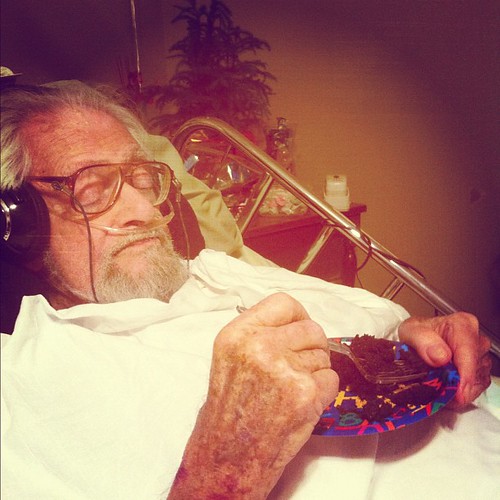
Grampa’s 98th birthday, his last one on earth, eating chocolate cake.
This is all the stuff I’ve been thinking about, lately. It’s not pretty, or happy, and I wish I had better. Today, everything seemed to go wrong. Crossed wires, lines of communication failing spectacularly every which way. Everything slightly askew, the picture gone crooked in the frame, the flavors of everything I tasted strangely off. I feel like I said all of the wrong things and none of the right things – even though I know it’s not true. I tried my best, and it wasn’t what I wanted it to be. I felt myself losing my footing, sinking into the muck of swampy quicksand, the alligator’s jaws visible out of the corner of my eye – and yet, I couldn’t stop the slow slide down into the thick of it. My grandfather’s birthday dim sum is the only traditional celebration my family has – the only day where all of us are together. Usually, it’s a somewhat chaotic, but amusing affair, and most of the peccadilloes of our meshuggeneh mishpoche are taken in stride along with slugs of jasmine tea from tiny cups and copious turnip cakes and dumplings. But today, it went awry – and it was my fault. I got into the muck when I ought to have nodded and smiled, and as I was doing it, I could hear Grampa’s gruff voice telling me, “Leave it alone! It’s not worth it!”
Getting into an argument right in front of his shrine, on his special day felt so wrong. Underneath all anger is sadness, and often it’s easier to get upset about the little things, rather than let ourselves feel the big hurts. I have been so torn up about missing him lately, crying a lot and just feeling his absence so intensely. It’s weird how all that emotion can get channelled into being upset about something else entirely. In some ways, it’s related – just in thinking about how he was the glue, the cornerstone of our family. The one who brought us all into being and kept us together. Without our patriarch present, it feels like there’s nothing to bind the unruly mess of us. Old family hurts, old woes. These things can have big echoes. The family member I got into it with broke the spell of our contretemps by grabbing me by the shoulders and shaking me while almost shouting, “Families are dysfunctional! Our family is dysfunctional! Get over it!” And she’s right.
Something that comes with age, at least in my Grampa’s case, is the wisdom that all families are imperfect. I hope I can start accepting that, because it hurts my heart so much. I am someone who always just wants everyone to get along, to be a big, happy, loving family. In these moments, I strain to hear his voice – to discern from the ether what exactly he would tell me, if he were here today… Maybe “easy does it”, which is an AA phrase I always mocked and scorned as hopelessly trite as a cynical teen, but only recently have heard in a new light. Maybe it was the way it was said, or the timing – but I think I finally got it. Go easy on yourself, be gentle, take it slow. You don’t have to get it right all the time. You are perfectly imperfect, and that is enough.
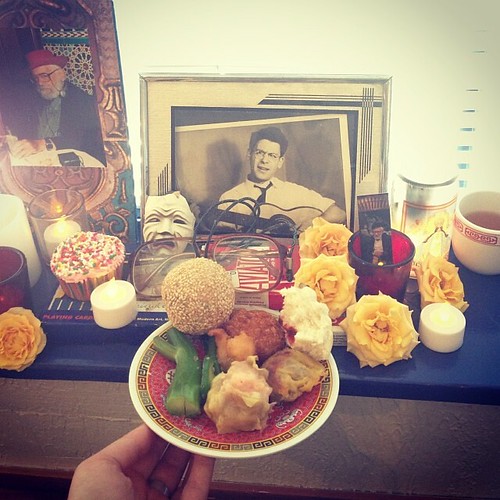
A friend of Grampa’s recently posted a comment on his obituary page that made me so happy. Hearing from his friends from all over is such a sweet gift, especially when they over little bits of his words and wisdom for me to hold close. These are some good ones:
“I did not know Charlie well in L.A. in the 1980s, but my beloved friend, Debra, and I still repeat some of his sage lines with laughter such as “MYOB” or “mind your own business” and “If your spouse says the moon is made of bleu cheese simply say, ‘It very well may be.’” When I asked how he had remained married for so many decades, was there a secret to be garnered, how did he do it? He said, “I let my spouse do whatever she wants and she the same for me.”
Here’s to you, Charlie! Wherever you are I know it’s good.”
I used to be afraid of old people when I was little. Not my own grandparents: all four of them I knew and loved, even if I was childishly fascinated at times by Gramma’s crepe papery forearm skin, or Grampy’s leathery face with it’s startlingly deep creases and wrinkles on top of wrinkles. Nonnie would always draw me close for a kiss, and when her whiskers brushed my cheek and I’d screech and giggle. I was so lucky to have them all – to be so cherished and accepted by my four elders. I only wish I’d had more time with them – that I had been older and they younger, so we could have had more conversations. But the old people in the nursing homes my elementary school would visit around Christmas were full of a different kind. These old folks were cast off, forgotten in corners by their families, the staff, themselves. None of them seemed lucid, though most were docile and still, save the old woman with applesauce down her chin who gaped at us and started shrieking when we attempted to sing her carols. I dropped my cowbell in the kerfuffle and was traumatized for weeks. Maybe longer.
There was something shocking to me about the idea that people would just ditch their parents and relatives in these places. It felt like coming across someone’s old toys tossed in a ravine. Why would anyone throw these good things away? You never picked them up to take home, though – because whoever did it surely had some kind of good reason. Maybe the toys were diseased, or cursed, or full of bugs or had touched poop. And I hate to say it, but there was that same sense of apprehensiveness about the nursing home residents: no one would have abandoned perfectly good old people if there wasn’t something horribly wrong with them. They were defective, insane, or maybe even criminals, considering the prison-like atmosphere of the rest-home. Kid logic, I guess. I think about the elderly a lot these days – how screwed we are as a society where we don’t value these people more.
When I started traveling with my grandfather, it was interesting to observe how people in difference countries and cultures reacted to us tootling around with a portable wheelchair. In some places, people seemed shocked, in others – indifferent. At times, we were treated with special deference – and in most Japanese restaurants, invariably, were shown a deep appreciation. The gift of my grandfather’s company throughout my life is a treasure that has changed me forever. Being able to know him, talk with him, travel with him, and to be his friend until the end of his life was so precious. I know all people are different, and that Charlie was certainly a rara avid and a true gem – but all the same, I can’t help of think that there are some ancient gems moldering away in rest-homes, ignored by their families. And that just kills me. I think about going there sometimes, and trying to seek out some wonderful old lonely person, who needs a grandkid as much as I crave a grandparent. I think I’m still a little scared.

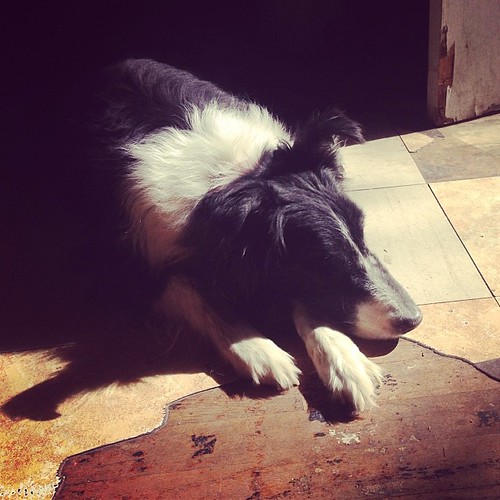
I have such a hard time not adopting elderly dogs from the animal rescue – wishing I could just give them a home where they could be loved and petted and sleep all day. I have had the honor of seeing two noble creatures through to advanced old age: my beloved feline companion Junior, who I had with me from age five until I was 26. He was 21 years old when he died. It was one of the hardest deaths I’ve ever mourned, and I still dream about him all the time. He was my familiar. Thelonious is my old man prince, whose company I have had the pleasure of keeping for the last 8 years. He’s 15 now, and totally blind. His retinas detached in 2009, but as border collies are one of the most intelligent breeds of dog, he has managed to get by surprisingly well by relying on his other senses.
A few weeks ago, I thought he was having a stroke because he was acting really strangely. In that moment, it hit me that at any time, his health could fail, and he could leave us. I lost it – totally freaked out. But on the way to the emergency vet, he perked up, feeling the wind riffle his ears and chuffing happily at the breeze through the open window. It ended up being, thankfully, just idiopathic vestibular disease – which basically means old dog vertigo. For a couple weeks, he was seriously out of sorts, and I would carry him up and down the steps to go to the bathroom every day. This dog has survived eating rat poison and nearly dying from internally bleeding to death, being blind and lost in cactus and coyote infested country after getting spooked by fireworks, having his immune system attack itself and cause blindness and other issues as a result of Vogt-Koyanagi-Harada Syndrome, and just being alive on this earth for an unusually long time. I’ve heard of border collies living well into their twenties, and I wonder how long he’ll be able to stick around. I want it to be forever. I want him to live to be one hundred, too. Being with Thelonious every day, I am constantly reminded of my Grampa. His old man’s stiff gait, his snoring had sneezes, how I have to lead him through the house so he doesn’t get stuck or bump into things. I love his sweetness and little bursts of joy over the pets and massages I give him. I am here to help him, to be his nurse and his companion, for as long as he remains here.
My stepmom told me this recently, And I know i’s true: “These animal companions and friends are old souls and have been given to us to bring comfort, solace and unconditional love. They are our teachers. We are never alone when they are near us.”
There’s something about the experience of loving someone, be it person or animal, up into their last days. They slow down, sleep a lot, react differently to stimuli – but the essence of their nature gets distilled down into this raw, undiluted, shining thing. I’ve seen it happen with the evolved people and creatures I’ve loved at the end of their time here: they become pure light, letting the physical fall aside, the ego dispersing into the greater consciousness. Becoming one with the world, with everything else. Becoming part of the sum total of all the energy in the universe. This is where the journey of the Fool in the tarot takes us, to the World – the final card. This is the ouroboros, the old one becoming a child again, the wise baby forgetting everything they once knew. A century of learning what it is to be alive, to be human. A completed circle, even if the ends of the rope are frayed, constantly unraveling – falling apart, and coming back together, all the time, forever.
These articles were helpful to me in writing this:
Profoundly Touching Photographs of Elderly Animals
Elderly Animals by Isa Leshko
TWO SHIPS – BY ADAM GOPNIK
More about my Grampa:
GOODBYE, CHARLIE
GOODNIGHT, GRAMPA
CHARLES LESSING POLACHECK, R.I.P.
WAVES
Year of the Horse
by angeliska on December 31, 2013
The tail end of the year is about to brush past us, this imagined point between now and then that keeps me feeling like I’m dancing on the head of a pin – trying to keep up, to push forward, stay with the beat of the heart of the world. Stay on my path. I feel like the snake’s egg broke this year, and all the most strange and unexpected things kept emerging, slithering through my fingers, too quickly. I remember at the beginning of last year feeling so wobbly and new, sticky winged and winded by the mystery of it all. So many aspects to my life at this point that I never could have predicted or imagined – and I think that if anyone had been able to tell me about them all, I doubt I would have believed them. It’s a funny thing, being involved in the work of fortune-telling – as so many people to me hoping I will tell them their futures, and all the things written in the book of fate. But that book hasn’t been written yet. We write it every day, with every action, every word, every thought. We create our own futures, moment by moment. Nothing is carved in stone about your fate, except that one day, you will die, and everyone you love on this earth will die. Nothing else is predestined about life. Knowing anything about our deaths, the whens and wheres of them – well, that’s useless too. In both cases, I believe that those kinds of knowing do more harm than good. To have your life foretold robs you of your free will, your ability to manifest and create the life you want for yourself. We are the creators of our own realities. But manifestation rarely goes as simply or as quickly as planned: oh no, because then we would lose the surprise of it all! That is one of the biggest and most valuable things I’ve learned this year – that I can still be surprised. Some good ones, some bad – but all things I never would’ve believed if they’d been predicted. I can appreciate surprises so much more now, than when I was a little child. Too much was unknown then, terrifyingly mysterious about the world around me. I wanted to know exactly what Santa was bringing me weeks ahead. Now, I wish deeply to have that sense of wonder and possibility in my life at all times. I want to believe in Santa, still – and the tooth fairy, the Easter bunny, fairies, elves, little green men, and all manner of invisible magics at work in the world. I believed fervently in unicorns, largely due to this book: De Historia Et Veritate Unicornis/on the History and Truth of the Unicorn.
I was a horse girl – only, one with no horses. No live ones anyway, although I begged my parents for one constantly (It can live in the yard! I’ll feed it apples! Pleeeeeeeaaase can I have a horse?) We were far too poor for anything like that, or even lessons, but I wasn’t aware of that at the time. I made do with drawing them obsessively, collecting Breyer figurines, and lurking around the stables in my neighborhood (I even stole the faded ribbons off the stalls and hung them on my wall, pretending I’d earned them.) By the time I actually got to ride on anything more proper than some old exhausted carnival pony being led around the ring, I was nearly twenty, and sitting nervously astride a big dappled mare named H.B. (which stood, appropriately, for Hell-Bitch.) We were atop a mountainside in Colorado, and the scent of a bear or puma nearby, combined with being taken out prior to feeding time after a long day on the trail meant that the horses were skittish and pissed. Which is a truly terrible combination of horse moods for an inexperienced rider. I had no clue how one might operate this flesh and blood vehicle, other than coercion with sugarcubees. I suppose that all those years of reading Black Beauty and Serendipity books lured me into the fantasy that the first horse I rode would swiftly become my best friend, and that we would immediately develop a powerful psychic mind-meld, and certainly would both want to go frolic in fields of clover and waterfalls together all day. Imagine my horror when it was suggested to me that I needed to kick my horse harder. We were warned that the horses might try to rub up against a tree trunk in an attempt to break your knee-cap, or find a low-hanging branch to knock you the hell off with. I don’t know why it was so hard to conceive of up until that point that these majestic beasts might have a will of their own – and might not really want to cart you around on their backs. After many misadventures that day, I had to concede humbly that horses were something I had loved and studied from afar for nearly my entire life, but that I truly didn’t understand at all. I respect them now, immensely, in a way that my childish adoration could never fully encompass. They are mighty, and standing next to one always makes me feel puny, curious and shy. I didn’t realize until fairly recently that I am year of the Horse, in the Chinese Zodiac (January birthdays revert to the previous year, so I thought I was a Sheep for a long time!) I felt a thrill when I realized that this is year of the Wood Horse – because I have a hopeful sense that this year will be a game-changer, even more so than the last one. This year is going to be full of surprises, and as much as possible, I want to be completely present with them. My main wish for 2014 is to be more in my body, more in the moment, and more consciously present in every way. I think about dancing a lot more than I actually do it, and I want to change that this year. I want to be more immediate, responding to messages as they come up instead of letting them get buried. I am the most impatient procrastinator, who is learning how to be a very patient do-er.
Horses have no patience for procrastination. This moment is all we have. Expand into it. Breathe deep. Toss your mane and kick the stormclouds open! My mama said she felt a strong kick right before her water broke – I was ready to be born! But when I got here, it took me years to feel like I belonged in my body. As a child, my consciousness always floated outside me, above me – I would narrate my actions and thoughts in the third person instead of just doing and thinking. And I was aware that that was odd. It bothered me, because I was pretty sure that most people didn’t have these kinds of conversations with themselves. Sometimes my awareness would slam back into my body with a shock, knowing: “This is me. I am nine. This is my name. I live in Texas. This is my life, and it is real, and not a dress-rehearsal for some play, or a game. It is real. This is real. I am real. I am this person now.” It’s a really hard thing to explain, but it makes a lot of sense for me now. I don’t have too many memories of my mother, but one of my very favorites is the lullaby she used to sing to me:
Hush-a-by, Don’t you cry
Go to sleepy little baby
When you wake you shall have
All the pretty little horses
Blacks and bays, dapples and grays
A coach and six little horses
When you wake you shall have
All the pretty little horses
Hush-a-by, Don’t you cry
Go to sleepy little baby
When you wake you shall have
All the pretty little horses
I want to be kind and wild and strong and free this year. I want to rest deeply when I sleep, and dream. I want to love my body, and treat it with love. I’m digging in, and unfurling wide. This is just the beginning. In a year, we will stand baffled at how far we’ve come. I’m extending these wishes to you, that you may be kind and wild and strong and free, and that your dreams be sweet. I’m going out to the country to stamp my hooves in the soft old dust and whinny songs to the stars. I leave you with some horse art and music to inspire and delight you. Some star things and word things. Leaden hollows and glancing lights. Fireworks and thick clay. A new day.


Giant ‘Kelpies’ Horse Head Sculptures Tower Over the Forth & Clyde Canal in Scotland
“Currently in the last stages of construction after nearly 7 years of development, the Kelpies are a pair of gargantuan horse heads by public artist Andy Scott that now tower over the Forth & Clyde canal in Falkirk, Scotland. The sculptures measure some 30 meters tall (99 ft.) and are meant as a monument to the horse-powered heritage of Scotland.”


I’ve been marveling at the captured images from Google Street View curated by 9-Eyes (aka. Jon Rafman) ever since he was covered in Coilhouse awhile back (Old 9-Eyes Is Back In Town…) I especially love the pictures of horses.


“My work is not so overtly about movement. My horses’ gestures are really quite quiet, because real horses move so much better than I could pretend to make things move. For the pieces I make, the gesture is really more within the body, it’s like an internalized gesture, which is more about the content, the state of mind or of being at a given instant. And so it’s more like a painting…the gesture and the movement is all pretty much contained within the body.” – Deborah Butterfield


Ulrika Kestere — “The Girl with Seven Horses”
“Once upon a time there was a girl who had 7 invisible horses. People thought she was crazy and that she in fact had 7 imaginary horses, but this was not the case. When autumn came the girl spent a whole day washing all her clothes. She hung them on a string in her garden to let the gentle autumn sun dry them. Out of nowhere, a terrible storm came and its fiercefull winds grabbed a hold of all her clothes and all seven horses. The girl was devastated and spent all autumn looking for each horse spread around the country, wrapped in her clothes.”

Arion on a Sea-Horse – 1855

Wild white horses of the Carmargue

Let us build an expendable day
without winding the hours, counting
only the salient clarity – that day
of all days that came bearing oranges.
The columns close on the niggling particulars,
leaving their chewed scrap of paper
spinning off in the sand,
devoured by winters.
Not a leaf in the forest
survives our recall, though its scent and vibration
stay in the memory: in that forest
I put forth my foliage
and carry its sighs in my veins
with no thought for the hour or the day.
The years and the months betray us
month follows month in the vast of the tunnel
October and April clash like two lunatic stones,
the apples rain into one basket,
the silvery catch into one net,
while night with rapiers precision
cuts through the days splendor – the day
that is ours if we are there to retrieve it tomorrow.
— Pablo Neruda

Uffington White Horse
Photo by Terry Hancock
“Part of the Orion Molecular Cloud, an immense star forming region very close to earth, The Flame and Horsehead Nebulas offer a glimpse into the process from which stars and their planets are created. The colorfully lit areas are being irradiated by the young stars which have formed in the recent past and as a result, the ionized hydrogen in the clouds glows. The dark regions, on the other hand, are areas of dusty material in the interstellar medium dense enough to obscure the glow from behind. The Horsehead is such an object and from our vantage point on Earth, it bears a striking resemblance to the head of a horse.”
“Rigel, Betelgeuse, and Orion. There was no finer church, no finer choir, than the stars speaking in silence to the many consumptives silently condemned, a legion upon the dark rooftops. The wind came down from the north like a runner in lacrosse, violent and hard, to batter every living thing. They were there, each one alone in conversation with the stars, mining ephemeral love from cold and distant light.”
― Mark Helprin, Winter’s Tale
Mark Helprin’s Winter’s Tale is one of my favorite books, ever. It is so, so gorgeous. I am so grateful to all the people in my life who, at one time or another, insisted that I read it. It is being made into film that will come out on Valentine’s Day. Even watching the trailer made me sob, so I’m hoping that the film similarly slaughters and elates me half as much as the book did.

Here are three quotes from the novel about the horse:
“He moved like a dancer, which is not surprising; a horse is a beautiful animal, but it is perhaps most remarkable because it moves as if it always hears music.”
“Truth is no rounder than a horse’s eye.”
“The horse could not do without Manhattan. It drew him like a magnet, like a vacuum, like oats, or a mare, or an open, never-ending, tree-lined road.”
I discovered The Wild Horses of Newbury via Tom Hirons/Coyopa and it stunned me. Please watch:
From the film-maker:
“‘The Wild Horses of Newbury’ was shot by me, Mark Carroll, very early on a single morning in February 1996 at the building site of the Newbury Bypass. (UK) This controversial road was to cut through some beautiful, ancient English countryside and had met with massive and radical direct action protests, hence the number of security guards. The whole episode only lasted a few minutes.. nothing was staged. The security guards and police had circled two very old Oak trees and were preparing to chop them down , when two scruffy, seemingly wild horses appeared and began to interfere with the felling. One of the horses even confronted one of the police horses…..
It was a very magical moment.”
NEW MOON in Capricorn January 1st 2014 (SuperMoon)!
Oh and – for the first time ever, I’ve not been plucking or dyeing my here and there grey hairs. My friend Abe Louise Young is on the same page, and just posted this sentiment, which I share whole-heartedly:
“In preparation for 2014 I am becoming a silver fox. Embracing mortality and the time-limited nature of all of us. Letting my hair grow wild, eau naturale and starlight–full moon-colored. Ask no permissions, hide no facets, grab aging and kiss it.”
Croning on up.
Learning to Measure Time in Love and Loss
By CHRIS HUNTINGTON
“and for all our believing, bastards in church alone dry heaving, searching for truce to feed the fear, near the beginning of the year”
Hello Lovers has a new album out, and it is brilliant: Glorified
And here’s a mix I made for your prancing pony disco and dreamytimes. Happy New Year!
More to read from New Year’s Eves of yore:
✶ NEW YEAR’S EVE FOXFIRES AT THE CHANGING TREE
✶ FUCK THE PLAN 2012
✶ AN EPICALLY EPIC AND FAIRLY TARDY YEAR IN REVIEW – OR, HOLY SHIT: 2011!
✶ A Bright Blue Wish
✶ New Year’s Redux
✶ Stargazer Honey
✶ Blue Moon
✶ Lone Grove New Year
✶ Pink Moons
✶ The New Year
✶ Lucky Stars and Garters
✶ La Nouvelle Année
Pomegranate Star Ritual for The Winter Solstice
by angeliska on December 21, 2013
My heart-sister and friend Brenda Francis has generously revealed the secrets of her sacred pomegranate star ritual for all those who desire to honor the Pumica grantatum’s skin as ornament. They are really special, and look beautiful dried and garlanding your parlor or tannenbaum. Today is the Solstice, and when night falls, we will be together in the darkness, lighting candles, lighting the fire, lighting the way. May your darkest night find a bright source of warmth, a sparkle and a glimmer in your heart of hearts.
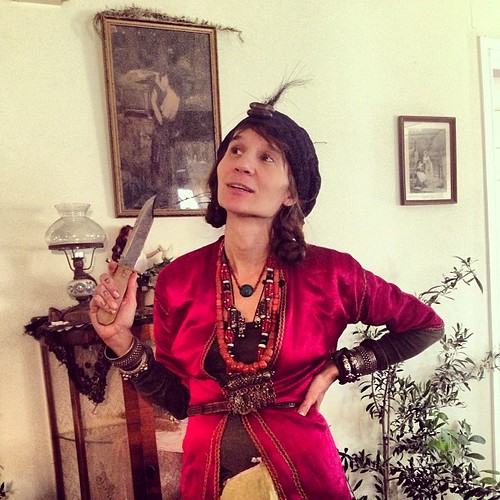
“About the pomegranate I must say nothing,” whispered the traveller Pausanias in the 2nd century, “for its story is somewhat of a holy mystery.”

1. Put on an apron because pomegranates splatter red droplets on your dress.

2. Put on pretty pretty music. I went with Laura Marling. She is young, but she was born on Imbolc.

3. Choose a knife. This is a ritual.
4. Assume the space of clear intent. This is a ritual. Banish the circle, or at least spray some lavender water on your face.

5. Make the first incision, cutting the first petal of the star toward the center.

6. Make 4 or 5 or 6 more cuts, depending on how many points your star has. 7 sided stars can get tricky and thin-armed.

7. Empty the seeds into a bowl, carefully cut the white away. Maitain the integrity of your star. Don’t let any of its arms flop off.


Note::These are sacramental fare or altar offering or party food or breakfast (Fruit Salad Of Light recipe following)

Fruit Salad Of Light: 7 bananas, thirded and sliced. Eggs of dragon. Pomegranate seed. Vanilla extract. Salt for that salty flavor. A gopping heapful of coconut butter (not oil, butter or manna as it is called). Stir with restrained passion. Do not add maraschino cherries. Ever. Spoon with the family crest.

8. Don’t eat any pomegranate seeds while you do this operation! You might get stuck with a old man Hades…If you start to, spit them out back into the bowl and cross yourself, or say fuck it, that myth does not apply to me.

9. Trim the edges neat. When you are done, wash the stickiness off your star and pat it dry gently with a tea towel. Run a red thread through one arm of the star, the one that looks like the top. Add beads to the thread if desired.


You can do this ritual tonight if you like, or anytime between the Autumnal Equinox and the Winter Solstice. Or anytime, really. But this is when the pomegranates are naturally ripest. Tonight, whatever you do, light a candle. Light a fire. Be warm, and remember that the light is in you. You live!

Have you been feeling sad? Bone-tired and soul exhausted, like you might like to just sleep until Spring? Me too. Go read these things:
WATER IMMERSION DAY By Thea Elijah – from TRYING TO BE GOOD
Winter Solstice: 21 Alchemical Reflections from Carl Jung to Pema Chödrön.
December 18, 2013 Pele Report, Astrology Forecast
Venus Retrograde in Capricorn: Heart Shaped Box
I like listening to Finnish folk music all year round, but it’s especially perfect in this season, and for the Solstice. Here are some of Brenda’s current favorite selections:
Tallari – Sydämestäni rakastan
Karelian Folk Music Ensemble “Tui Tui Tuomen Kukka”
Finnish Folk Song, MeNaiset – Kuulin aanen (I Heard the Voice)
Karoliina Kantelinen “Ellös huolta huomisesta”
Karoliina Kantelinen “Soittelen soutusalmen suorimaista”
Vallåtar från gammelboning (Swedish kulning)
Happy Winter Solstice!
Related posts:
THE COLOR OF POMEGRANATES
PERCHTA
COLD WINTER MOON, SOLSTICE BLUE
WINTER SOLSTICE – BRIGHT STARS + FIRELIGHT
WINTER SOLSTICE – BLOOD MOON
Winter Solstice – Messe de Minuit
Winter Solstice – Dark Season
The Color of Pomegranates
by angeliska on December 20, 2013
This recent autumn was the best year for pomegranates. The tree planted by the pond in the garden seven or so years ago has been flourishing in this strange weather we’ve been having. Oft times, at harvest, the fruits would be cankered with the befouling kisses of some strange bug, with brown patches and tell-tale black pinholes on the thick red rinds. No such plague this year, thankfully! The pomegranates I plucked were larger and far sweeter than ever before – crimson globes hung like giant Christmas ornaments on the tree that’s grown nearly taller than the house. I’ve been fixated on their magic this year especially, and feel so grateful to have this gorgeous tree growing near me, feeding me and my loved ones with her bounty. In honor of this grand tree and her marvelous fruit, I’ve compiled some of my favorite poems, writings and images inspired by the magic of the pomegranate.
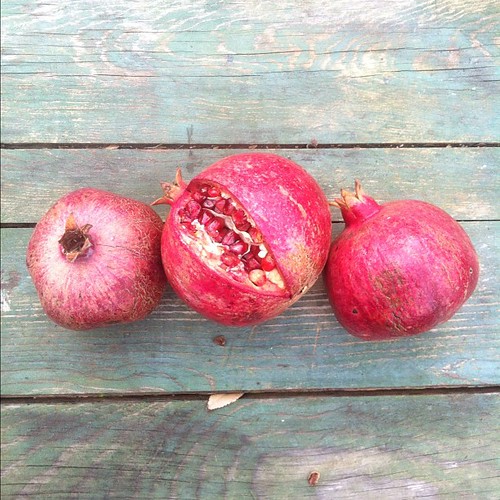
In modern times the pomegranate still holds strong symbolic meanings for the Greeks. On important days in the Greek Orthodox calendar, such as the Presentation of the Virgin Mary and on Christmas Day, it is traditional to have at the dinner table “polysporia”, also known by their ancient name “panspermia,” in some regions of Greece. In ancient times they were offered to Demeter and to the other gods for fertile land, for the spirits of the dead and in honor of compassionate Dionysus. When one buys a new home, it is conventional for a house guest to bring as a first gift a pomegranate, which is placed under/near the ikonostasi (home altar) of the house, as a symbol of abundance, fertility and good luck. Pomegranates are also prominent at Greek weddings and funerals. When Greeks commemorate their dead, they make kollyva as offerings, which consist of boiled wheat, mixed with sugar and decorated with pomegranate.It is also traditional in Greece to break a pomegranate on the ground at weddings and on New Years. Pomegranate decorations for the home are very common in Greece and sold in most home goods stores.
“In order to eat a pomegranate you need this many things: a pomegranate, a knife, a cutting board, a bowl and a towel.
Also, two hands. These help with the making of the pomegranate.”
― Tahereh Mafi
“This is our Central Texas fall, blue skies, an occasional floating shower that is gone too soon, luscious ripe prickly pear fruit,black juicy native persimmons, and pomegranate trees loaded with sweet heavy grenades.
The pomegranate utterly drips with symbolic significance beyond our physical senses. It is also at once pleasing and teasing our taste buds – with that sweet pop of its edible ruby seeds, attained through the laborious task of consuming a few morsels at a time.
The illustrious Punica granatum has an ancient pedigree. Not only does it appear in the Old Testament, but circles of Jewish scholars believe that it is actually the pomegranate and not the apple that is the forbidden fruit so fatefully consumed in the garden of Eden. According to same tradition, the pomegranate (rimon) is considered to be a holy symbol due to the held belief that the number of seeds contained in the fruit are equivalent to the 613 mitzvoth (commandments). The sacred rimon is used abundantly in Jewish ritual for a variety of symbolic implications.
Our eminent pomegranate is called “Granada” in Spanish, meaning “grenade”, which its physical shape resembles. In the Major Arcana of the Tarot, the High Priestess and the Empress are both illustrated with imagery of the pomegranate. The High Priestess sits in front of a curtain adorned with the fruit’s likeness and represents intuitive knowledge and femininity, among other attributes. The empress, the mother figure, sits in the gown of pomegranates on her throne in a field of grain. She represents the seed and the harvest, and reminds us that we reap what we sow, to say the least.
Punica granatum is universally a symbol of femininity, fertility and abundance. This long held belief is reinforced each autumn, when the pomegranate reaches its peak of maturity, coinciding with the season of plentiful harvest. Her majesty of fruits reminds us once more, that no plant is ever merely a plant. but an entire mythos unto itself.
May you in good health, continue to follow the beckoning of their provocation to explore ever deeper the enchantment of their ways.”
– From Season of The Sacred Pomegranate
by Carla Vargas-Frank, as featured in the most recent La Botanica

A behemoth pomegranate, just plucked from my tree. I took a bundle of them as potluck offering for a Full Moon Story Circle and potluck.
Once when I was living in the heart of a pomegranate, I heard a seed
saying, “Someday I shall become a tree, and the wind will sing in
my branches, and the sun will dance on my leaves, and I shall be
strong and beautiful through all the seasons.”
Then another seed spoke and said, “When I was as young as you, I
too held such views; but now that I can weigh and measure things,
I see that my hopes were vain.”
And a third seed spoke also, “I see in us nothing that promises so
great a future.”
And a fourth said, “But what a mockery our life would be, without
a greater future!”
Said a fifth, “Why dispute what we shall be, when we know not even
what we are.”
But a sixth replied, “Whatever we are, that we shall continue to
be.”
And a seventh said, “I have such a clear idea how everything will
be, but I cannot put it into words.”
Then an eight spoke–and a ninth–and a tenth–and then many–until
all were speaking, and I could distinguish nothing for the many
voices.
And so I moved that very day into the heart of a quince, where the
seeds are few and almost silent.
The Pomegranate ― Khalil Gibran
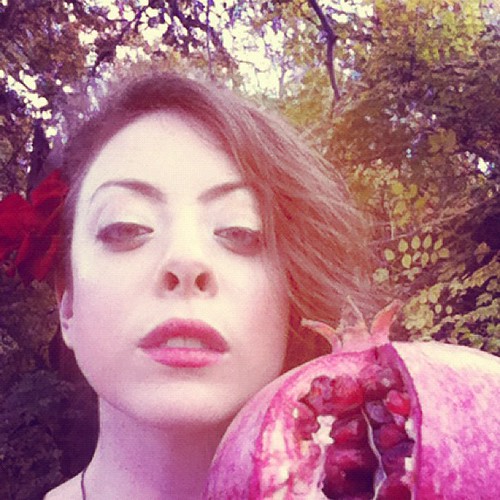
In the Garden of Eden grow pomegranates bigger than your head. Have a bite, won’t you?
“I felt like a seed in a pomegranate. Some say that the pomegranate was the real apple of Eve, fruit of the womb, I would eat my way into perdition to taste you.”
― Jeanette Winterson, Written on the Body
One of the greatest masterpieces of the 20th century, Sergei Parajanov ‘s “Color of the Pomegranate”, a biography of the Armenian troubadour Sayat Nova (King of Song) reveals the poet’s life more through his poetry than a conventional narration of important events in Sayat Nova ‘s life.
“Parajanov made films not about how things are, but how they would have been had he been God.”
— Critic Alexei Korotyukov
“Its rich, deep colors remind us also of the fall – midnight blues, blood reds, rich yellows. It really is a feast for the eyes. The whole film is a poem, both visually and cinematically.
Sofiko Chiaureli, the main character(s) in the film and thought of to be Parajanov’s muse, is incredible to watch as she shifts between male and female seamlessly, morphing and gliding across the screen with such elegance and grace, its impossible to keep your eyes off of her.”
– RECSPEC – THE COLOR OF POMEGRANATES
“The pomegranate is the symbol of Armenia and represents fertility, abundance and marriage. One ancient custom widely accepted in ancient Armenia was performed at weddings. A bride was given a pomegranate fruit, which she threw against a wall, breaking it into pieces. Scattered pomegranate seeds ensured the bride future children. In Artsakh it was accepted to put fruits next to the bridal couple during the first night of marriage. The pomegranate was among those fruits, and was said to also ensure happiness. It is believed the couple enjoyed a pomegranate wine as well.The symbol of the pomegranate is connected with insemination. It protected a woman from infertility and protected a man’s virile strength. Currently, pomegranate juice is famous with Armenians in food and heritage.
The pomegranate gained a new symbolism after Armenian Genocide that left millions of Armenians spread all over the world; Armenians use the pomegranate and its many seeds to symbolize the Armenian people and their resilience. The pomegranate is also seen as the fruit of life for Armenians because during the genocide the only food they had came from fruits on trees. It is said that there are approximately 365 seeds in each pomegranate and the Armenians survived by eating one seed each day during their exile.”
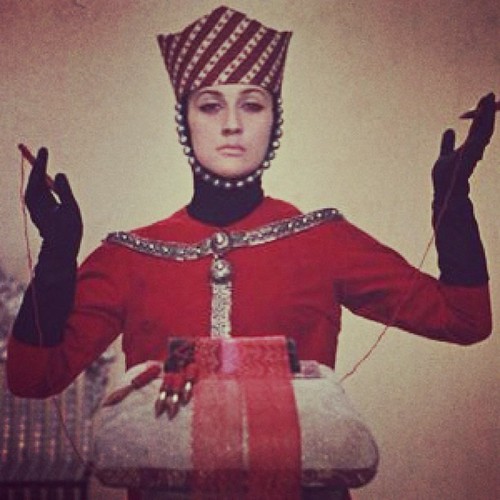
“It was the face of spring, it was the face of summer, it was the warmness of clover breath. Pomegranate glowed in her lips, and the noon sky in her eyes. To touch her face was that always new experience of opening your window one December morning, early, and putting out your hand to the first white cool powdering of snow that had come, silently, with no announcement, in the night. And all of this, this breath-warmness and plum-tenderness was held forever in one miracle of photographic is chemistry which no clock winds could blow upon to change one hour or one second; this fine first cool white snow would never melt, but live a thousand summers.”
― Ray Bradbury, Dandelion Wine
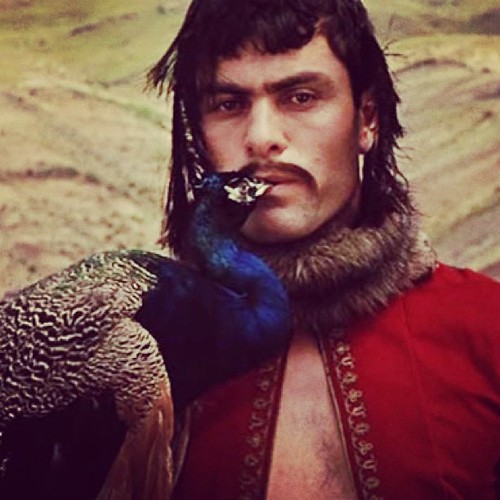
“My heart is like a singing bird
Whose nest is in a water’d shoot;
My heart is like an apple-tree
Whose boughs are bent with thick-set fruit;
My heart is like a rainbow shell
That paddles in a halcyon sea;
My heart is gladder than all these,
Because my love is come to me.
Raise me a daïs of silk and down;
Hang it with vair and purple dyes;
Carve it in doves and pomegranates,
And peacocks with a hundred eyes;
Work it in gold and silver grapes,
In leaves and silver fleurs-de-lys;
Because the birthday of my life
Is come, my love is come to me.”
― Christina Rossetti, Poems of Christina Rossetti

“And her sweet red lips on these lips of mine
Burned like the ruby fire set
In the swinging lamp of a crimson shrine,
Or the bleeding wounds of the pomegranate,
Or the heart of the lotus drenched and wet
With the spilt-out blood of the rose-red wine.”
― Oscar Wilde
“Thy lips are like a thread of scarlet, and thy speech is comely: thy temples are like a piece of a pomegranate within thy locks.
Song of Solomon 4:3
The Tamil name maadulampazham is a metaphor for a woman’s mind. It is derived from, maadhu=woman, ullam=mind, which means as the seeds are hidden, it is not easy to decipher a woman’s mind.

You tell me I am wrong.
Who are you, who is anybody to tell me I am wrong?
I am not wrong.
In Syracuse, rock left bare by the viciousness of Greek
women.
No doubt you have forgotten the pomegranate-trees in
flower,
Oh so red, and such a lot of them.
Whereas at Venice
Abhorrent, green, slippery city
Whose Doges were old, and had ancient eyes.
In the dense foliage of the inner garden
Pomegranates like bright green stone,
And barbed, barbed with a crown.
Oh, crown of spiked green metal
Actually growing!
Now in Tuscany,
Pomegranates to warm, your hands at;
And crowns, kingly, generous, tilting crowns
Over the left eyebrow.
And, if you dare, the fissure!
Do you mean to tell me you will see no fissure?
Do you prefer to look on the plain side?
For all that, the setting suns are open.
The end cracks open with the beginning:
Rosy, tender, glittering within the fissure.
Do you mean to tell me there should be no fissure?
No glittering, compact drops of dawn?
Do you mean it is wrong, the gold-filmed skin, integument,
shown ruptured?
For my part, I prefer my heart to be broken.
It is so lovely, dawn-kaleidoscopic within the crack.
From “Birds, Beasts, And Flowers: Poems By D. H. Lawrence.”
“If the authors of Genesis envisioned any one particular fruit dangling from that infamous tree in Eden, scholars argue it was likely the pomegranate. In the Greco-Roman tradition, those same ruby seeds cursed Persephone to an eternal half-life, consigned her to winter after winter with her abductor-husband, Hades, among the pomegranate groves of the dead. From Jerusalem to Athens to Rome, this is the fruit you get when love spoils into lust, when desire goes to seed. This is not a fruit you want to crack open.”
THE POEM STUCK IN MY HEAD – D. H. Lawrence’s “Pomegranate”
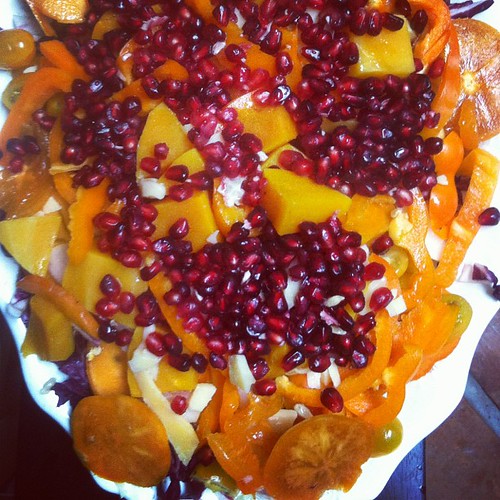
My contribution to Thanksgiving dinner last year: persimmon, pomegranate, squash, orange pepper, robusto cheese, asian pear, golden cherry tomato salad. It was so delicious, I might have to repeat it again soon…
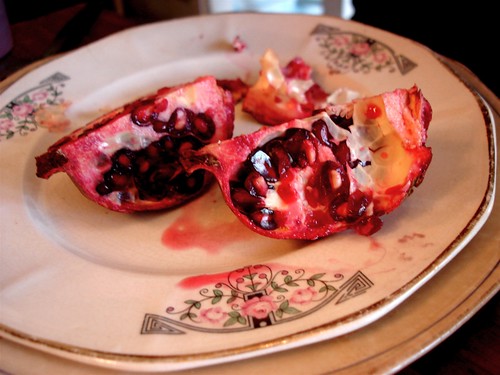
If you buy a pomegranate,
buy one whose ripeness
has caused it to be cleft open
with a seed-revealing smile.
Its laughter is a blessing,
for through its wide-open mouth
it shows its heart,
like a pearl in the jewel box of spirit.
The red anemone laughs, too,
but through its mouth you glimpse a blackness.
A laughing pomegranate
brings the whole garden to life.
Keeping the company of the holy
makes you one of them
Whether you are stone or marble,
you will become a jewel
when you reach a human being of heart.
Plant the love of the holy ones within your spirit;
don’t give your heart to anything
but the love of those whose hearts are glad.
Don’t go to the neighborhood of despair:
there is hope.
Don’t go in the direction of darkness:
suns exist.
The heart guides you to the neighborhood of the
saints;
the body takes you to the prison of water and earth.
Give your heart the food of holy friends;
seek maturity from those who have matured.
THE LAUGHTER OF POMEGRANATES ― Mawlana Jalal-al-Din Rumi
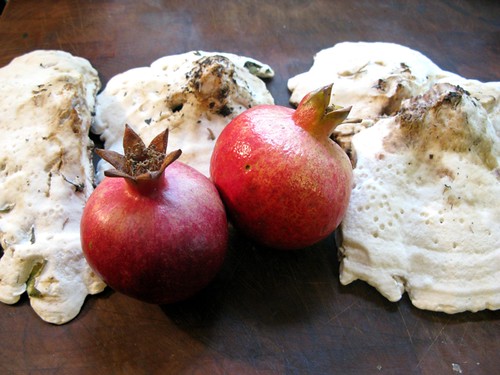
pomegranates + mushrooms
Love makes of each moment an eternity
And tends the garden of the heart’s desire
When love mocks, ruby tears fall heavy as pomegranates
And when love looks, it sees your deepest mystery.
Love seeks out the tears of hidden hearts
And turns not from the Lovers of the Dawn.
Is there a remedy for the pain of love?
Or is it too unbearable for thought?
One taste of the medicine
And you will realize just how sick you have been.
Those who plead in the defense of love
In love’s judgement shall find grace
And to that court, Hafiz
May your heart fly…
― Hafiz
“In older myths, the dark road leads downward into the Underworld, where Persephone is carried off by Hades, much against her will, while Ishtar descends of her own accord to beat at the gates of Hell. This road of darkness lies to the West, according to Native American myth, and each of us must travel it at some point in our lives. The western road is one of trials, ordeals, disasters and abrupt life changes — yet a road to be honored, nevertheless, as the road on which wisdom is gained. James Hillman, whose theory of ‘archetypal psychology’ draws extensively on Greco–Roman myth, echoes this belief when he argues that darkness is vital at certain periods of life, questioning our modern tendency to equate mental health with happiness. It is in the Underworld, he reminds us, that seeds germinate and prepare for spring. Myths of descent and rebirth connect the soul’s cycles to those of nature.”
― Terri Windling
“Take from my palms, to soothe your heart,
a little honey, a little sun,
in obedience to Persephone’s bees.
You can’t untie a boat that was never moored,
nor hear a shadow in its furs,
nor move through thick life without fear.
For us, all that’s left is kisses
tattered as the little bees
that die when they leave the hive.
Deep in the transparent night they’re still humming,
at home in the dark wood on the mountain,
in the mint and lungwort and the past.
But lay to your heart my rough gift,
this unlovely dry necklace of dead bees
that once made a sun out of honey.”
― Osip Mandelstam, The Selected Poems
“Be to her, Persephone,
All the things I might not be;
Take her head upon your knee.
She that was so proud and wild,
Flippant, arrogant and free,
She that had no need of me,
Is a little lonely child
Lost in Hell,—Persephone,
Take her head upon your knee;
Say to her, “My dear, my dear,
It is not so dreadful here.”
― Edna St. Vincent Millay, Collected Poems
Cold Winter Moon, Solstice Blue
by angeliska on December 18, 2013
The Full Cold Moon in Gemini is still soaring above as I write this, casting a bright purity of blue light over the trees grown bare with the season. I am always shocked by how much stronger the moonlight seems in winter, with no leafy canopy to dapple the stone paths and altars in my backyard. I set my stones and crystals out there tonight, to charge and bathe in that light. Little rituals, small things we can do when more formal gatherings are waylaid by sniffles and holiday whatnot. With the Solstice right around the corner to be celebrated, it was lovely and peaceful to have a bit of quiet time to contemplate, to write, and to do these tiny works that make such a big difference to my sense of inner calm and well-being. The full moon can stir up a lot of energy, and I’m feeling this one particularly. The Winter Solstice’s approach brings with it for me a sense of hush, a quiet that steals over the land, honoring the moments in-between, the midnight vigils of the only person awake at night. I’ve reverted back to my nocturnal habit, up until dawn nearly, every night – alone and writing, or reading. This is a holy time, a sacred season – the light in the darkness, a single candle’s flame illuminating expectant faces in the dark cave, the longest night of the year. How do you honor the Solstices? What do you do when the moon is full?
I’ve been feeling hibernatory, and lulled towards slumber at all times lately, save late at night when I really ought to be abed. I’m giving in to whatever strange rhythms my body seems to be dictating and sleeping in after staying up into the wee hours, when all is quiet except the owls, a stray cat in heat, and my hounds breathing, dreaming doggie dreams at the foot of the bed. No memorable dreams for me lately, though apparently I’ve been getting ’round a good deal – showing up in the dreamscapes of friends far and wide. Tonight I’ve taken melatonin, and will have some mugwort tincture and dream oil to see what lays on the other side of the mirror. For myself. I’m using these stunning images by the Pre-Raphaelite painter Edward Robert Hughes (1851-1914) to guide me on my journey, into, ideally a world inhabited by angels, valkyries and moon maidens…

Twilight Fantasies

Night with her Train of Stars and her Great Gift of Sleep

The Valkyries Vigil
“As we near the Solstice, the longest night of the year, it is helpful to remember that we too are being called into our deepest dark. Down to the places we hide from view; where we keep our grief, where we brace and hold, where we are ashamed and unforgiving too. We are asked to acknowledge our untruths, to bare our fragile stories in the open, to be seen – which is also to release. Without any proof, we trust that a way will be born then in the dark, out of nothing, by this braving forward.” – Toko-pa

Dream Idyll (A Valkyrie)

Heart of Snow

Pack Clouds Away and Welcome Day

Radiant Moon
DECEMBER FORECAST 2013 – by Lena Stevens
December 16-22: The energy shifts as we approach the Full Moon and then the Winter Solstice. You may feel jerked around by things seeming one way today and upside down tomorrow. This is a time of sudden adjustments often made by others but affecting you. There will be many lessons around attachments to how you think things ought to be and how you think people ought to behave. In this somewhat emotional time, stay out of negativity and judgment and accept the adjustments.
December 17: Full moon is at 2:28AM MST (Mountain Standard Time). You may wish to celebrate it the night of December 16. Use this full moon to expand your sense of what could be. The time between this full moon and the Winter Solstice should be honored and quality time should be carved out to do what brings you joy. What brings you joy? What feeds you spiritually? What do you still need to adjust and revise and modify? What do you need to let go of? What needs expansion and more inspiration? Ask these questions and then go for it!
December 21: Winter Solstice is at 10:11AM MST (Mountain Standard Time) Do a ceremony around honoring yourself and your own truth. Your desires should be given top priority. Remember you cannot fix or create intentions for anyone else. Don’t be afraid to dream big. If you are still feeling the weight of what you have carried, changed, released, processed, started or created in these past months, release it somehow in a fire or other ceremonial way.

Moonlight – Alphonse OsbertFrench

The Dream – Pierre Puvis de Chavannes

Blue Moon – Photograph by me
Full Moon in Gemini – December 2013 – Singularity – by Leah Whitehorse
“The Sun sits on the galactic centre and just meditating on the chart for a few minutes blows my mind. The Galactic Centre is postulated to be a supermassive black hole so heavy that the entire galaxy spins around it. Everything revolves around what’s inside and anything that comes too close is absorbed and transmuted into something else entirely, including light. It’s as though the Sun is absorbing the energy of the galactic core and shining it on the Moon – like holding your face up to the midday Sun with your eyes closed. It’s too bright, too intense to be able to open your eyes. With Mercury sitting nearby, it’s like receiving divine cosmic instruction but the instructions are written in God script. Some part of you recognises it but it’s a language you forgot.”
Astral Insights from Mystic Mamma: FULL MOON in Gemini December 17, 2013

Photograph by Margarita Kareva

Our annual 12th Night Celebration in Austin is right around the corner, and we’re getting very excited preparing for a beautiful welcome to the carnival season and a sweet farewell to winter and hexmas times!
I’ve been contemplating some new wintery scents for the season, and have a hankering to try these lovelies out:
Serge Lutens Fille en Aiguilles
Fille en aiguilles contains notes of pine needles, vetiver, bay leaf, spices, fruit and incense. The memory of pine forest under sunshine, a very feminine sensuality. Adventurous, sexy, intriguing, witchy, smart and serious.
D.S. & Durga Eau de Cologne – Siberian Snow
Rare, narcotic, jasmine, crisp mint, Oriental amber, sandalwood & powdery incense. Worn by Countess Anna Vladoska at her legendary balls.
Slumberhouse Cologne- Norne
Fog caked needle, lichen, fern and moss perfume the nocturnal air beneath grandiose canopies of fir and hemlock – a headspace captured in perfect equilibrium. Containing not one single essential oil nor synthetic, Norne is luxuriously composed with entirely 100% pure forest absolutes; a connoisseur grade fantasy/surrealist recipe of incensed coniferous woodsy resins inspired by the catharsis of self worship.
‘
This video of a big Russian crow using a scavenged lid as a toy to slide down a snowy peaked roof is one of my favorite things ever. Not only is he using a tool (something only very highly developed and intelligent animals do – which crows are indeed), but he’s using it idly, not out of necessity – to do something FUN! Remember, this is a creature that can FLY! Who discovered that it’s fun to go sledding! So wonderful.
An English Ladymass – Anonymous 4
Music for your Solstice.
From winter solstices of yore:
WINTER SOLSTICE – BRIGHT STARS + FIRELIGHT
WINTER SOLSTICE – BLOOD MOON
Winter Solstice – Messe de Minuit
Winter Solstice – Dark Season
In Fallow Fields
by angeliska on November 28, 2013
The harvest has been brought in, and now we feast on the bounty of the earth – but how many of those potatoes waiting to be mashed were dug out of the ground by the same dirty fingers who will later wash and peel them? How many of the full bellies will have known what it is to be truly hungry? I ask these questions because I find myself thinking all the time lately about how we got to be where we are, and what came before. I have a thing about holidays – not just enjoying them (though I really do), but honoring the turning of the year, all that it brings, and all that it means. What it really means, underneath all the layers of sedimentary history, stories, old traditions with forgotten origins. It’s impossible for me to overlook the fact that Thanksgiving in this country is a bogus holiday built on the myth of friendship (and eventual betrayal, genocide, slaughter) between white settlers and the people who were here first. But before that story, there was an older one – a simpler one, about the ones who tilled the land, who gleaned the fields, who huddled close to the fire, to each other. I feel that we instinctively need our fall festivals, our moment of fullness before winter’s fingers dig in. It’s an ancient ritual, celebrating the abundance of the fertile earth goddesses, Ceres/Demeter/Isis/Inanna – and all the accompanying symbols come from what was sacred to those who practiced the old ways, in the old days, right down to the cornucopia. In Greek Mythology, the horn of Amalthea (she was the kind goat who suckled Zeus) became known as the cornucopia or horn of plenty. Before the frosts turn everything green and gold to gray and dun, we stop to pause and feel grateful for our stocked larders, our fattened pigs, our fields ready to lay fallow for a season. This is everything we worked for. Of course, in this current day, there has been a massive disconnect from that way of thinking, and many of us go through the motions: loading our carts in bustling grocery stores, stuffing ourselves, and merely enduring the company of our families. How to reconnect to that sense of belonging with the land, when almost everything we do is destroying it? I am curious if we will remember days of plenty so vividly when food shortages come to be widespread again. We used to live together, in tribes, in villages, in big groups. The old ones and the young ones, the strong ones and the fragile ones. We used to always be together like this, breathing each other in, listening to all the stories, working and living and loving and fighting and sleeping and waking. Now we live apart – connected by ether, but disparate, solitary. Some part of me remembers, though – what it’s like to lay sleeping on the ground, in a circle of other humans, firelight dancing on the cave walls. Curled into myself, but listening to the night sounds of breathing, whispering, a baby’s cry – and thinking, “This is how we are supposed to live – together. This is how it used to be, everywhere, for humans on this planet.”
I’ve been thinking about the wise old grandmother turkey I met recently, a grey and elegant crone named Chincha who lives on my friend’s farm. She is eleven years old, and mostly blind. She is friendly, though the other birds pick on her, because even with her still formidable size, she has grown weak with age, shrunken. Does Chincha know that the number one predator of her species is us? I never had met a turkey I liked and respected – though I suppose that really I had just never been properly introduced to any turkeys before. Will I still eat them? Yes, I think so – but I will be thinking of her bright black inquisitive gaze, and wondering if the bird on my plate had such spirit. I am a dedicated carnivore, but I do think about the creatures I consume – and I don’t know if that makes it better or worse. Both, I guess. I’m grateful for their gifts.
Before this week, I don’t think I’d ever known anything about the The Occupation of Alcatraz by Native Americans, or about Unthanksgiving Day (also known as The Indigenous Peoples Sunrise Ceremony), an event still held on the island of Alcatraz to honor the indigenous peoples of the Americas and promote their rights. This coincides with a similar protest, the National Day of Mourning, which began in Massachusetts.
“From November, 1969 to June, 1971, a group called Indians of All Tribes, Inc., occupied Alcatraz Island. This group, made up of American Indians relocated to the Bay Area, was protesting against the United States government’s policies that affected them. They were protesting federal laws that took aboriginal land away from American Indians and that aimed to destroy American Indian cultures. The Alcatraz occupation is recognized today as one of the most important events in contemporary Native American history. It was the first intertribal protest action to focus the nation’s attention on the situation of native peoples in the United States. The island occupation ignited a protest movement which culminated with the occupation of Wounded Knee on the Pine Ridge Reservation of the Oglala Sioux in South Dakota in 1973. Because of the attention brought to the plight of the American Indian communities, as a result of the occupation, federal laws were created which demonstrated new respect for aboriginal land rights and for the freedom of American Indians to maintain their traditional cultures.”
ALCATRAZ IS NOT AN ISLAND
“Before AIM [American Indian Movement], Indians were dispirited, defeated and culturally dissolving. People were ashamed to be Indian. You didn’t see the young people wearing braids or chokers or ribbon shirts in those days. Hell, I didn’t wear ’em. People didn’t Sun Dance, they didn’t Sweat, they were losing their languages. Then there was that spark at Alcatraz, and we took off. Man, we took a ride across this country. We put Indians and Indian rights smack dab in the middle of the public consciousness for the first time since the so-called Indian Wars…. AIM laid the groundwork for the next stage in regaining our sovereignty and self-determination as nation, and I’m proud to have been a part of that.”
– Russell Means (Oglala Lakota)

Photograph by Mitchell Kanashkevich from his series, JOURNEY THROUGH RURAL ROMANIA
If Chincha were a human, I like to think she would look like this woman.
Also, I highly recommend reading this today: IT’S DECORATIVE GOURD SEASON, MOTHERFUCKERS.

“In the Hollow”
I recently came across the incredibly powerful paintings of Michigan artist Andrea Kowch. Her paintings speak to me on so many levels: something about her fascination with those yellow fields, gray skies, the hard-bitten faces and floating hair of her women, staring sharply, consorting with animal visitors. I’ll let her work speak for itself, though:

“An Invitation”

“The Visitors”

“Sojourn”

“The Merry Wanderers”
Much of what I wanted to share here began on a Thanksgiving a few years ago, trying to explain my love for eerie, slightly barren landscapes, and the art and films that take them as themes. Hungry outsiders lost in golden fields, haunting big white farmhouses, making bad decisions. I can’t leave any of that alone, it seems, so here it is again – expanded upon. Andrew Wyeth, Terence Malick, Philip Ridley, and now, Andrea Krowch – all making this art about a specifically American place and feeling – and it’s not entirely a good place or feeling. They all go there, though, again and again – wandering around between the rows, under that big horrible sky.
You see strange things hurl past you at high speeds on those backroads.
Faded signs whose obsolete messages you still struggle to make out,
beautiful abandoned houses, and dead trees that read as sculpture against
the big sky – black-limbed and bony, reaching up in agony with hundreds
of twisted wooden witch-fingers. I wish all the time that I could just bring them
all home with me to hang blue-bottles from. There’s got to be a way to do that.
I saw an old black limousine with bashed in windows parked in the middle of
a tawny cornfield. It looked like a lost still from The Reflecting Skin, and made
me think again of some of my favorite films that take place in the weird liminal
space that is a fallow field. They are all tied together in my mind – that one,
and Tideland, and also Malick’s Days of Heaven and Badlands. All favorite
films of mine, and all masterpieces of wrongness set in tall yellow grass
with decrepit old houses. A lot can happen in the terrifying wide open of
a prairie. That grass can whisper to you of terrible things. All of those films
come from this place, I think:
Andrew Wyeth. Christina’s World. 1948.
The woman crawling through the tawny grass was the artist’s neighbor in Maine, who, crippled by polio, “was limited physically but by no means spiritually.” Wyeth further explained, “The challenge to me was to do justice to her extraordinary conquest of a life which most people would consider hopeless.” He recorded the arid landscape, rural house, and shacks with great detail, painting minute blades of grass, individual strands of hair, and nuances of light and shadow. In this style of painting, known as magic realism, everyday scenes are imbued with poetic mystery.

EDWARD HOPPER [1882–1967] – House by the Railroad, 1925

“Malick’s closest creative relative as an American artist may not be other filmmakers, but rather Andrew Wyeth, a realist painter who nonetheless offered such intensely studied, obliquely conceived pictures that they always seem to vibrate with a sense of hidden elements and forces. In much the same way, Malick constantly alchemises images into emotions, which is the very aspect of his films that remain hardest for the more literal-minded to grasp.”
– From Ferdy on Film’s piece about To The Wonder (which I still haven’t seen!)


Badlands is one of my top ten favorite films ever. I love Terence Malick so much.


Oh Sissy. I love her because she’s brilliant, and I love her because she reminds me so much of my mom. In this still, she makes me think of Jeliza Rose, below – beautiful and precocious innocents dazzled by a strange and dangerous new world.

Tideland is reviled by many as being a pointless exercise in depravity by Terry Gilliam, but I loved it immensely. It is disturbing, and often uncomfortable to watch, but it is also beautiful and powerful. Most of my favorite films are a combination of both (see The Reflecting Skin, below).


The Reflecting Skin

“Like an irrational but beautiful dream, The Reflecting Skin unfolds with a clarity that’s disturbing. It’s a true American Gothic, a movie in which breathtakingly blue skies and Van Gogh-gold wheat fields are unlikely witnesses to the horrors confronting eight-year-old Seth Dove. For Seth, the world of childhood is one of nightmares in broad daylight: his friends are being senselessly murdered, his tormented father incinerates himself before his eyes, his half-crazy mother abuses him, his beloved brother returning from World War II is mysteriously wasting away, and the strange woman living next door must be a vampire.
Even with its obvious flaws, however, there’s something oddly compelling about this weird, weird movie. The Reflecting Skin may befuddle you by what it’s all about, but like a vivid dream, you’ll have a difficult time forgetting it.
Director Philip Ridley has stated that his film is heavily inspired by the paintings of Andrew Wyeth in its visual style.”
From NO MORE HEROES ANYMORE


Fall Plowing, by Grant Wood (1931)

I honestly can’t remember where this is from.

Or this. But here they are. Happy Thanksgiving.
THE REFLECTING SKIN
BADLANDS
DAYS OF HEAVEN
TIDELAND
Related posts:
VULTURES + PERSIMMONS
Huexoloti Honey
Russet + Bone
Lone Grove Lullaby
The Erl-King
by angeliska on November 15, 2013
It’s the season for reading my most favorite story from my most favorite book by my most favorite author… The Erl-King, by Angela Carter, from her astounding anthology of dark fairy tales, The Bloody Chamber. It’s the very best thing to read around a wood-fire on a chilly evening, which is exactly what I shall be doing this upcoming full moon, for the Moon Language Story Circle. It’s the Mourning Moon in Taurus, and the theme of this month’s circle is Sadness and Relief. I love reading stories aloud, and don’t often enough get the chance to do it, so I’m very excited to get to participate in this gathering. This one, though – ach! It’s just such a pleasure to let those words roll off your tongue, almost musically. It’s a hypnotizing tale, about the magic of the woods, hunter and prey, and a strange kind of love.
I came across a sort of random assortment of fashion-y images stashed in one of my various inspiration folders, and thought their autumnal glamour might illustrate some lines from the story well. I forget where they’re all from, alas. But aren’t they lovely?

I walked through the wood until all its perspectives converged upon a darkening clearing; as soon as I saw them, I knew at once that all its occupants had been waiting for me from the moment I first stepped into the wood, with the endless patience of wild things, who have all the time in the world.

A young girl would go into the wood as trustingly as Red Riding Hood to her granny’s house but this light admits of no ambiguities and, here, she will be trapped in her own illusion because everything in the wood is exactly as it seems.

He smiles. He lays down his pipe, his elder bird-call. He lays upon me his irrevocable hand.
His eyes are quite green, as if from too much looking at the wood.
There are some eyes can eat you.

The woods enclose. You step between the first trees and then you are no longer in the open air; the wood swallows you up.
There is no way through the wood any more, this wood has reverted to its original privacy.

The clearing was cluttered with dead leaves, some the colour of honey, some the colour of cinders, some the colour of earth.

The trees stir with a noise like taffeta skirts of women who have lost themselves in the woods and hunt round hopelessly for the way out.

What big eyes you have. Eyes of an incomparable luminosity, the numinous phosphorescence of the eyes of lycanthropes. The gelid green of your eyes fixes my reflective face; It is a preservative, like a green liquid amber; it catches me. I am afraid I will be trapped in it for ever like the poor little ants and flies that stuck their feet in resin before the sea covered the Baltic. He winds me into the circle of his eye on a reel of birdsong. There is a black hole in the middle of both your eyes; it is their still centre, looking there makes me giddy, as if I might fall into it.

Your green eye is a reducing chamber. If I look into it long enough, I will become as small as my own reflection, I will diminish to a point and vanish. I will be drawn down into that black whirlpool and be consumed by you. I shall become so small you can keep me in one of your osier cages and mock my loss of liberty. I have seen the cage you are weaving for me; it is a very pretty one and I shall sit, hereafter, in my cage among the other singing birds but I — I shall be dumb, from spite.

(Artwork by Kristina Carroll)
Erl-King will do you grievous harm.

The two notes of the song of a bird rose on the still air, as if my girlish and delicious loneliness had been made into a sound.

(Artwork by Chloe North)
Piercingly, now, there came again the call of the bird, as desolate as if it came from the throat of the last bird left alive. That call, with all the melancholy of the failing year in it, went directly to my heart.
I had to buy another copy especially for the occasion… I’ve had soooo many copies, but I’m forever lending it out…

Randomly came across this beautiful signed copy, but trying to warrant a $125 expenditure proved paining, horribly tempted though I was (and still am!)
Had to restrain myself mightily from not only buying this, but also passionately caressing her signature. There’s something magical about the fact that she was here in Austin, also – even though I was just a wee one at the time. She was here! Yes, I’m a little obsessed with her genius. I was only partially successful in not making a scene. Minor tantrum, but escaped sans book, bank account intact. Still ravenously coveting this treasure.